


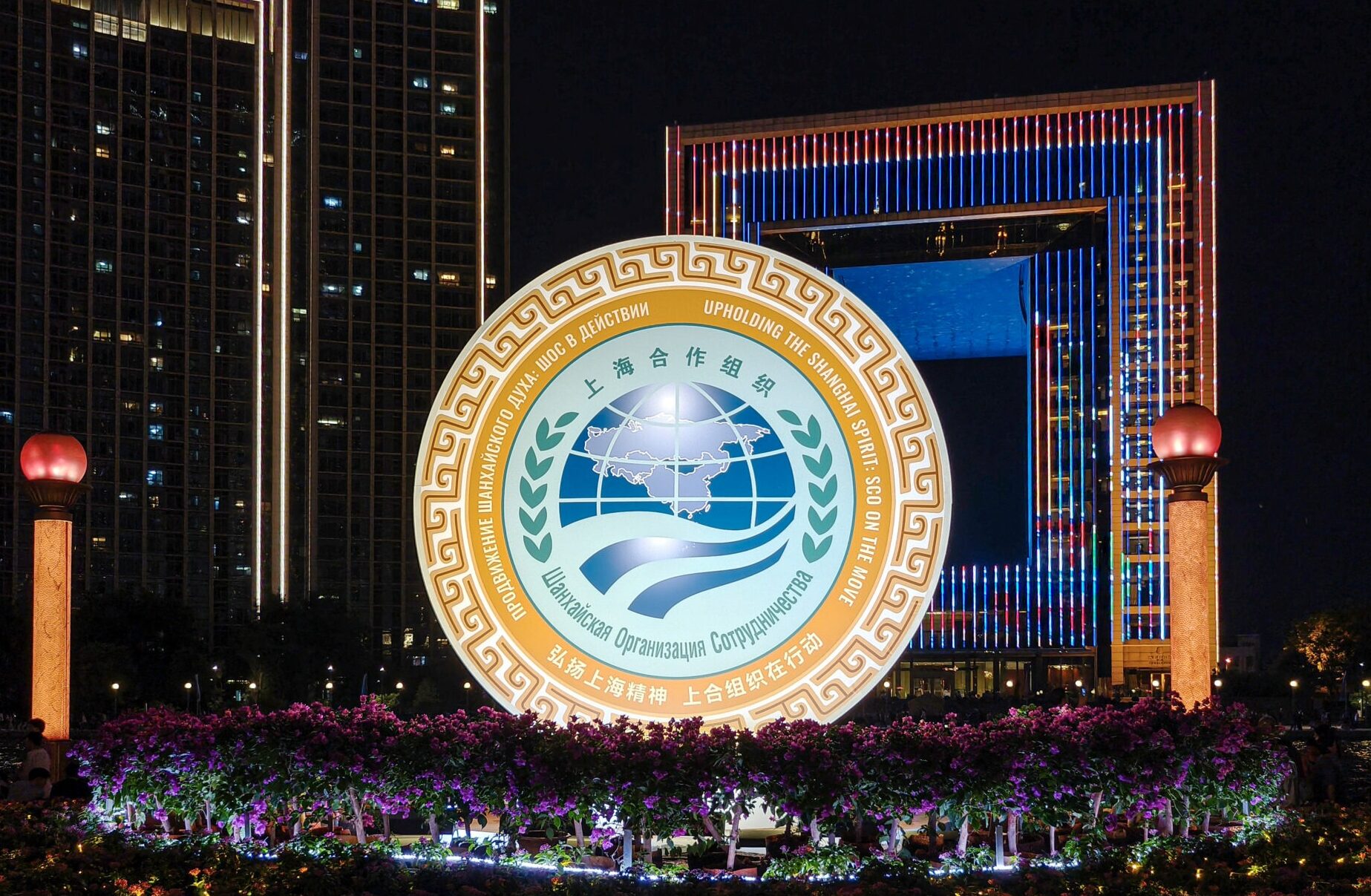
The Shanghai Cooperation Organization (SCO) Summit, taking place on 31 August and 1 September, will be another opportunity for China and Russia to try to promote an alternative to Western-led international institutions. But the organisation, now in its 25th year, faces internal rivalries and tensions that are becoming ever more difficult to sweep under the rug.
The SCO appears to be high on geopolitical symbolism and low on genuine relevance, at least on the political and security front. Despite its Regional Anti-Terrorist Structure and the Peace Mission military exercises between SCO member countries, the organisation’s security agenda has been weak with very little to show in terms of actual results. It is not a security treaty, and it has had little effect in diluting the political and military tension between its major players.
One such point of tension is the Sino-Indian conflict. This is a long-running contest that predates the SCO by decades and periodically erupts into clashes at their disputed border. The most recent one took place in 2020 and was unusually violent, causing the first casualties resulting from such clashes in decades and throwing the relationship into a freezer. Talks this month have made some progress, but the fundamentals of the border conflict are likely to remain unresolved. The two sides have discussed ways to improve understanding of the border demarcation in appropriate areas. In an effort to manage border issues, two new additional military hotlines were agreed upon to connect India’s Eastern Army Command and Central Army Command with their Chinese counterparts. While these institutionalised communication channels are useful to avoid incidents along parts of border, an absence of mechanisms is not necessarily the problem. These may be useful, though in previous crises, such mechanisms were not.
A larger problem is that China’s growth and power have created new security complications for countries such as India, which is carefully managing its engagements with the SCO as a fine diplomatic balancing act between Washington on one side and Beijing and Moscow on the other. While its relationship with Washington has come under stress, New Dehli understands the limits of alternative options. Prime Minister Nerendra Modi’s engagements with the SCO, the Quad and other minilateral groupings are a demonstration of what India calls its multidirectional foreign policy. A good example of this emerged from the 2025 SCO Summit in Tianjin, where a photo op between Modi, Xi Jinping and Vladimir Putin gave India an opportunity to show that it had options. However, the fact that China continues to be India’s most important national security threat will limit the utility of these partnerships. The SCO cannot resolve these problems.
Still, in 25 years, the SCO has evolved from having a narrow Central Asia border security focus to become a wider regional institution. Beijing and Moscow’s use of the SCO to speak the language of multipolarity has found certain appeal among Global South countries seeking alternatives to Western-led architectures. But this message is clouded as the two repeatedly violate the UN Charter by taking unilateral actions against their neighbours, exhibiting little respect for international law. Many in the Global South may ignore such violations, but the hypocrisy tends to accumulate and undermine the legitimacy of such messaging. Moreover, countries such as India don’t want the SCO to become such an anti-Western grouping.
One area where the SCO is progressing is in intra-group trade, though it’s unclear if the organisation itself was responsible for this. This is also primarily driven by China-Russia and China-India bilateral trade. By some estimates, intra-SCO trade in 2024 was worth US$725 billion (A$1 billion), up from US$463 billion in 2021. The initiative to establish an SCO Development Bank, which the members agreed to in principle at the 2025 Summit, would futher strengthen Beijing’s efforts to shape a new economic architecture, potentially as ‘China’s answer to Western financial hegemony’. China has been pushing this since 2010 with the goal of expanding the global footprint of the Chinese yuan and emerging as an alternative to Western-led post-Bretton Wood institutions.
But even here, there are problems. The SCO Bank initiative itself is not without its frictions and fears. Russia is a reluctant supporter because of Moscow’s fear of Chinese economic dominance in Central Asia, traditionally Russia’s backyard. India has also remained sceptical of the bank because it would enhance China’s regional dominance. In fact, this has been an issue since the SCO began. While China wanted it to be a regional economic grouping, Russia made every effort to shape it as a security bloc precisely due to a fear of Chinese dominance. Furthermore, India works closely with Western financial institutions and is against the idea of making the SCO into an anti-Western bloc driven by China and Russia.
The SCO faces an uncertain future. Its key members fear each other at least as much as they need each other, and the reasons they need each other are themselves varied. There is no acknowledged leader to the group either, despite China’s material dominance. This isn’t a solid foundation for any ambitious structure, but it may survive because none of the major partners can afford to abandon it.









Leave a comment