



Newsletters
Subscribe to The Informer for monthly expert analysis, and to Events for advance notice of visiting world leaders and distinguished guests.
You may unsubscribe from Lowy Institute newsletters at any time. For information on our privacy practices and how to unsubscribe, see our Privacy Policy.
Subscribe to

The most-pressing world events explained by Lowy Institute experts and global contributors, in your inbox, every Thursday.
You may unsubscribe from The Interpreter at any time. For information on our privacy practices and how to unsubscribe, see our Privacy Policy.

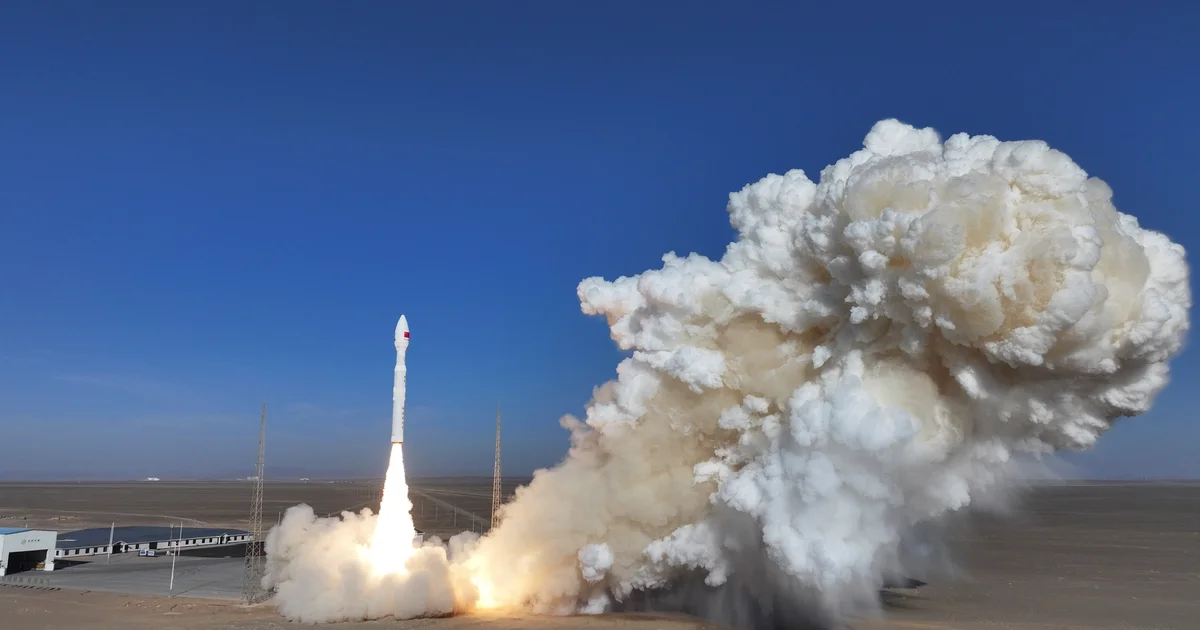
The Lijian-1 carrier rocket carrying 9 satellites, including one from the United Arab Emirates, lifts off from near the Jiuquan Satellite Launch Centre in northwest China, 10 December 2025 (Wang Jiangbo/Xinhua via Getty Images)
Washington and Beijing frame space as a binary contest, but the UAE is quietly building capability from both.
1 September 20264 min read
In space, the UAE is choosing capabilities, not campsIn space, the UAE is choosing capabilities, not camps
When the United Arab Emirates launched its SEO Earth-observation satellite from China’s Taiyuan Satellite Launch Centre on 17 August, the event attracted little international media attention. Yet the mission offers a useful glimpse (Opens in new window) into how one is managing an increasingly competitive space environment.
None of this would be particularly surprising if the UAE were gradually drifting into China’s space orbit. But it is not.
That is hardly token participation. The airlock will be an integral part of Gateway, enabling astronauts to conduct spacewalks and transfer equipment between the space station and outer space. The UAE has deliberately taken an active role in shaping the wider Artemis partnership; it jointly chaired (Opens in new window) the 2025 meeting of Artemis Accords signatories with NASA and the Australian Space Agency.
For the UAE, the central question is not necessarily which partnership to join but which relationships can accelerate the construction of a sustainable domestic space sector.
Put those relationships beside SEO and a more insightful picture emerges. Rather than choosing between American and Chinese space spheres, the UAE is choosing partnerships according to what each can contribute to its own national objectives.
This is not geopolitical neutrality. The UAE has a deep security relationship (Opens in new window) with the United States, and technological cooperation with China can raise sensitivities in Washington. Space is also discussed in terms of rival architectures: the US-led Artemis program on one side and the China–Russia-led (Opens in new window) International Lunar Research Station on the other.
But that binary framing can obscure how emerging space powers see their own interests. For the UAE, the central question is not necessarily which partnership to join but which relationships can accelerate (Opens in new window) the construction of a sustainable domestic space sector.
The country’s government has made that objective quite explicit. In May this year it announced (Opens in new window) an AED1 billion International Space Cooperation Program aimed at research and development partnerships with foreign institutions and companies. The program is intended to diversify sources of knowledge and technology, localise advanced capabilities, develop Emirati talent and turn research into commercially useful industries.
Seen in that context, SEO is less a standalone Chinese collaboration than one component of a diversified portfolio.
The UAE has not publicly released detailed technical specifications for SEO, and it would be a mistake to infer capabilities that have not been disclosed. The mission is being presented (Opens in new window) instead around sustainability and skills development. That framing itself is revealing: Abu Dhabi is clearly emphasising what the partnership adds to its national capacity, not the geopolitical identity of the partner supplying it.

The “Blood Moon” is seen above the Dubai skyline on 3 March 2026 (Giuseppe Cacace/AFP via Getty Images)
The same pattern can be seen elsewhere. UAE companies use American launch providers, while Emirati institutions collaborate (Opens in new window) with European, Japanese, Indian and other international partners. To date, the country’s most ambitious science missions have themselves depended on broad international networks. The successful Hope mission to Mars, for example, combined (Opens in new window) Emirati leadership with extensive collaboration involving US universities.
This approach reflects the broader reality of contemporary space activity. Few countries can independently master every part of the complex chain running from satellite design and launch to human spaceflight, planetary exploration, communications and data services. Partnerships are therefore unavoidable and often desirable. What matters is how countries establish them, and whether cooperation builds lasting national capability rather than simple dependence.
The UAE’s approach is particularly revealing because its ambitions are enormous relative to the country’s population. It is simultaneously pursuing Earth observation, human spaceflight, planetary exploration and an extraordinarily ambitious mission (Opens in new window) to the asteroid belt. International cooperation is not an optional aspect of those ambitions; it is one of the mechanisms through which the UAE intends to achieve them.
That makes the country a useful counterexample to common predictions that space missions will simply divide into American and Chinese blocs. Competition between Washington and Beijing will undoubtedly shape which technologies can be shared and where political limits are imposed. The UAE cannot ignore those constraints. But SEO suggests that substantial room remains for smaller space powers to exercise agency within that framework.
For countries building their own space capabilities, the emerging choice may therefore be less about picking sides than about capitalising on opportunities. The UAE’s strategy appears to be to engage with Washington, Beijing and others where the partnership advances a specific national goal while ensuring that the expertise, infrastructure and institutions accumulated along the way remain firmly Emirati.













Leave a comment