


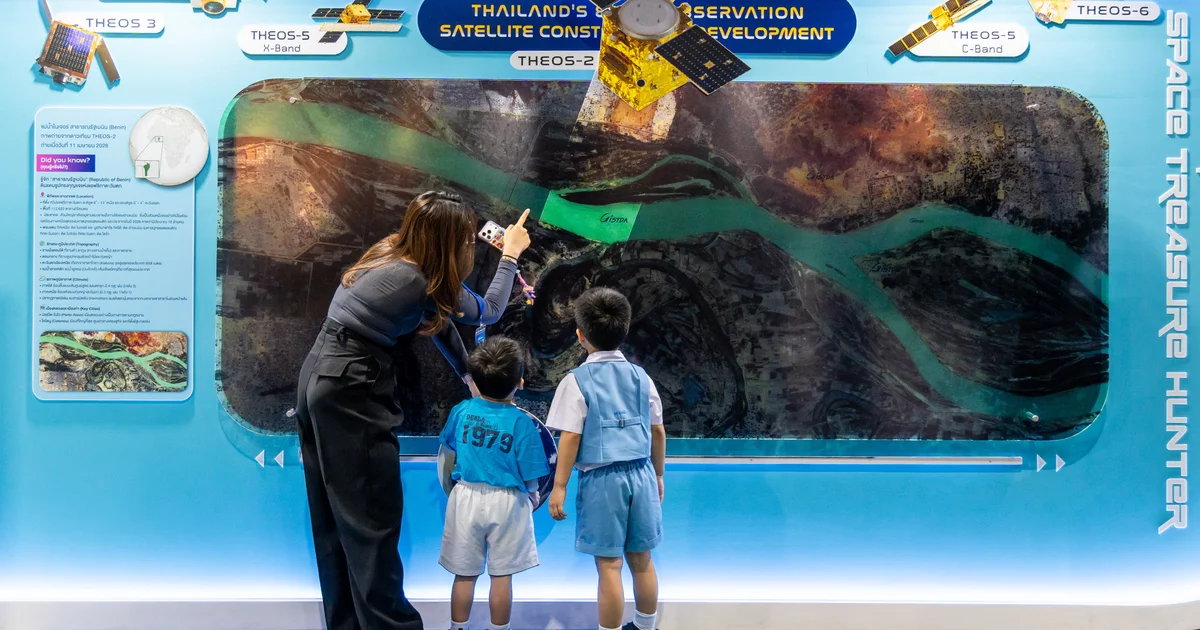
The latter program included extensive training in satellite design, manufacturing, integration and testing. THEOS-2A was lost (Opens in new window) in an Indian launch failure in January 2026, but the expertise gained during its development remained in Thailand. That distinction between acquiring hardware and retaining knowledge is precisely what the new GalaxySpace partnership will be judged against.
GISTDA already applies (Opens in new window) satellite data to floods (Opens in new window), water management (Opens in new window), agriculture (Opens in new window), urban development (Opens in new window) and air pollution (Opens in new window). It has ground infrastructure, experienced personnel and domestic users. That context means Thailand can ask harder questions than a first-time buyer: Does the new system integrate with existing capabilities? Does the training enable Thai operators to work independently? Can the technology support new, locally led missions?
Success in Thailand would give GalaxySpace a powerful reference customer. Failure to add much beyond what GISTDA has already achieved would expose the model’s limits.
The regional prize is much larger than a sequence of CubeSat sales. A recent Deloitte study (Opens in new window) estimated that wider use of Earth-observation data could contribute as much as US$100 billion to Southeast Asia’s GDP by 2030. Much of that value would be created on Earth, in agriculture, infrastructure, insurance, resource management and disaster response, rather than by spacecraft.
Many countries will not need a large national satellite. They need affordable data, trained people and enough domestic capacity to adapt space technology to local problems. A smaller spacecraft combined with ground support and education can provide an accessible entry point.
This puts Chinese companies into direct competition with established European, American and Japanese suppliers. GalaxySpace’s advantage may lie not in any single technology, but in integrating the spacecraft, ground systems, training and support into a single service. To keep convenience from becoming lock-in, customers should specify data rights, open interfaces, maintenance arrangements and measurable training outcomes from the outset.
Southeast Asian customers could magnify their leverage through ASEAN cooperation (Opens in new window): comparing procurement terms, aligning technical standards and jointly demanding interoperability, local participation and a clear path to operational independence. Suppliers that build domestic capability will offer more lasting value than those that merely install proprietary systems.
As such, Lingzhi-09 is a small spacecraft carrying a large business proposition. If the model succeeds, Chinese commercial firms will have shown that they can export much of the technical scaffolding around a national space program rather than merely satellites.
For Western governments and space companies, the implication is uncomfortable. They may still focus on launch performance and spacecraft specifications while China learns to compete across the entire relationship: software, technical standards, training and the supplier ties that shape the next procurement. Better hardware – or warnings about dependence on China – will not be enough on their own. Western suppliers will need to match affordability with interoperability, skills transfer and a credible path to local control. Thailand is therefore more than a test of GalaxySpace’s export model. It is also a test of whether China’s competitors really understand what the competition has become.











Leave a comment