


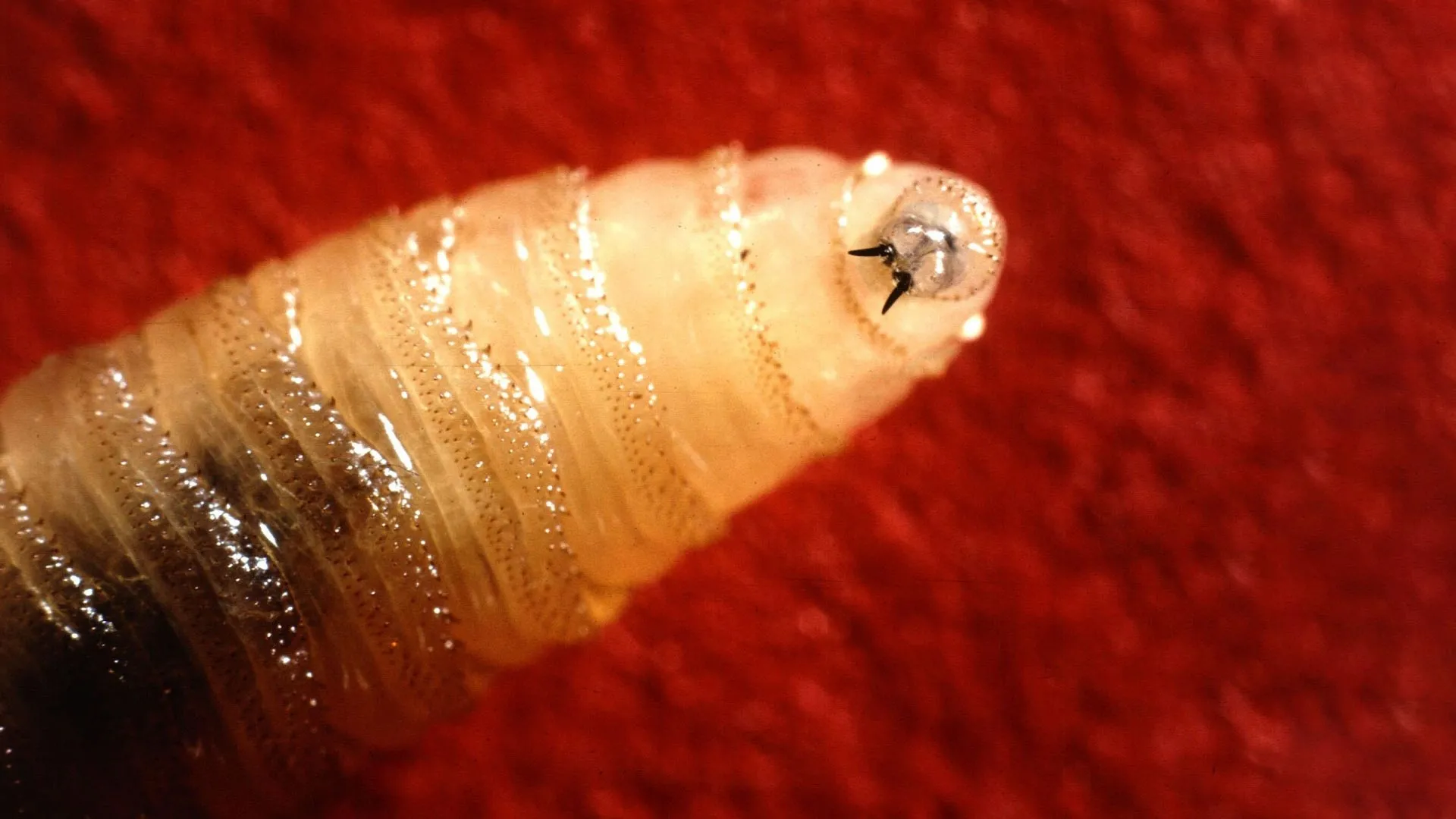
In the 1950s, New World screwworm infestations inflicted enormous losses on U.S. livestock producers. In the Southwest alone, the pest caused an estimated $50 million to $100 million in damage each year before a major eradication campaign eliminated it from the United States and pushed its range south to Panama.
Now the flesh-eating pest is moving north again. New World screwworm has reached Texas and New Mexico, raising concerns for livestock, wildlife, pets and, in rare cases, people.
To help officials better understand where the threat could emerge next, researchers at the University of California San Diego and the County of San Diego Health and Human Services Agency (HHSA) Public Health Services developed a new tracking tool focused on the parasitic fly and its larvae, which feed on living tissue.
Tracking New World Screwworm Risk
“Our County public health partners alerted us to the need for better situational awareness of New World screwworm,” said Eliah Aronoff-Spencer, MD, PhD, professor of medicine at UC San Diego School of Medicine and affiliate member of the UC San Diego Design Lab and Qualcomm Institute. “We built a dashboard to generate regional risk profiles. This is just one example of how we are responding to County needs with a focus on real-world issues. It’s a model that has brought us great success, like the Tijuana River Crisis Environmental Dashboard.”
The dashboard estimates screwworm risk for individual counties across the country. It brings together several types of information, including confirmed detections, environmental conditions that may favor the fly and its larvae, and reports in the news media.
For now, access is limited to public health officials and partners involved in the project. The researchers eventually hope to release a version that can be used by the public.
One unusual feature is the inclusion of news coverage, which may provide early clues before official reporting systems catch up.
Seema Shah, MD, MPH, who is medical director of the Epidemiology and Immunization Services Branch for the County of San Diego’s Public Health Services Department, noted the incorporation of news articles was one of the dashboard’s innovations. “Traditional reporting mechanisms for public health are often delayed,” she said. “Lab confirmation can take days or weeks. By incorporating media reports, we can identify potential threats sooner and stay one step ahead.”
“The tool gives you a sense of where you might expect to see cases next,” added Mark Beatty, MD, MPH, the assistant medical director for the County’s Epidemiology and Immunization Services Branch. “That’s helpful in determining how we should be preparing. Is the threat imminent, or do we have six months? We’re in a very concerning phase right now, and the tool backs that up.”
Why Screwworm Is So Dangerous
New World screwworm differs sharply from most fly larvae. While many maggots consume dead or decomposing material, screwworm larvae feed on healthy, living flesh.
Female flies lay their eggs in open wounds or natural body openings. After hatching, the larvae burrow into the tissue and begin feeding. As they continue, wounds can become deeper and larger, increasing the risk of secondary infections. Without treatment, severe infestations can badly injure or kill livestock and wildlife.
Humans can also become infected, although such cases are uncommon. New World screwworm does not spread from one person to another the way an infectious disease such as COVID-19 does. Instead, larvae can enter wounds or mucous membranes, where they must be removed quickly to limit further damage to the surrounding tissue.
The pest can expand its range in several ways. Adult flies are capable of traveling miles while searching for hosts, but infected livestock, pets, birds, and other wildlife can also help carry the parasite into new areas.
“We knew in 2023 that New World screwworm was going to move northward, but I wasn’t expecting it to move as fast as it has,” said Beatty. “Although the source of the infections in the U.S. is still under investigation, the fact that it’s in the U.S. is 100% clear.
“Once it entered Texas, we quickly saw an increase in detections,” he continued. “It’s in a place where it used to live, so it’s not surprising it’s taking a hold again.”
Reviving a Proven Eradication Strategy
The United States has defeated New World screwworm before.
During the 1950s, officials carried out one of the most successful biological control campaigns in history using a method known as the sterile insect technique. Huge numbers of male flies were sterilized with radiation and released into the environment. When wild females mated with them, they produced no viable offspring, gradually driving the population toward collapse.
Officials are now turning to a similar approach.
The U.S. Department of Agriculture (USDA) is leading the latest eradication campaign, which combines releases of sterile insects with pesticides and quarantines designed to limit animal movement.
Authorities are also seeking U.S. Environmental Protection Agency approval for a genetically modified all-male strain that is currently being tested in the field. At the same time, UC San Diego researchers are developing next-generation genetic technologies that could strengthen future efforts to control or eradicate screwworm.
“We are working closely with the California Department of Food and Agriculture to connect local veterinarians with screwworm resources for surveillance in our region,” said Emily Trumbull, DVM, veterinarian and lead for the Epidemiology Unit’s One Health Program. “The flies can affect any warm-blooded animal, so working together with veterinarians serving livestock, pets and wildlife is critical for identifying suspect cases and preventing cases in people. The dashboard takes into account environmental factors that can help us understand how the risk to our local region is changing before the fly arrives. That’s why the dashboard is valuable.”
A New Approach to Public Health Response
The screwworm dashboard was developed through Resilient Shield, a UC San Diego initiative and U.S. Centers for Disease Control (CDC)-funded center led by Aronoff-Spencer and co-PIs.
Resilient Shield is one of 13 core facilities that make up the CDC’s new Insight Net, a national network devoted to modeling outbreaks and disease threats. Its approach is designed around a simple idea: public health agencies identify the problems they urgently need solved, and researchers then build tools around those real-world priorities.
“In public health, we always know our most urgent priorities, but too often we don’t have the immediate resources or in-house technical solutions to achieve them,” said Shah. “The screwworm is a perfect example. It is a critical threat, but it is an issue our academic partners might never have prioritized without our direct ticket. This partnership solves our immediate problem while providing shareable, open reference designs that demonstrate exactly how public health, academia, and industry can successfully work together.”
Rather than having academic teams guess which tools public health organizations need, agencies confronting real-world problems can submit requests directly to Resilient Shield. In addition to San Diego County, its partners include the California Department of Public Health, the Navajo Nation and organizations across the broader Insight Net network.
Building Tools Around Real World Threats
The structure is intended to help specialists from different institutions respond quickly when a new problem emerges.
The first request submitted to the center came from Shah and involved tracking influenza. That effort was co-led by Resilient Shield co-PI Ruy Ribeiro at Los Alamos National Laboratory.
For the current screwworm threat, Aronoff-Spencer worked directly with mathematical epidemiologist Natasha Martin, DPhil, professor of medicine and vice chief in the Division of Infectious Diseases and Global Public Health at UC San Diego School of Medicine.
Resilient Shield has also created a modular and scalable resource hub that can be adapted to different public health challenges. Working with technology partners including Google and MITRE, the center brings together many kinds of data, including information on human disease, livestock, environmental conditions, weather, national health records, and social listening.
When a new request arrives, researchers can rapidly assemble the necessary tools using components from the shared hub. Depending on the problem, that could include public-facing websites and social media resources, secure computing systems, advanced simulation engines, or AI agent builders.
“Our central innovation is the true convergence of partner priorities with scalable engineering,” said Aronoff-Spencer. “We do not build in a vacuum. Our infrastructure is built directly on the priorities dictated by our partners. In addition, because our platform is built on an open, modular architecture, every solution we develop strengthens the system and makes it more adaptable for the next public health challenge.”
Learn more by visiting the Resilient Shield, County of San Diego Public Health Services or USDA Stop Screwworm Hub websites.













Leave a comment