


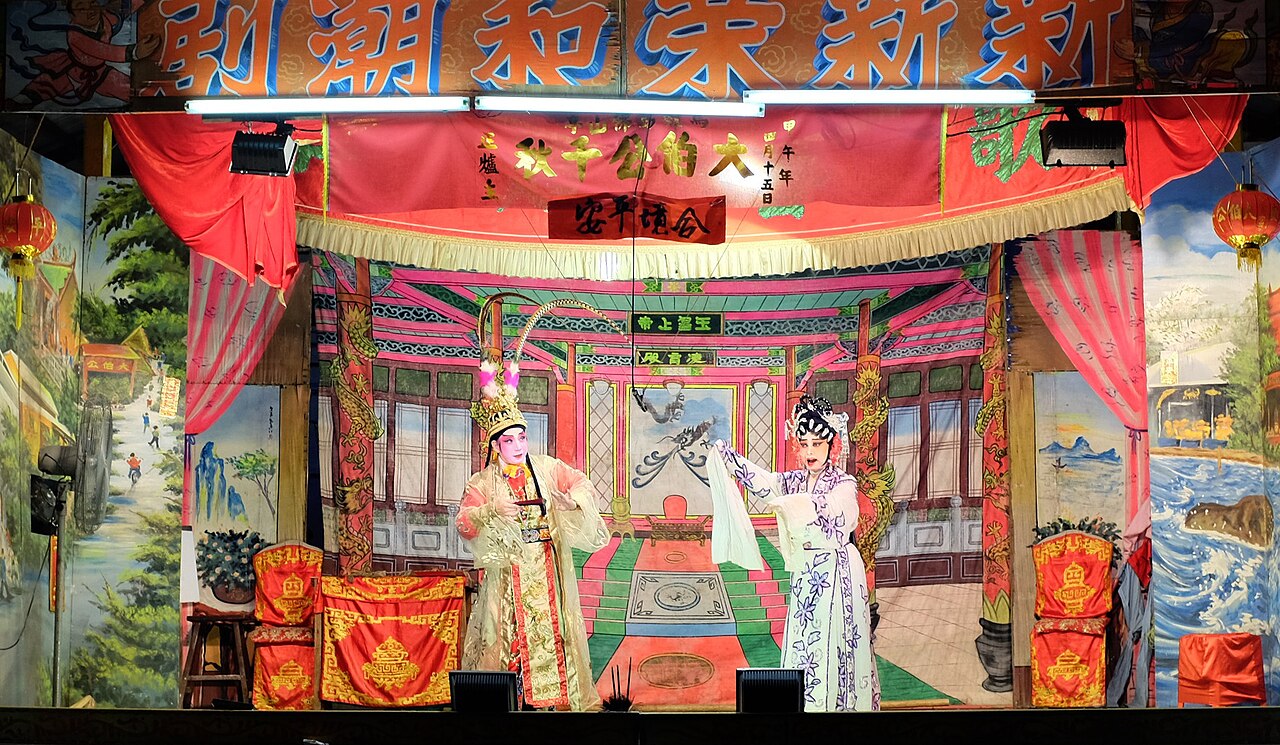
On 18 June 2026, a Mandarin-dubbed version of Dear You, a mainland Chinese production shot largely in Teochew, opened in Singapore theatres. Guidelines administered by the Infocomm Media Development Authority (IMDA) held that Chinese-language films for general release should be in Mandarin; the distributor, Clover Films, applied separately to screen the original and was allowed eight screenings at one cinema.
The 4,800 tickets for these screenings sold out within two hours. A second batch of eight screenings followed on 22 June, with waits of up to four hours and some 200 people queueing in person at the Golden Village cinema at the VivoCity mall. When a further 40 screenings were released on 29 June, 14,000 tickets sold in under three hours, and 70 more followed in early July across nine cinemas run by Golden Village and Shaw Brothers. By July IMDA had approved 272 Teochew screenings.
The journalist Constance Tan, writing in Mothership, described how her grandmother went to the Mandarin version on opening day, having missed the Teochew sessions. Her family came from Jieyang, one of the three main Teochew cities of eastern Guangdong; she had little schooling and, by her granddaughter’s count, about ten words of Mandarin. Tan, who speaks to her only in dialect (“her in her native Teochew and me in my half-baked imitation”), asked her afterwards what she had made of it. She had missed most of the dialogue. A nursery rhyme recited in the film went past her in Mandarin. She remembered the architecture of the share house where the protagonist lived and the streets of Siam. “I think the Teochew version would have been much clearer,” she said.
Tan saw a parallel with the film itself. Dear You, directed by Lan Hongchun, is called in Chinese Gei ama de qingshu 給阿嬤的情書, “love letters to grandma”. In its story, a grandmother in Shantou, Guangdong, believes her husband left for Southeast Asia and abandoned the family. When her grandson goes to Bangkok to find the rich grandfather he has heard about, he learns that the man died in 1960, and that for years afterwards a woman in Thailand had kept the remittance letters, qiaopi 僑批, coming in his name. The letters pass between people who cannot always read them, and photographs travel with them. Tan’s grandmother, cut off from the dialogue, watched the film the same way: without her own language, Tan wrote, the images became her only way into the story.
The Speak Mandarin Campaign
The rationale for the rule that limited those sessions goes back nearly 50 years. On 7 September 1979, prime minister Lee Kuan Yew launched the Speak Mandarin Campaign. Earlier that year a review of the school system led by education minister Goh Keng Swee had found that fewer than 40% of pupils reached minimum competence in two languages, blaming in part the dialects children spoke at home. Singapore’s schools taught Chinese pupils English and Mandarin. Lee held that a child who spoke Hokkien, Teochew, or Cantonese at home would master neither.
The educational case was the one most often made, but the campaign also served political ends. Singapore’s Chinese had arrived from Fujian, Guangdong, and Hainan speaking mutually unintelligible languages, and their associations, schools, temples, and newspapers were organised by dialect and native place. Reaching Chinese Singaporeans meant going through those bodies. A single Chinese language would let the state address them directly.
Lee saw Mandarin as the logical basis of this homogenisation. English would be the language of work and administration, but, as Lee said when opening the 1984 campaign, “English will not be emotionally acceptable as our mother tongue”. Mandarin “unites the different dialect groups”. He was as clear about the alternative: dialects persisting, “with not Amoy but pidgin Hokkien becoming most common, and Mandarin restricted to the classrooms. That is totally unacceptable.”
The campaign was enforced largely through broadcasting. Dialect advertising had already been withdrawn from television in 1978. From late October 1979, Hong Kong serials, the staple of Cantonese-language viewing, were dubbed into Mandarin before broadcast. Dialect programs disappeared from television by 1981 and from radio on 1 January 1983, and with them went the storytellers of the Hong Kong-based subscription broadcaster Rediffusion, whose serialised tales had been a fixture of shophouse and coffee-shop listening for three decades.
Lee Dai Sor, the best known of them, left the air on 30 December 1982, the day Rediffusion’s Singapore service stopped its dialect programs. Until his death in 1989 he told stories at wedding banquets, recorded Cantonese storytelling tapes, and served on the council of the Tung On Wui Kun clan association. Lee Kuan Yew himself stopped speaking Hokkien in 1979 and still described the decision as deliberate 30 years later.
The campaign also coincided with the decline of the Chinese-educated world that had been the base of left-wing politics in the 1950s and 1960s. English-dominant bilingualism was fixed in the schools in 1979, and in 1980 Nanyang University, the only Chinese-medium university in Singapore and one with, as Luke Lu and Chien Wen Kung put it, “a history of leftwing student activism”, was merged into the new National University of Singapore. Mandarin was promoted as the language of Chinese schooling and values in the same years that the institutions giving Chinese education an independent public life were merged into English-medium national ones: Nanyang University into the National University of Singapore in 1980, the principal Chinese dailies into one state-linked press group by 1984, and the Chinese-medium schools into a single national stream by 1987.
Among ethnic Chinese children entering primary school, the proportion who mainly spoke Mandarin at home rose from 26% in 1980 to 69% in 1989. As China opened, the case for Mandarin shifted from the classroom and communal cohesion to opportunity abroad. By the campaign’s 30th anniversary, in 2009, Lee Kuan Yew was telling his audience that with Mandarin “you can speak to 1,300 million Chinese from all provinces in China” and predicting that within two generations it would become the mother tongue.
Related
Timber, tycoons and the making of Sarawak politics
A review of a compelling new political history
In 2014, opening the campaign’s 35th year, prime minister Lee Hsien Loong listed where dialect was still welcome. Seniors could listen to the news in dialect on Mediacorp’s radio station 958FM. Those who wanted to learn could attend classes run by clan associations. Those drawn to Cantonese or Teochew opera could pursue it at community centres and the Kreta Ayer People’s Theatre in Chinatown. Streaming services have since carried dialect films and Hong Kong titles in Cantonese, outside the licensing regime that governs cinemas, and by 2024 Channel 8 was running a weekly belt of dialect programs on free-to-air television.
But in cinemas the Mandarin-only rule stayed, with exceptions. IMDA had allowed unrestricted screenings of films with substantial dialect content, such as 881, Long Long Time Ago, and Wonderland, and some 30-40 dialect films are screened at festivals each year.
Questions in Parliament
On 19 June, the day after Dear You opened in Singapore, the filmmakers Eric Khoo and Jack Neo wrote to The Straits Times that dialect films “are not an issue on home videos and streaming platforms and even on board airplanes, so why should cinemas continue to bear the brunt of this outdated policy?”
Within days, People’s Action Party (PAP) and opposition MPs alike had filed parliamentary questions. The Workers’ Party MP Kenneth Tiong asked whether the ministry would abolish the Mandarin requirement and allow dialect films on general release, noting that fewer than 12% of households now spoke dialect at home. The PAP’s Cai Yinzhou and Dennis Tan of the Workers’ Party asked whether heritage value had formed part of the assessment.
Replying on 7 July, Senior Minister of State Tan Kiat How told Parliament that the guidelines had “generally served us well”, while allowing that there was “scope to consider how we can expand the space for dialects, while continuing to uphold the importance of Mandarin”.
On 23 August, Prime Minister Lawrence Wong announced in his National Day Rally speech that so long as a Mandarin-dubbed version was available, there would be no cap on dialect screenings. The Ministry of Digital Development and Information revised the guidelines the same day, with effect from September 2026. Films in full or majority dialect may now be screened in cinemas without limit, provided Mandarin subtitles are shown and a Mandarin-dubbed version is also made available. On subscription television the cap of one dialect arthouse film a week is gone, as is the ceiling on dialect songs on a music channel. On free-to-air television and radio, Mandarin remains the mainstay.
Streaming, the ministry confirmed in July, carries no dialect restrictions, and subscription television now joins it. Free-to-air television, watched at home by anyone with a set, stays Mandarin-first. Cinema screenings, which are paid for but open to anyone, now require a Mandarin version alongside the dialect one.
We can see that the regulations for dissemination of Chinese-dialect content differ depending on how widely a particular medium reaches. Subscribers choose and pay for what they watch, and dialect is left alone there. A free-to-air channel addresses the whole population, and there Mandarin keeps its place.
Cinema sits in between: anyone can buy a ticket, and a film on general release is advertised to everyone. The new policy accordingly widens the opening for dialect films but within a narrow condition, moving the restriction from the number of screenings to the existence of a second version: Dear You, a commercial release that came with a Mandarin dub, met that condition from the start. An arthouse or festival title made without a Mandarin version does not, and it cannot use the new route until someone pays to produce one. The rules are thus less liberalising than they first appear; they suit large commercial releases like Dear You and do little for smaller films that do not.

Prime Minister Lee Hsien Loong at an event commemorating the 40th anniversary of his father’s Speak Mandarin Campaign, 23 October 2019 (Photo:: Singapore Chinese Cultural Centre 新加坡华族文化中心 on Facebook)
Dialect as heritage
Lee Hsien Loong’s 2014 speech had named the limited settings in which dialect was to have a place: the clan association classroom, the community centre, the opera stage in Chinatown, the radio bulletin for the elderly. A first-run cinema is not on that list.
Yet at the Teochew screenings of Dear You, Teochew was the language of a new commercial release, in sold-out cinemas. Prime Minister Lawrence Wong went to the Teochew version and followed little of it. In his National Day Rally speech he recalled one line from the grandmother character, “Be a person of compassion and loyalty”, and said that “hearing those words in dialect made them even more endearing”. Constance Tan’s grandmother, who expected the Teochew version to be much clearer to her, saw the Mandarin version and remembered mainly the share house and the streets of Siam. The prime minister, who could not follow the Teochew, was moved by it; the grandmother, who could have, saw the Mandarin version instead.
The response to the film also drew on an older memory of the campaign. Luke Lu and Chien Wen Kung’s interviews with Chinese Singaporeans born between 1940 and 1966 found that many now blame the campaign for the erosion of Chinese culture, and that “Lee Kuan Yew” works in their accounts as shorthand for “the oppressive sociopolitical conditions in Singapore in the 1960s to 1980s”.
That memory belongs to a Chinese-educated generation that lost its university and its public languages within a few years. The Dear You audiences were broader, including families like Tan’s. The public argument that surrounded the film was put in milder terms than that memory. Filmmakers Khoo and Neo called the rule “outdated”. Mothership’s Ilyda Chua described dialect as “once a problem to be ‘policy-managed’ away” and “now priceless cultural heritage”.
The affection for the film was also nostalgic, and the prime minister described it in those terms. Dear You, he said, “reminded us of our pioneers, the sacrifices they made and the hardships they endured, as well as the values they lived by”. The film is itself a story of emigration and remittance, of a grandmother in Shantou waiting on letters from Southeast Asia, and for many Chinese Singaporeans that is a family story. The nostalgia was for a world of migrant grandparents and for the language that went with it—a language that some younger viewers, like Tan, speak only in a “half-baked imitation”. The state can readily endorse this kind of nostalgia, since it concerns the past rather than present policy.
Cultural engineering lives on
The bargain of 1979 was that Mandarin would be the public Chinese language and dialect would retreat to the home and, later, to heritage. The letters and parliamentary questions of June did question the dubbing rule, and some MPs asked whether its rationale still held. Their demands, though, concerned cinema—not Mandarin’s place as the common Chinese language. They targeted one surviving piece of the cultural engineering of the Lee Kuan Yew years, and the state could meet them by revising its guidelines.
Yet the basic agenda of Lee’s project, especially as it pertains to non-Mandarin dialects, lives on. Lawrence Wong’s National Day Rally speech restated its terms: “Many see dialects as a cultural heritage worth preserving. I agree.” And: “we must also protect the hard-won gains of the Speak Mandarin Campaign”. The ministry’s factsheet used the same formula, calling dialects “cultural heritage worth preserving, while continuing to uphold the importance of Mandarin”. As the government uses the term, “heritage” recognises the value of dialect while keeping it subordinate to Mandarin in public life.













Leave a comment