


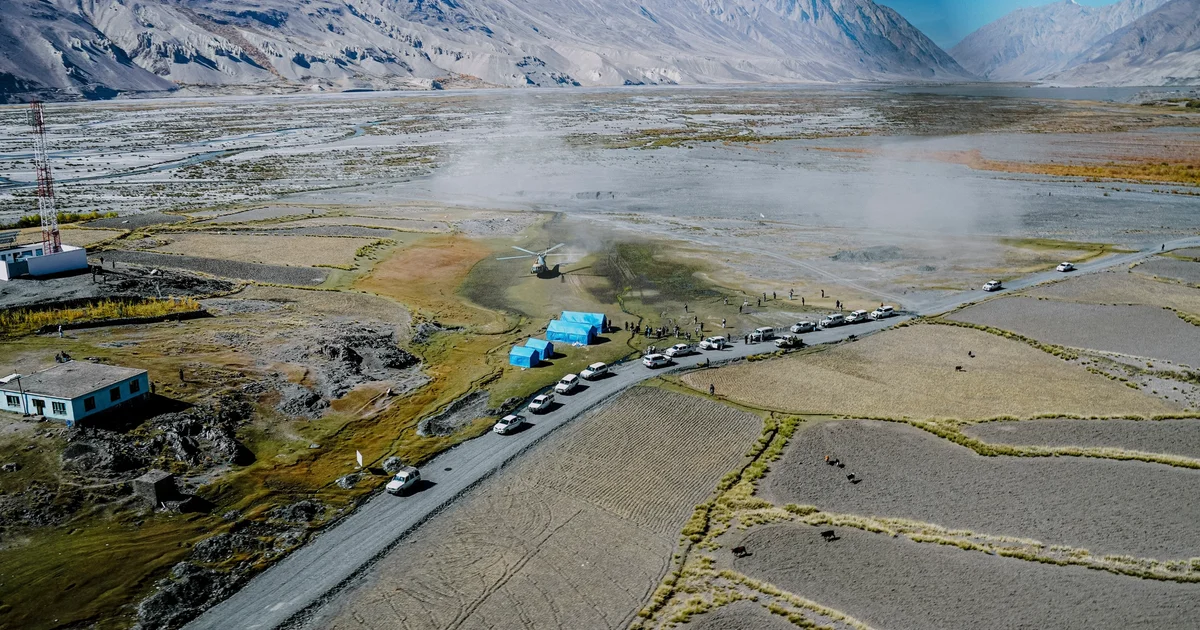
The Wakhan Corridor is a narrow strip of Afghan territory extending eastwards between Tajikistan and Pakistan before reaching China’s Xinjiang region.Its strategic importance is hardly new (Opens in new window). During the 19th century’s Great Game era, it served as a buffer between the British Empire in India and the Russian Empire to the north.
The mountains that once made Wakhan useful as a buffer also made it extraordinarily difficult to reach. High passes, severe winters and poor infrastructure have kept the corridor isolated. The new road does not change that geography, but it does begin to work around it, and Beijing has been paying attention.
In February, Afghanistan’s ambassador to China, Mawlawi Asadullah Bilal Karimi, met Liu Jinsong, head of the Department of Asian Affairs at China’s foreign ministry. According to Chinese and Afghan accounts, the discussions included China-Afghanistan relations. Afghan reporting also said activation of the Wakhan Corridor was discussed.
In March, Afghanistan’s Acting Minister of Commerce Nooruddin Azizi also met China’s Special Representative in Kabul, Yu Xiaoyong (Opens in new window) in Kabul to discuss connectivity and transit.
While this demonstrates diplomacy around the idea, there is a distinction between a road reaching China, and China agreeing to open a full commercial crossing. Beijing has made no public commitment to do so, and that is likely to remain the challenge.
A functioning trade route would require customs facilities, security arrangements and infrastructure, as well as a road capable of handling sustained commercial traffic. A high-altitude gravel road through the Pamirs is a different proposition from a modern trade corridor.
China’s calculations are likely to be cautious for another reason: security. (Opens in new window)Beijing has maintained pragmatic relations with the Taliban while stressing its concerns about militant groups operating from Afghan territory, particularly those that could threaten China’s Xinjiang region. China has also supported security cooperation along the Wakhan frontier. In 2025, China’s Foreign Minister Wang Yi (Opens in new window) said Beijing supported the resumption of bilateral patrols in the corridor and called for stronger Afghan action against the East Turkestan Islamic Movement and other militant groups.
For Beijing, therefore, the road is not simply about moving goods. It is also about what happens in the mountains beside Xinjiang. This is where the road becomes more interesting than its modest size suggests.











Leave a comment