


The independent AUKUS Public Inquiry has drawn a critical conclusion for Australia’s defence debate: though AUKUS Pillar One should be cancelled, the nation still requires a credible, sovereign fleet of 12 submarines to defend its maritime approaches, and nuclear propulsion is an option.
Defenders of the status quo have rushed to dismiss the inquiry’s findings, but they’ve ignored its acceptance that nuclear propulsion may be preferable.
Peter Garrett, the inquiry’s lead commissioner, is a long-standing opponent of nuclear technology. Questioned by journalists, he confirmed that the panel had accepted advice (from me) that low-enriched uranium (LEU) nuclear submarines should be considered as an alternative, subject to assured waste management pathways. He declined, however, to endorse the option personally.
Too many people are conflating the case for nuclear propulsion with the flawed assumption that AUKUS Pillar One, using reactors fuelled by highly enriched uranium (HEU), is the only way to deliver it.
Pillar One does not fail on strategic intent; it fails on engineering, industrial and budgetary reality. By relying on second-hand Virginia-class nuclear submarines (SSNs) drawn from an overstretched US Navy and then boats of the unbuilt SSN-AUKUS design featuring an untested reactor, the plan guarantees a capability chasm throughout the 2030s and 2040s. As Collins-class boats are decommissioned, the Virginias won’t be available, because of USN shortages, and construction work in Britain on SSN-AUKUS submarines will languish as building of Dreadnought-class ballistic missile submarines takes first priority.
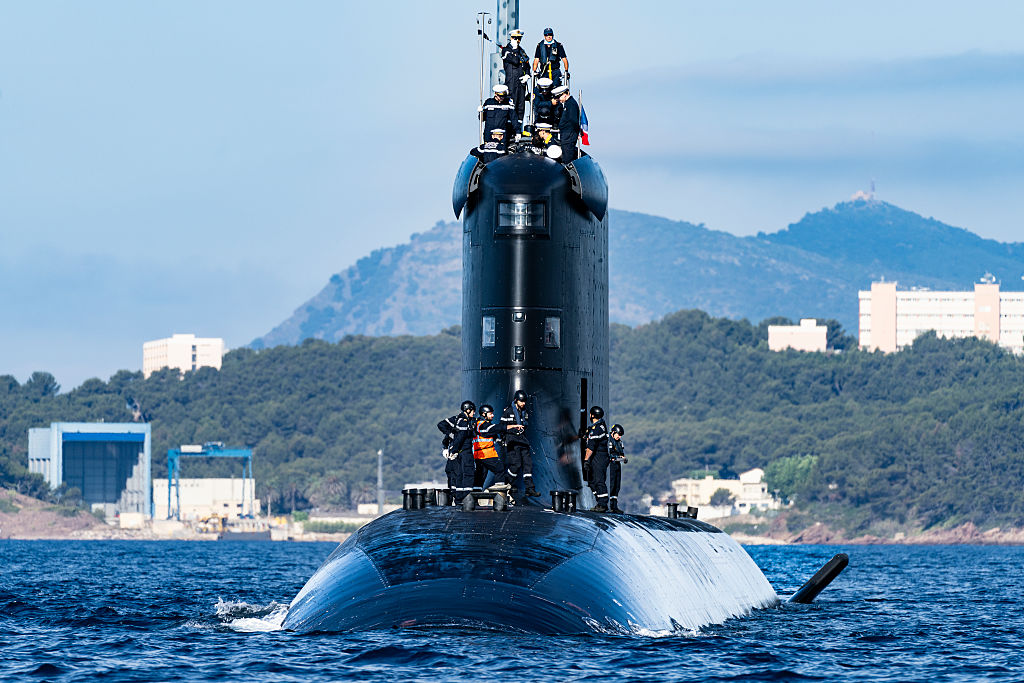
An operational, in-production alternative exists today: France’s Suffren-class attack submarine, a case detailed in my earlier assessment of French SSN alternatives. Going for it would not affect our security ties with the US and Britain: we’d just be changing the design of our future SSNs, not our alliance partners.
Twelve Suffren-derived submarines, each having half the displacement of a Virginia and requiring half as large a crew, are something that Australia can afford to build, crew and sustain domestically. Retired senior public servants Jon Stanford and Michael Keating have analysed Parliamentary Budget Office through-life costings in their submission to the AUKUS Public Inquiry. They estimate that acquiring 12 Suffren SSNs in a continuous building program and sustaining them over 31 years would cost about A$180 billion at constant 2025 prices. Contrasting with the minimum A$268 billion baseline estimate for buying and running eight larger AUKUS submarines, the French baseline delivers 50 percent more operational boats at about 70 percent of the through-life cost.
Crucially, the LEU fuel cycle solves the intractable nuclear waste problem. The Suffren design operates on standard, civil-grade fuel, avoiding the non-proliferation hurdles and reliance on the United States as the sole source of HEU, a weapons-grade material. Australia already has decades of experience managing LEU fuel at the research reactor in Lucas Heights and maintains an active, routine bilateral arrangement with France to export and reprocess spent LEU fuel.
By contrast, neither the US nor Britain has an operational, fully costed disposal pathway for retired HEU naval reactor cores. Britain currently has 23 decommissioned nuclear submarines tied up at the Rosyth and Devonport dockyards, 12 of which have sat for decades waiting to have their nuclear fuel removed. Once we factor in a A$120 billion estimate provided by the AUKUS Inquiry to manage the unbudgeted HEU waste liabilities, the financial case for LEU becomes overwhelming.
National security strategy must be driven by operational risk and capability, not political pride. As I have previously argued, a continuous domestic build of 12 LEU Suffrens would carry a vastly lower schedule, technical and environmental risk. It would also guarantee Australia an independent undersea deterrent under its own command, avoiding a capability gap.










Leave a comment