


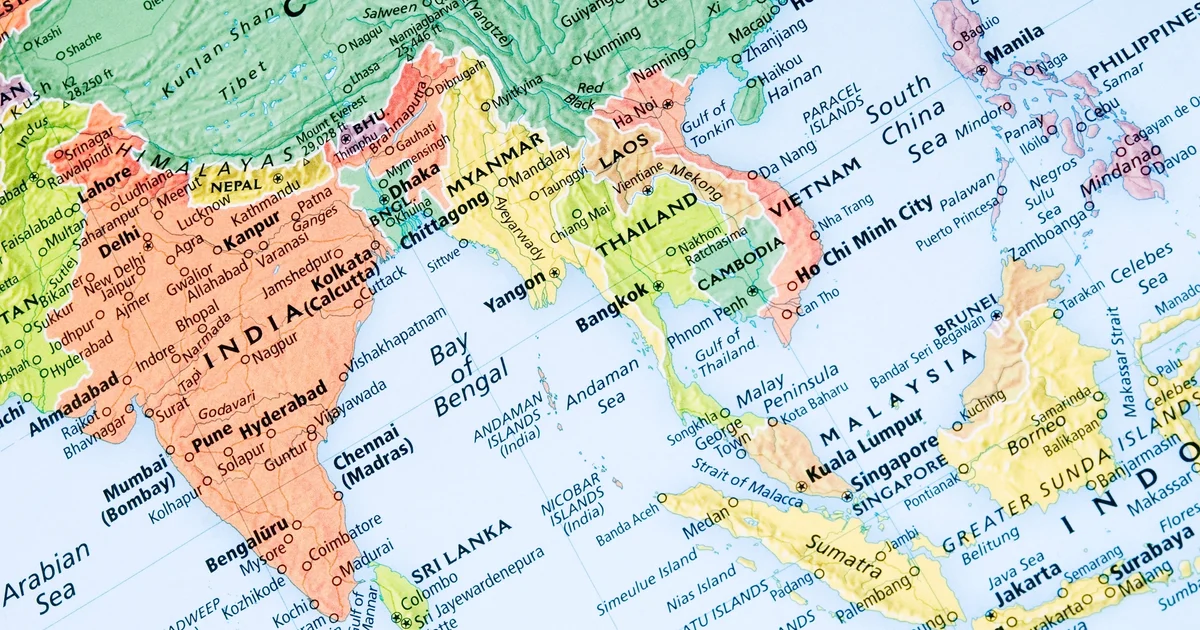
Meanwhile, Southeast Asian neighbours view the crisis entirely through immediate survival metrics: Bangkok prioritises border trade, migration, and energy security; Singapore focuses on financial stability; and Jakarta and Kuala Lumpur weigh ASEAN’s credibility. Further afield, Washington views Myanmar through the prism of Indo-Pacific competition with China, while Moscow sees an opportunity to challenge Western influence.
None of these perspectives necessarily ignores human rights. But none begins there.
Governments decide whether to act based on whether doing so advances their own interests. This is the reality of international relations, and it applies just as much to middle powers like Australia.
Supporting Myanmar’s democratic aspirations aligns perfectly with Australia’s strategic interests. Myanmar has become an epicentre of cyber-enabled organised crime (Opens in new window), human trafficking (Opens in new window), and narcotics production (Opens in new window). Framing the country solely as a humanitarian crisis risks overlooking why it matters to Australia’s own security.
Rather than asking why regional capitals have adopted different approaches, advocates must ask how they can better align their advocacy with those priorities without compromising their principles.
In practice, this means tailoring the message to the listener’s specific vulnerabilities. When engaging Beijing, advocacy must bypass abstract democratic ideals entirely. It should focus on proving that the junta’s ongoing instability is an active liability to China’s core interests. Crucially, advocates must demonstrate to a deeply pragmatic Beijing that the democratic coalition possesses the institutional cohesion and capability to manage a transition smoothly, dismantle criminal syndicates, and protect foreign investments far more effectively than a failing military junta.
Understanding another government’s interests is not an act of capitulation. It is the acquisition of leverage.
Bypassing democratic rhetoric to speak the language of realpolitik does not mean abandoning justice and accountability. It simply recognises that in a contested Indo-Pacific, moral arguments only carry weight when they are tied to a state’s fear of instability or its desire for advantage. Influence begins where sentimentality ends.
Myanmar’s future will ultimately be determined by the courage and resilience of its people. But international support will be shaped by the calculations of governments.
Moral courage remains indispensable. In an increasingly contested Indo-Pacific, strategic literacy may prove just as essential.












Leave a comment