


On 24 August 2025, the former academic Peter Berkowitz delivered a lecture at the National Leadership Academy (AKN NU), the highest tier of cadre training by Nahdlatul Ulama (NU), Indonesia’s largest Islamic mass organisation. Berkowitz, now a senior fellow at the Hoover Institution, served as Director of Policy Planning at the State Department during Donald Trump’s first presidential administration and maintains extensive ties to pro-Israel and neoconservative foreign policy networks.
Those affiliations eventually became public controversy. In February 2025, Berkowitz published an open letter to Secretary of State Marco Rubio urging wide-ranging cooperation with NU, which was promoted on the website of the Center for Shared Civilizational Values (CSCV),the American organisation serving as NU’s international secretariat. Yet Berkowitz’s lecture drew little public notice until he appeared at a Universitas Indonesia forum on 23 August, where his record provoked a wave of online criticism and forced the university to apologise within a day. As NU’s own outlet acknowledged, it was the UI affair that brought Berkowitz to national attention, and with it, the fact that NU’s national executive board (Pengurus Besar Nahdlatul Ulama/PBNU) had hosted him the week before.
The clerical leadership sided with the critics. NU’s supreme spiritual leader (or Rais Aam) Miftachul Akhyar demanded the AKN NU academy be halted and that PBNU’s memorandum with CSCV be suspended. PBNU Chairman Yahya Cholil Staquf—widely known as Gus Yahya—apologised on 28 August, calling Berkowitz’s invitation an oversight. But it was not enough: in November 2025, Akhyar convened NU’s Syuriah oversight council to call formally for Gus Yahya’s removal as PBNU chair. A PBNU plenary dismissed him the following month, installing an acting chairman in his place. Gus Yahya contests the legal validity of both the Syuriah and PBNU’s actions, but nonetheless saw fit to apologise to PBNU colleagues over the Berkowitz affair and the organisation’s financial governance as the price of a second plenary that reversed his dismissal in late January 2026.
The crisis arrives at a particularly fraught moment. Widely regarded as the world’s largest Muslim organisation, NU is set to convene its 35th Muktamar (national congress) in East Java in August 2026, 100 years after the organisation’s founding in the same province. Gus Yahya has declared his intention to recontest the PBNU chairmanship.
Three interlocking pressures have driven the internal turmoil ahead of that milestone. First, government co-optation under former president Joko Widodo integrated NU into the state’s strategy for managing Islamic movements and placed senior NU figures in cabinet, raising questions about the organisation’s independence. Second, a 26,000-hectare coal concession issued in 2024 fractured the PBNU leadership and deepened grassroots suspicions that the national board had drifted from its founding mission.
But the third and most consequential factor is that which we focus on here: NU’s sustained engagement with a network of sometimes ideologically contradictory foreign partners, of which the Berkowitz affair was the most visible manifestation. Unlike the coal concessions or the perceived closeness to the government, NU’s international engagement was a deliberate institutional strategy built across multiple presidential terms and involving partners spanning countries and diverse ideological inclinations. Understanding how that long-developed strategy accumulated its domestic political costs teaches wider lessons about the limits of international engagement by high-profile religious actors whose authority ultimately derives from grassroots legitimacy.
“Humanitarian Islam”: for the West, not the rest
After the 11 September 2001 attacks, promoting “moderate Islam” became a pillar of Western counterterrorism strategy. The RAND Corporation’s 2007 blueprint Building Moderate Muslim Networks urged Washington to cultivate credible Muslim partners as a counterweight to extremism—and it found one in NU, instrumental in the democratisation of the world’s largest Muslim-majority country.
“Humanitarian Islam” is NU’s primary framework utilised to promote its vision internationally. It positions the organisation’s theological tradition as a global model of moderate, pluralist, civically-engaged Islam, in deliberate contrast to the hardline Salafi–Wahhabi ideology that characterised groups like al Qaeda and ISIS. This is distinct from Islam Nusantara, the framework championed by Gus Yahya’s predecessor Said Aqil Siroj, which celebrated the accommodation between Islamic teaching and the syncretic indigenous beliefs of the archipelago. While Islam Nusantara explained NU to Indonesians, “Humanitarian Islam” branded NU for the world.
Yet the framework was not a grassroots theological movement within NU. It was C. Holland Taylor, a former telecommunications executive from North Carolina with no prior connection to Indonesian Islam, who developed it in close collaboration with Gus Yahya. Taylor holds a formal appointment as Special Adviser for International Affairs to the PBNU chairman. Together, they established several nonprofit organisations. CSCV, incorporated in North Carolina, became NU’s de facto permanent secretariat for international engagement. Alongside CSCV, the Bayt ar-Rahmah Foundation (BRF) functioned as the primary vehicle for the project’s international promotion.
Taylor’s networks extended deep into American neoconservative foreign policy circles. Figures affiliated with his project included Mary Ann Glendon, former US ambassador to the Holy See under George W. Bush and professor emerita at Harvard Law School, and Peter Berkowitz himself. In October 2020, then-Secretary of State Mike Pompeo delivered an address at NU’s Ansor youth wing headquarters in Jakarta, an event Taylor played an instrumental role in arranging. Promoting NU, Taylor also provided written testimony before the US Congressional Human Rights Caucus last year. By that point, Humanitarian Islam had been thoroughly absorbed into the neoconservative world, particularly within global religious freedom circles.
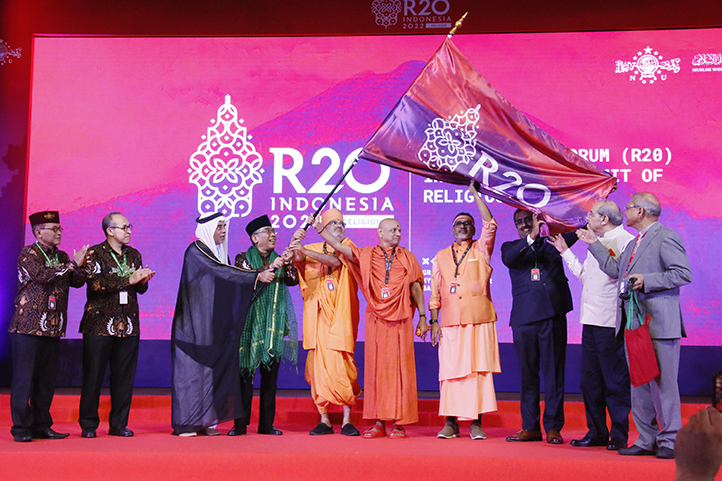
The project has built an impressive track record of global influence. This string of prestigious achievements includes appearances at the European Parliament in 2019, a subsequent Nobel Peace Prize nomination, and, most recently, the co-organisation of the R20 religious dialogue track within Indonesia’s 2022 G20 presidency. These outputs were legible almost exclusively to foreign policy audiences searching for a credible Muslim counterweight to Salafi-jihadism. But the partners Humanitarian Islam attracted ultimately revealed how NU’s contradictory approach allowed the initiative to be instrumentalised by states, and various political actors and movements looking to whitewash their mistreatment of Muslims.
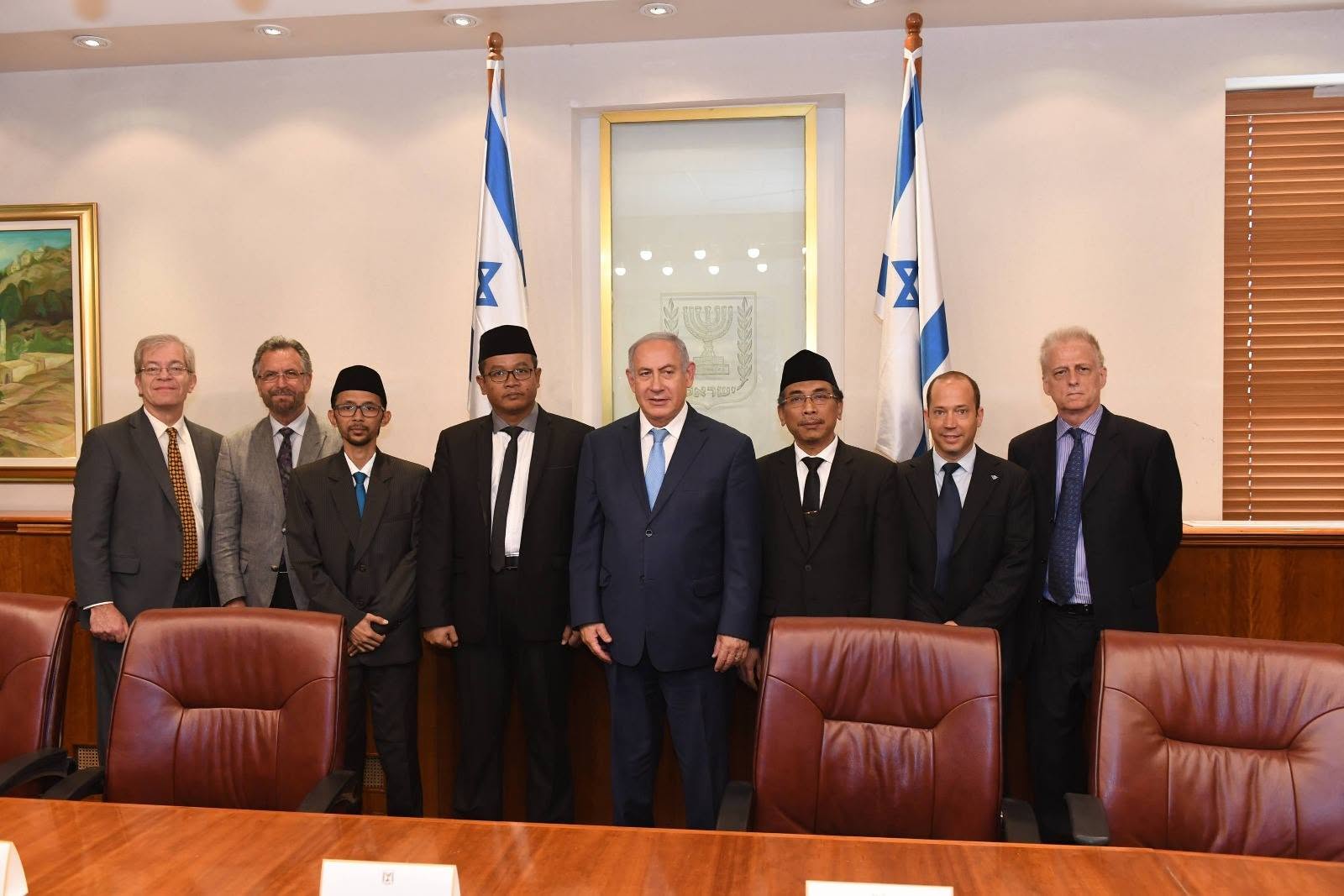
Yahya Cholil Staquf (third from right) leads a delegation in a meeting with Israeli Prime Minister Benjamin Netanhayu in Tel Aviv, June 2018. C. Holland Taylor appears on the far right (Photo: Prime Minister of Israel on Facebook)
The contradictions of NU’s foreign outreach
This has been most starkly seen in NU’s engagement with China. In February 2019, Robikin Emhas, then a senior PBNU official, joined a Chinese government-funded delegation to Xinjiang alongside representatives from Muhammadiyah, Indonesia’s second largest Muslim organisation. Upon his return, he publicly denied the existence of detention camps, stating that he had found no evidence of the facilities described in international reporting.
The Wall Street Journal’s reporting on the delegation brought the visit to international attention, drawing criticism from human rights advocates and Muslim activists worldwide. Due to the backlash, both NU and Muhammadiyah issued statements calling on China to stop human rights violations and allow international access—a notable retreat from their initial positions. Initially, however, Beijing had secured an effective public endorsement from the world’s largest Muslim organisation on one of the most sensitive human rights questions affecting Muslim populations globally. Chinese engagement with NU did not cease after the episode, as evidenced by China’s increasing educational outreach targeted toward NU and Muhammadiyah students.
The R20’s most revealing partnership, meanwhile, was forged by an invitation from Taylor for BJP General Secretary Ram Madhav to participate formally in the summit’s organisation. As a senior leader of the Rashtriya Swayamsevak Sangh (RSS), Madhav represented the BJP’s Hindu nationalist ideological parent, an organisation associated with recurring communal violence and the destruction of Muslim places of worship. NU, an organisation that had built its international brand on pluralism and the rejection of supremacism, had thus welcomed an RSS leader as a formal partner in a summit ostensibly dedicated to everything RSS was not.
As scholar Ahmad Rizky M. Umar observed at the time, Madhav exploited the Humanitarian Islam framework for the BJP’s own domestic purposes. In February 2022, he invoked Indonesian Muslim practice to defend a hijab ban in BJP-controlled Karnataka, precisely the kind of instrumentalisation the project’s architects had sought to prevent.
Two further entanglements compounded the impression of NU inconsistency. First was the co-sponsorship of the R20 by the Muslim World League, a Saudi Arabia-based Wahhabist organisation. To protect that funding relationship, PBNU quietly overruled LDNU, an internal body that had recommended abolishing Wahhabism as a legitimate Islamic tendency, a position NU had maintained since its founding in 1926. NU was consequently being marketed internationally as the antidote to Wahhabism whilst accepting Saudi money that constrained its own theological commitments.
Meanwhile, NU’s affiliated political party, the National Awakening Party (PKB), holds membership in the Centrist Democrat International. Its vice presidents have included former Hungarian prime minister Viktor Orbán, a right-wing populist figure known for his Islamophobic and anti-pluralistic views. This association also sits uncomfortably alongside NU’s self-presentation as a champion of pluralist democratic values.
Yet the most politically explosive of NU’s foreign entanglements involved its deepening ties with neoconservatism, and by extension, pro-Israel circles. In 2018, Gus Yahya visited Prime Minister Benjamin Netanyahu in Jerusalem at the invitation of the American Jewish Committee. Netanyahu’s office publicised the meeting on social media, provoking protests in Indonesia.
Israel’s war on Gaza after the 7 October 2023 attacks made NU’s diplomatic overtures towards senior Israeli officials impossible to ignore. NU’s response to Israel’s aggression was more measured than many of its activists wanted and the contrast with Muhammadiyah’s more direct statements was damaging. More damaging still was the comparison with NU’s own record: former president Abdurrahman Wahid had kept warm personal ties with Israeli figures whilst firmly advocating Palestinian statehood, and the organisation’s advocacy on the Rohingya issue had been far more forthright.
Related
Selective moderation: Indonesia–UAE religious diplomacy
Pragmatic political interests lie behind the promotion of ‘moderate’ Islam in both countries.
Gus Yahya’s more cautious response thus could be read as a regression from NU’s own traditions. The domestic context sharpened the problem: under President Prabowo Subianto, Indonesia has adopted a markedly more conciliatory posture on Israel–Palestine than his predecessors. NU consequently found itself more muted on the issue than the Indonesian state itself, a striking reversal for an organisation long cast as the country’s ambassador for moderate Islam.
In July 2024, five young NU activists met with Israeli President Isaac Herzog during active Israeli military operations in Gaza (surprisingly to the condemnation of Gus Yahya himself). The encounter was initially framed as personal rather than institutional, but the environment in which such contacts had become possible was largely one that the PBNU leadership had shaped. Against this backdrop, Gus Yahya’s subsequent claim that he had been unaware of Berkowitz’s pro-Israel affiliations is difficult to reconcile with the years of documented collaboration between him and Taylor.
The attempt to oust Gus Yahya in the wake of the Berkowitz incident in late 2025 was not just an internal struggle over coal mining rights received by the organisation’s leaders from the Indonesian state. Yahya’s opponents drew on and instrumentalised genuine grassroots grievances about the NU leader’s diplomatic efforts toward Israel. The attack was credible precisely because of his years of entanglement with neoconservative intellectuals and activists.
The limits of Islamic moderation as a foreign policy
The NU case surfaces two lessons with implications well beyond Indonesia.
The first is structural: a religious organisation whose authority derives from domestic legitimacy cannot indefinitely conduct foreign policy over the heads of its own constituency. Sustained engagement creates partner networks and funding relationships that gradually constrain what it can say and do at home, and such engagement is never politically neutral.
Representing “moderate Islam” abroad, aligned with the American neoconservative religious-freedom project, conflates moderation with geopolitical alignment. For NU’s grassroots, the Gaza war made that balancing act impossible, and the international reputation that once attracted foreign partners became a liability at home. NU’s social base of so-called nahdliyin in the pesantren villages of Java eventually saw through PBNU’s hypocrisy, and other religious actors and organisations engaged in similar externally supported activism will likely face the same fate.
The second lesson is for policymakers. Western governments and foundations that invested in NU assumed that an organisation could promote moderation for foreign audiences without accumulating political risk domestically. PBNU treated international visibility as a source of legitimacy; in fact, it was a means of expending it. As such, the approach of building such partnerships tends, over time, to hollow out the very domestic authority that made those organisations worth engaging in the first place. Balancing the interests of a domestic constituency against the ideologies of foreign partners is the challenge the moderate Islam project has consistently failed to meet.
Ultimately, how these plays at the Jombang Muktamar is hard to predict. The contest is competitive, with constantly evolving dynamics. Gus Yahya may not be especially popular owing to the debacle described here, but his saving grace may be that no single credible challenger has yet consolidated support.. What is clearer is which charge against the incumbent carries most weight: of all the grievances against him, the pro-Israel one is the most salient and powerful enough to have trigger this crisis in the first place. However, whether this Muktamar leads to that abovementioned rebalancing remains an unresolved question. NU’s foreign relations are deep and institutionalised, and may well outlast its current leadership squabble.









Leave a comment