


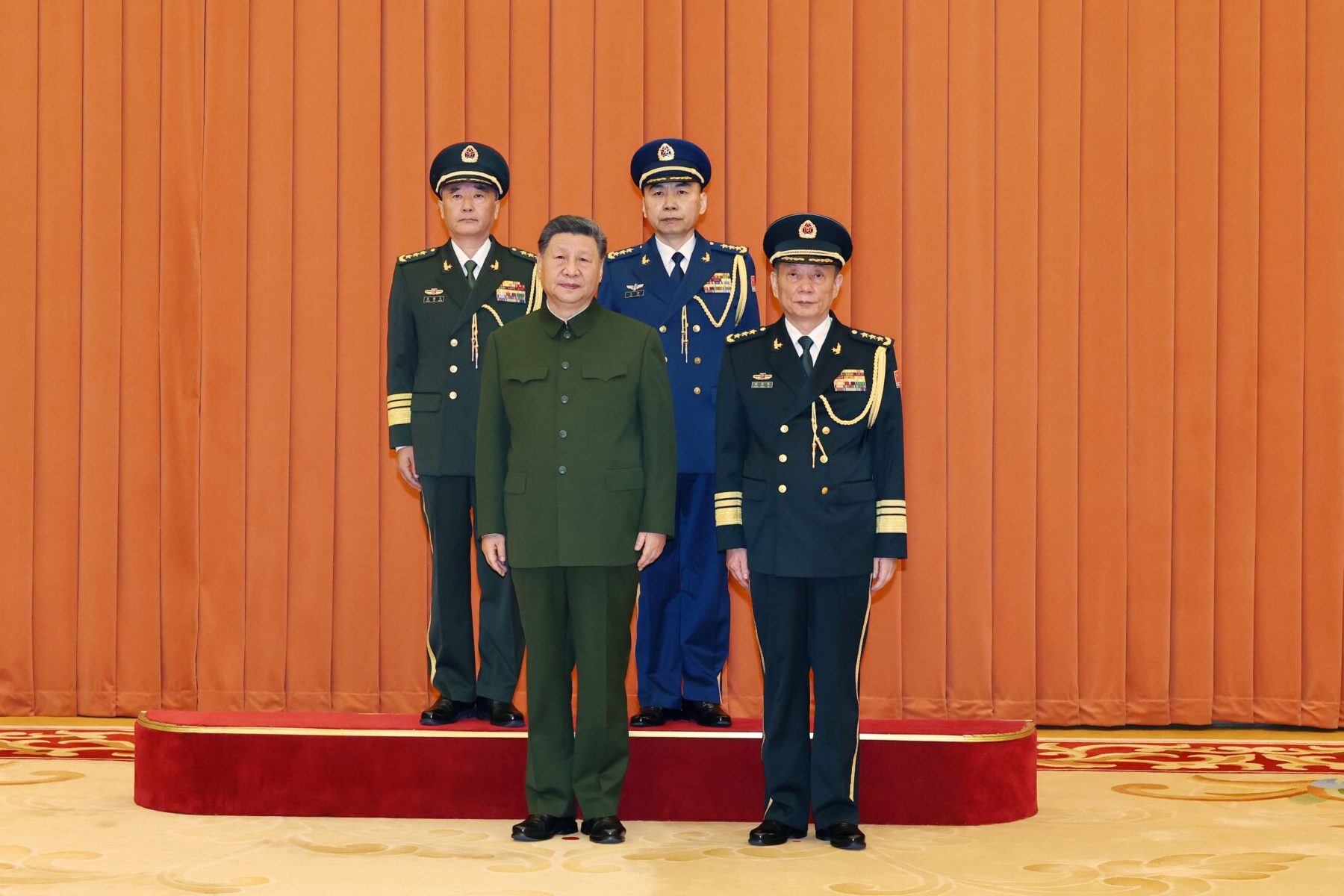
The Chinese military’s latest promotion of new generals should not be viewed simply as an effort to fill vacancies but as part of its reconstruction following purges of senior leadership. These changes highlight that President Xi Jinping is prioritising internal control and the force’s management and restoration, potentially pushing any major military operations aside.
After a major wave of personnel turmoil this year, the top ranks of the People’s Liberation Army (PLA) appear to be entering a phase of partial replenishment. On 29 June, two newly promoted generals appeared alongside Defense Minister Dong Jun and Central Theater Command Commander Han Shengyan at a celebration of the 105th anniversary of the founding of the Chinese Communist Party. It was their first public appearance together with other senior PLA officers.
On 3 July, China held a promotion ceremony for the rank of general. One of the two, Zhang Shuguang was also appointed secretary of the Central Military Commission’s (CMC’s) Discipline Inspection Commission and as director of the CMC Supervisory Commission. The other officer elevated to the ranks of general was Wang Gang, commander of the Chinese air force.
According to Xinhua News Agency, the ceremony was held on 3 July in Beijing. CMC Vice Chairman Zhang Shengmin presided and read out the promotion order signed by Xi, who also attended. With this event, the number of active PLA generals rose from four to six: Dong, Han, Wang, Zhang Shengmin, Yang Zhibin and Zhang Shuguang. This was not merely a routine adjustment of military ranks. Rather, it signalled an effort to stabilise the PLA’s senior command structure after a period of extensive purges.
Zhang Shuguang and the centrality of discipline inspection
Zhang Shuguang comes from the army’s political work system. Publicly available information shows that he became a member of the 20th Central Commission for Discipline Inspection in 2022. His career has long been concentrated in the PLA’s discipline inspection system, which enforces rules and fights corruption and other wrongdoing. He previously served as director of the Case Review Bureau under the Discipline Inspection Department of the PLA’s former General Political Department and later as director of the Discipline Inspection and Supervision Bureau of the CMC Discipline Inspection Commission.
Zhang Shuguang also has a long institutional overlap with Zhang Shengmin in the PLA’s discipline inspection system. When Zhang Shengmin became secretary of the CMC Discipline Inspection Commission in 2017, Zhang Shuguang was serving as director of the CMC’s Discipline Inspection and Supervision Bureau. In 2018, Zhang became secretary of the Discipline Inspection Commission of the Northern Theater Command Air Force. In December 2021, he was promoted to secretary of the Army Discipline Inspection Commission and awarded the rank of lieutenant general. In July 2026, he succeeded Zhang Shengmin as head of the CMC Discipline Inspection Commission and the CMC Supervisory Commission, placing him in charge of the PLA’s highest anti-corruption and internal supervision apparatus.
Zhang Shuguang’s career trajectory shows that he has been almost entirely shaped by the PLA’s discipline and supervision system. For Xi Jinping, he is not simply another senior officer: he is the successor to Zhang Shengmin’s discipline inspection network and the inheritor of the PLA’s internal coercive control mechanism. His promotion highlights Xi’s continuing concern with internal control, political loyalty and disciplinary rectification inside the military. In other words, Zhang’s promotion to general is not based primarily on operational experience. Its significance lies in his ability to help Xi maintain control over the PLA’s anti-corruption and supervision system. Looking ahead to the 21st Party Congress in 2027, Zhang Shuguang may well enter the CMC and take formal charge of the military’s internal discipline and supervision system.
Wang Gang and the stabilisation of the air force
Wang, the other newly promoted general, has spent most of his career in the air force. Earlier in his career, Wang was an aerobatic pilot. In 2012, he was transferred to the air force headquarters as director of the Military Training Department. In 2016, he became assistant chief of staff of the air force and was promoted to major general. In 2022, he became air force chief of staff and was promoted to lieutenant general. In July 2025, Wang visited Pakistan for exchanges with the Pakistani military and reportedly discussed observations from the India-Pakistan air combat experience.
It is worth noting that former air force commander Chang Dingqiu attended the Fourth Plenum in October 2025 but was absent from the general promotion ceremony in December of the same year. Wang, by contrast, attended the promotion ceremony on 22 December 2025. This suggests that he had likely already been entrusted with responsibility for the air force’s military affairs as a lieutenant general, working alongside Shi Honggan, the air force’s discipline inspection secretary responsible for political work. Wang’s formal appointment as air force commander and his promotion to general indicate that the air force’s senior personnel structure is gradually returning to a more institutionalised track.
However, the promotions of Zhang Shuguang and Wang – born in 1964 and 1965, respectively – also reflect a broader reality within the PLA’s current command system: the next generation of officers, born after 1970, has not yet taken over the highest operational and service-level posts. Many senior vacancies are still being filled by current deputies. At the level of service commanders, such appointments are intended to stabilise organisations and maintain continuity in internal administration.
Since the PLA’s military reforms, the division of labour has followed the principle that theatre commands focus on operations, while the services focus on developing force capabilities. Service commanders are primarily responsible for administration, force development, training systems and equipment planning within their respective services. Combat operations are led by theatre commanders. As a result, the commanders of the army, navy, air force and rocket force remain important, but their direct roles in wartime operational command are more limited than that of theatre commanders.
Internal control remains Xi’s priority
From this perspective, Wang’s promotion is primarily about internal management and stabilising morale within the air force, rather than immediately enhancing China’s external combat command capability. This is particularly important after reports that Yang Wei, the chief designer often referred to as the father of the J-20 fighter, may have been investigated in connection with corruption allegations. Such developments could affect air force pilots’ and personnel’s confidence in the integrity of aircraft development and design. By appointing Wang, a former aerobatic pilot with long experience in air force training and internal management, Beijing may be seeking to reassure pilots and stabilise the air force’s force-building system. In any Taiwan-related military operation, however, the leading command role would still likely rest with the Eastern Theater Command rather than the air force commander alone.
Taken together, the promotions of Zhang Shuguang and Wang send two important signals. First, Xi still views internal management of the PLA as the most urgent military-political task. Only after securing the leadership of the military discipline inspection system can Xi further arrange the military personnel lineup ahead of the Fifth Plenum and the 21st Party Congress. Second, although the PLA will continue to display military strength through exercises, missile tests and far-seas operations, the core priority during this period of senior-level turbulence remains internal rectification, organisational stability and control over military morale, rather than the immediate launch of a high-risk external military operation.
Conclusion
These promotions should not be viewed simply as an effort to fill vacant general-rank positions. They should be understood as part of the PLA’s post-purge reconstruction. Zhang Shuguang represents discipline inspection and political control, while Wang represents service-level stability and air force management. Their shared significance is that Xi is rebuilding control over the PLA’s senior ranks while continuing to purge and replenish the force at the same time. By elevating a trusted discipline inspection officer and a professional service commander capable of maintaining institutional stability, Xi is attempting to restore his grip over the PLA’s upper echelon.







Leave a comment