


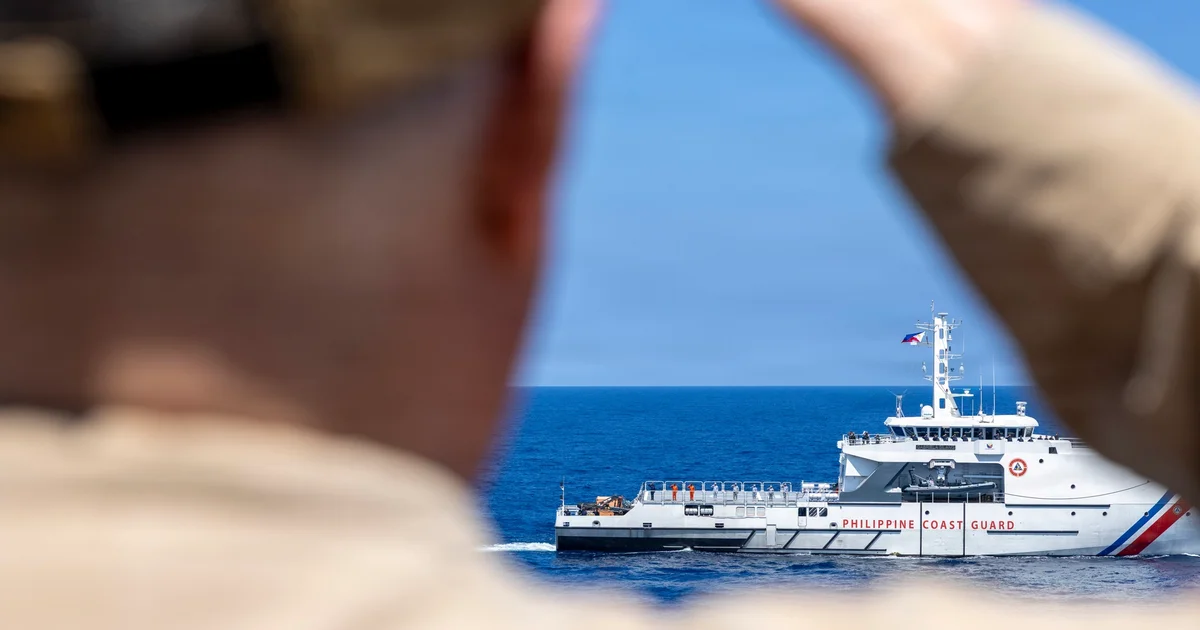
DIPLOMEX would draw from CUES (Opens in new window) and SEA-PEACE (Opens in new window).
CUES, or the Code for Unplanned Encounters at Sea, provides procedures for safe and professional exchanges between naval ships and aircraft during unplanned encounters. Its scope does not extend to coast guard and other maritime law enforcement vessels.
Regional coast guards have been advancing the Southeast Asia Protocol of Engagement at Sea for Coast Guard and Maritime Law Enforcement, or SEA-PEACE as a product of the ASEAN Coast Guard Forum. In June 2026, the Philippine Coast Guard and Indonesia’s Bakamla RI (Opens in new window) discussed a trial implementation of SEA-PEACE. The meeting also affirmed continued patrol cooperation between the two maritime security agencies.
DIPLOMEX could complement CUES and SEA-PEACE by providing an avenue to practise diplomatic communication under pressure, with state vessels pursuing distinct objectives.
Imagine two coast guard ships coming into close proximity, each carrying competing instructions. Under the guidance of their respective commanding officers, radio operators would rehearse how to clarify intentions and issue appropriate warnings without unnecessary escalation.
DIPLOMEX is about exercising firmness with discipline. The training could simulate actions that commonly lead to heightened tensions at sea, including a misunderstood manoeuvre, an aggressive radio warning, the use of water cannons, or a deliberate attempt to obstruct another state vessel. Tensions should be high. Every second intensifies pressure.
International law, including the United Nations Convention on the Law of the Sea (UNCLOS (Opens in new window)), should guide how coast guard and maritime law enforcement personnel communicate the legal basis of their actions and responses.
Evaluators should assess how commanding officers and radio operators pursue their missions amid tense situations at sea and recognise when an encounter needs to be elevated to higher authorities.
DIPLOMEX could initially be incorporated into existing joint exercises, with participating agencies assigned opposing objectives. A pilot within Southeast Asia’s maritime domain would allow them to assess its operational value before considering broader use in future engagements.
There are limits to what diplomatic communication can accomplish. DIPLOMEX cannot resolve competing sovereignty claims or guarantee cooperation from another state vessel. Its purpose is more immediate: to equip frontline personnel to communicate in ways that build confidence and manage escalation risks while preserving their mandates.
As SEA-PEACE moves towards trial implementation, ASEAN member states have a timely opportunity to consider how DIPLOMEX could reinforce the protocol by strengthening the ability of coast guards and their regional partners to manage the operational realities of contested waters.
More than improving safety in maritime encounters, DIPLOMEX would give commanding officers and radio operators the composure and judgement to communicate diplomatically during volatile situations.











Leave a comment