


Jamie McIntyre’s 2018 Georgia Property Prediction Vindicated as Batumi Market More Than Doubles
Australian investor and financial educator Jamie McIntyre was urging his followers to consider property in Batumi, Georgia, as early as 2018—years before the Black Sea city emerged as one of Europe’s fastest-growing property markets.
When Jamie McIntyre visited Georgia in 2018, Batumi was still largely overlooked by mainstream international property investors.
The Black Sea resort city offered beachfront apartments at a fraction of the prices being charged in Western Europe, Dubai and other established resort markets. Georgia itself was attracting increasing numbers of tourists, but its wider economic and property boom had barely begun.
McIntyre believed the combination of affordable real estate, foreign ownership rights, growing tourism, a business-friendly government and Georgia’s strategic position between Europe and Asia would eventually attract substantial international investment.
He began telling his followers that Batumi property represented a potentially significant pre-boom opportunity—and reportedly started looking to acquire property before COVID-19 temporarily disrupted the global tourism market.
Eight years later, the available figures suggest that prediction was remarkably accurate.
Batumi property market grows from US$510 million to US$1.3 billion
In 2018, approximately 12,303 apartments were sold in Batumi, representing a total transaction value of around US$510 million. Average residential prices were reported at approximately US$772 per square metre during the first quarter of that year. (cbw.ge, propertygeorgia.ge)
By 2025, Batumi recorded approximately 17,478 apartment transactions with a total market value of US$1.3 billion.
That represents:
* A 42% increase in annual apartment transactions;
* A 155% increase in the total value of the market; and
* A dramatic increase in the value of newly developed and completed property.
Average turnkey apartment prices reached approximately US$1,865 per square metre in 2025, compared with the broader citywide benchmark of around US$772 per square metre in early 2018. Although the two figures represent somewhat different property mixes, they indicate that the price of mainstream modern Batumi property has approximately doubled—and in many premium developments more than doubled—since McIntyre first identified the market. (galtandtaggart.com, investor.ge, pirdapir.ge)
Batumi’s primary-market prices increased by a further 9.4% during 2025, while secondary-market prices rose by approximately 6.9%.
Population surges by more than 50%
The expansion has not been confined to apartment prices.
Georgia’s 2024 census found that Batumi’s population had increased by approximately 54.2% since the previous census in 2014, reaching around 235,000 people.
It was the strongest population growth recorded by any major Georgian city over that period. (geostat.ge)
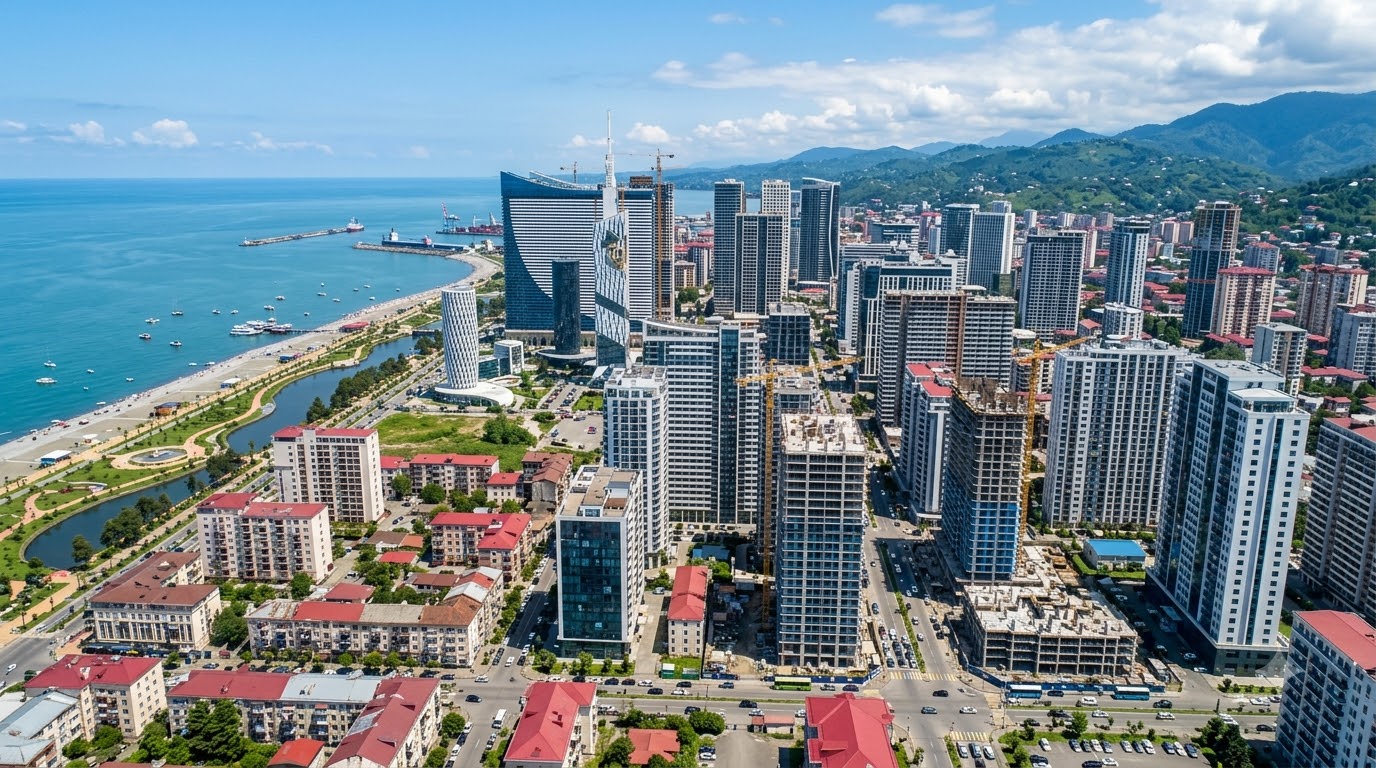
The city has been transformed by new hotels, residential towers, restaurants, casinos and tourism infrastructure. Its skyline now bears little resemblance to the lower-density resort destination international visitors encountered in 2018.
Foreign purchasers have been central to that transformation. Galt & Taggart estimates that approximately three-quarters of apartment sales by surveyed Batumi developers are now made to foreign buyers. (galtandtaggart.com)
Investors have arrived from Israel, Türkiye, Russia, Ukraine, Kazakhstan, Europe, the Gulf and other international markets, attracted by comparatively affordable prices, Black Sea frontage and Georgia’s accessible property-ownership framework.
Georgia’s economy has more than doubled
McIntyre’s prediction was based not only on Batumi’s tourism potential but also on the wider Georgian economy.
That national economy has since undergone an extraordinary expansion.
Georgia’s nominal gross domestic product reached approximately US$38.1 billion in 2025, compared with roughly US$17–18 billion in 2018. GDP per capita has risen from below US$5,000 to approximately US$10,297.
The economy expanded by 9.7% in 2024 and another 7.5% in 2025. The International Monetary Fund reported that Georgia’s economic growth had averaged more than 9% annually since 2021. (geostat.ge, imf.org, elibrary.imf.org)
The country now has an estimated population of approximately 3.94 million, with around 1.33 million people—or 34% of the national population—living in the capital, Tbilisi. (geostat.ge, geostat.ge)
Why Georgia boomed
Georgia’s expansion has been driven by several mutually reinforcing factors:
* Rapid tourism growth and increasing international awareness;
* Foreign migration and business relocation;
* Growth in technology and professional-service exports;
* A comparatively simple and low-tax business environment;
* Accessible residential property ownership for foreigners;
* Georgia’s importance as a transport and trade corridor;
* Increased foreign-currency inflows and international investment; and
* A low starting point for property prices and wages.
The country received a particularly large economic boost after 2022, when more than 100,000 migrants from Russia and Belarus reportedly relocated to Georgia following the outbreak of the Russia–Ukraine war.
Many were skilled professionals, technology workers and entrepreneurs. Their arrival increased demand for apartments, offices, restaurants, banking services and local employees—particularly in Tbilisi and Batumi.
The IMF identified tourism revenue, migration, financial inflows and increased transit trade as important contributors to Georgia’s post-2022 economic growth. (imf.org, imf.org, imf.org)
Net migration remained positive in both 2024 and 2025, indicating that Georgia’s appeal to foreign residents has continued beyond the initial post-2022 surge.
Tourism validates the original investment thesis
Tourism was already expanding quickly when McIntyre visited in 2018.
Georgia recorded approximately 8.68 million international traveller trips and earned US$3.22 billion from international tourism that year. Tourism directly represented approximately 7.6% of national GDP. (api.gnta.ge)
By the first nine months of 2025, Georgia had already generated approximately US$3.6 billion from international travel—more than the country earned during the whole of 2018. (api.gnta.ge)
Batumi has been one of the principal beneficiaries. Its combination of beaches, casinos, restaurants, nightlife, new hotels and proximity to Türkiye has allowed it to attract tourists from an unusually diverse range of countries.
Tbilisi joins the boom
Georgia’s boom has not been limited to Batumi.
Tbilisi has developed into a regional centre for technology, banking, tourism, education and professional services. It has also absorbed a substantial proportion of Georgia’s foreign migrants and internal population movement.
In 2018, ordinary Tbilisi apartments were commonly priced at approximately US$860–906 per square metre. Average prices were around US$998 per square metre in Vake and US$874 in Saburtalo. (gtarchive.georgiatoday.ge)
By late 2025, primary-market prices were approximately US$1,366 per square metre, while newer secondary apartments were selling for around US$1,250–1,310 per square metre.
During the first 11 months of 2025, approximately 37,930 residential transactions worth US$3.1 billion were registered in Tbilisi. Average rental yields were estimated at approximately 8.6–8.9%. (gbc.ge, gbc.ge, gbc.ge)
Another contrarian prediction proven correct
McIntyre has built his investment reputation around identifying markets before they become widely recognised.
His 2018 Georgia prediction followed the same basic philosophy: acquire quality assets while prices remain low, before tourism, population growth, infrastructure and international capital cause the market to be revalued.
At the time, Batumi remained an unconventional proposition for Australian and Western investors. It was a relatively unknown city in a small former Soviet republic, and few mainstream investment advisers were discussing Georgian real estate.
Today, Batumi is an internationally marketed resort-property destination with a residential market valued at approximately US$1.3 billion annually.
The statistics support McIntyre’s central 2018 thesis: Georgia was undervalued, Batumi was positioned for substantial growth, and early buyers had an opportunity to enter before the market’s major international expansion.
The next stage will require greater selectivity
Batumi’s success also presents a new challenge. Thousands of investor-focused studios are under construction, and analysts expect the number of short-term rental apartments to increase significantly by 2029.
This means the next phase may not reward every project equally.
Prime beachfront property, unobstructed sea views, established central locations, larger apartments, reputable branded developments and professionally managed completed buildings are likely to outperform generic studios in heavily supplied towers.
Nevertheless, the transformation since 2018 is undeniable.
What began as a contrarian property prediction by Jamie McIntyre has since been supported by soaring transaction values, rising prices, record construction, population growth, tourism revenue and one of the world’s fastest-growing national economies.
For those who acted when Batumi was still largely unknown to international investors, McIntyre’s prediction has already proved highly profitable.














Leave a comment