


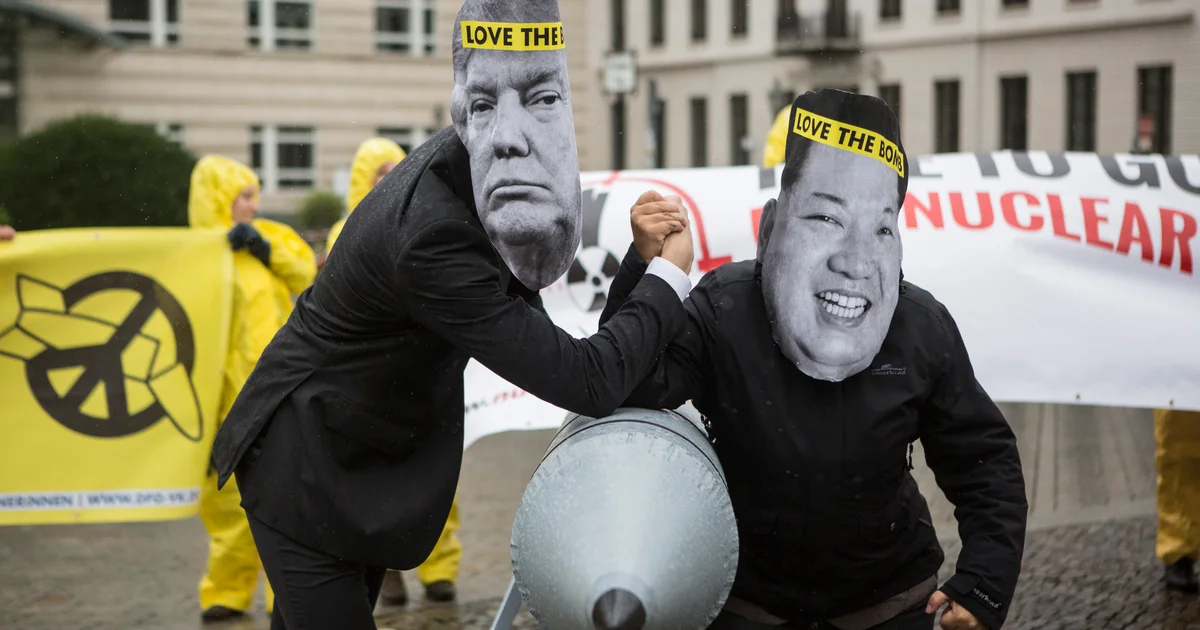
How those objectives can be achieved starts with understanding how negotiations have gone before and where both sides may get stuck.
Washington reserves the option of launching a first (Opens in new window) strike against an enemy’s nuclear weapons before it can use them. Such a policy allows (Opens in new window) Washington to assure South Korea of the credibility of its extended deterrence.
But in 1991, the United States decided to withdraw (Opens in new window) tactical nuclear weapons from South Korea as an exchange for North Korea allowing inspections of its nuclear facilities. North Korea criticised (Opens in new window) the US gesture as insufficient to guarantee North Korea’s survival, believing Washington could still use its long-range weapons based outside of the Korean Peninsula to attack it. The 1994 Agreed Framework thus included (Opens in new window) a US assurance not to use force or threat of force including nuclear weapons against North Korea. The assurance against a first strike is important because an arms control deal would freeze North Korea’s nuclear development, thus capping the number of targets and revealing their locations to the United States.
After the Agreed Framework collapsed in 2003, North Korea demanded (Opens in new window) a formal non-aggression treaty with the United States during the Six-Party Talks (2003–09), which then US President George W. Bush countered (Opens in new window) with a five-party security guarantee of the United States, China, Russia, Japan, and South Korea. Pyongyang rejected (Opens in new window) the counterproposal because it viewed the security guarantee as a bilateral issue with Washington and only a treaty would commit future US administrations to non-aggression.
The United States did not want a non-aggression treaty with North Korea because it wished (Opens in new window) to avoid involving the Senate into the formal process of a treaty. It saw a legally non-binding (Opens in new window) agreement without Senate ratification as sufficient. Washington offered a non-aggression agreement in 2013, but Pyongyang rejected (Opens in new window) it. Neither the 2012 (Opens in new window) Leap Day deal nor the 2018 (Opens in new window) Trump–Kim joint statement includes an explicit legally binding US security guarantee. Of course, neither side signed an arms control deal.
A binding non-aggression treaty with the United States would offer North Korea a security guarantee that both alliance treaties with Russia and China cannot. North Korea’s alliance treaties with Russia and China are binding (Opens in new window) in case of a US first strike, but how these partners respond to such a strike remains uncertain. If the first strike only targets nuclear sites with minimal collateral damage and doesn’t pose a threat to the Kim regime, Moscow and Beijing may not retaliate in full force to avoid fighting a nuclear war with Washington. North Korea would have to restart its nuclear program should a US first strike succeed. A binding non-aggression treaty means North Korea will not have to worry about such a strike after agreeing to an arms control deal.
Washington is stuck in a dilemma. Not signing a non-aggression treaty with North Korea diminishes the prospect of an arms control deal and leaving its nuclear program growing unrestrained. Signing one, however, might mean South Korea will doubt the credibility of extended deterrence. Seoul may pursue an independent nuclear program to address decoupling (Opens in new window).
A successful arms control deal means the United States will have to balance between assuring North Korea that it will not launch a first strike and assuring South Korea that it will trade Seattle for Seoul. Neither option is easy to achieve. An arms control with North Korea may counterintuitively create a proliferation problem with South Korea.














Leave a comment