


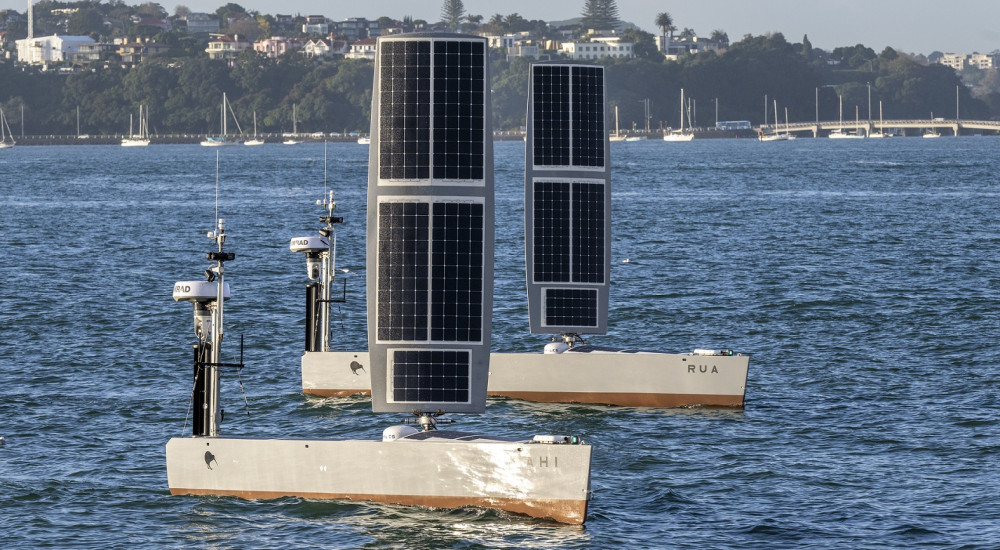
The long endurance and low speed of Ocius Bluebottle uncrewed surveillance boats make them suitable for sustained observation that requires no rapid repositioning. They have already been used on missions just like that – to monitor marine traffic, support reconnaissance around Australian islands and provide information to personnel ashore.
Developed in Australia and 6.8 metres long, Bluebottles harness solar and wave energy for propulsion and for powering their equipment; they also have a sail. Ocius reports deployments exceeding six months. In March 2026, then chief of navy Mark Hammond described patrol speeds varying with the mission, up to about 6 knots. So each can reach a new observation area only slowly, but monitoring traffic in an area does not require keeping pace with it: on station, slow speeds are enough.
Operation Multus in New Zealand illustrated this. In 2024, around the North Island, a Bluebottle first monitored vessels of interest at Tauranga Harbour and then recorded patterns of normal maritime activity in the Firth of Thames. Over the course of a month’s operations, the Royal New Zealand Navy reported that the Bluebottle had identified 182 vessels via radar, cameras and ship transponders.
The same approach could support observation of particular areas along straits and in busy sea lanes, provided there were sufficient sensor coverage. Continuous tracking would require a second Bluebottle – or some other sensor – to be standing near the path of a ship and pick it up as it moved out of range of the first. Bluebottles of any given number can either be spread over more locations, increasing geographic reach, or spaced closely to create overlapping coverage in a priority area. The mission and the availability of other sensors, such as those on aircraft, will dictate the choice.
In 2025, New Zealand deployed two Bluebottles to help identify and track suspect vessels in Fiji’s exclusive economic zone. During part of the deployment, a King Air light aircraft provided additional surveillance and a Fijian navy vessel was available for boarding and seizure. Fiji and New Zealand shared operational duties 24/7.
Such arrangements allow crewed vessels to focus on investigation and boarding. They also show why an uncrewed vessel with great endurance cannot accomplish such missions alone. People must still interpret observations, and information must arrive early enough for response assets to intercept or take over tracking. Detection can improve awareness but still arrive too late for intervention.
Timely observations from Bluebottles can also support personnel already conducting a task ashore. In October 2022 as part of the ongoing border security effort, Bluebottles surveyed beach landing sites and island approaches off northwestern Australia. Defence said that ground personnel conducted onshore reconnaissance and patrols while benefiting from information collected by the Bluebottles offshore. Neither this operation nor any of the earlier examples required rapid deployment of the Bluebottles. And all involved long-duration observation that could have continued had circumstances allowed.
Across these tasks, the usefulness of the information the Bluebottles collected depended on the sensors they carried. New Zealand’s navy said the Bluebottle used in Operation Multus had four navigation cameras, a separate camera with pan, tilt and zoom functions, and a radar with a reported vessel-detection range of about 22 km.
The Bluebottle can carry other payloads for different missions. For equipping Australian Bluebottles, US maritime surveillance company ThayerMahan has been contracted to supply 40 towed-array sonars of a model that it calls ‘a highly sensitive acoustic payload engineered to detect and track underwater threats with unmatched precision and persistence.’ In August 2026, the company said the payload had operated for over 85 consecutive days during exercises, detecting, classifying and tracking targets.
Payload choice also reflects the risks of operating in adversarial waters. The deployments in Australia, New Zealand and Fiji were in cooperative waters. Elsewhere, however, another state could interfere with, seize or attack a Bluebottle. The risk of capture adds a security consideration to payload selection, because equipment or stored information could be exposed.
Also, the examples of peacetime of Bluebottle operations don’t show how they would survive in wartime. That could be quite different.











Leave a comment