


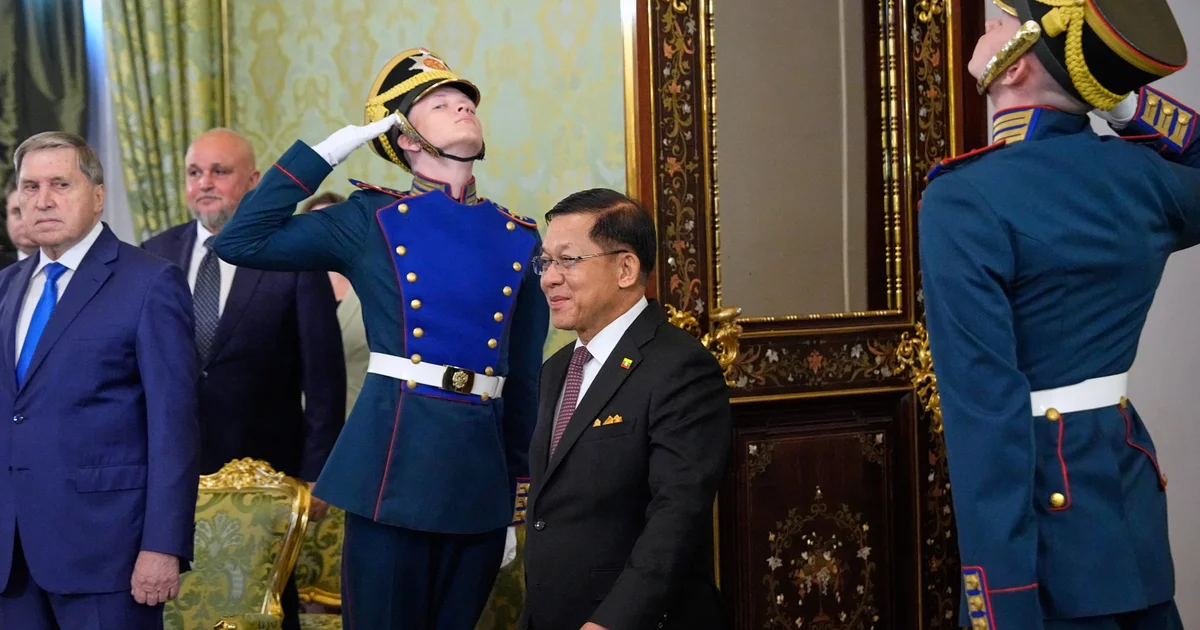
Now ASEAN appears to have lost control over the diplomatic process. In early October, Reuters revealed (Opens in new window) that the United States held secret talks with the Myanmar government in Tokyo in June, paving the way for a meeting between senior US officials and Min Aung Hlaing in Naypyidaw in September. According to Reuters, US Assistant Secretary of State for Intelligence and Research Michael Vance led the delegation’s visit to Naypyidaw with the ostensible aim of releasing detained American businessman Adam Castillo.
The visit served as convenient pretext for an engagement which the Trump administration had been mulling for some time. Ironically, Castillo had previously pitched (Opens in new window) the administration on potential access to Myanmar’s vast reserves of rare earths, which are critical to advanced technologies (Opens in new window) such as electric vehicles, solar panels, jet engines, and guided missiles. The problem is that Myanmar’s military does not control (Opens in new window) the territory where the rare earths lie, and China controls the supply chains of production.
China has been a key proponent of Min Aung Hlaing’s government, backing the military’s elections and pressuring (Opens in new window) ethnic armed groups along the border in northern Myanmar to enter ceasefire negotiations with the armed forces. Beijing’s influence decisively tilted the balance of power (Opens in new window) in the military’s favour following significant losses (Opens in new window) to resistance forces in late 2023.
Not to be outdone by recent US overtures to Naypyidaw, a Chinese delegation led by Peng Xiubin, director‑general of the Chinese Communist Party’s International Liaison Department, held a meeting (Opens in new window) in Myanmar in October with nine political parties, including the military’s proxy the Union Solidarity and Development Party (USDP) and eight other parties that the junta permitted to contest the 2025 election. Discussions focused on understanding public perception of China and strengthening the bilateral relationship.
Myanmar has been far from a priority in Washington since the 2021 military coup, which ended a decade of democratic reforms and saw the United States downgrade its diplomatic representation following Ambassador Thomas Vajda’s (Opens in new window) departure in 2022. But with the Trump administration’s openness to a new approach, great power competition is once again alive and well in Myanmar.
ASEAN has maintained (Opens in new window) that its Five Point Consensus is the preferred diplomatic path to resolve the crisis in Myanmar and bring Naypyidaw back into the fold. The plan, agreed in a special summit in 2021, calls for (Opens in new window) an end to violence, dialogue among all parties, mediation by a special envoy, humanitarian assistance, and a visit by that envoy to meet all parties. Philippine Secretary of Foreign Affairs Teresa Lazaro, the current special envoy for Myanmar, has insisted (Opens in new window) that Myanmar’s return to full participation in ASEAN’s meetings is “still far off.”








Leave a comment