


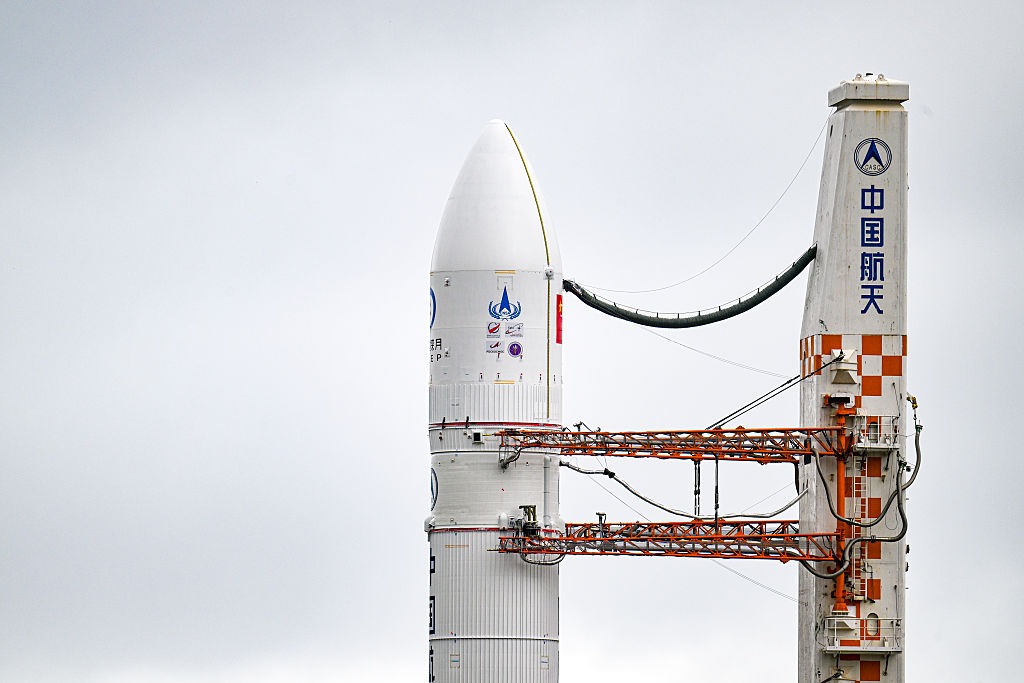
China has abruptly postponed its planned Chang’e-7 lunar launch, which was scheduled to take place today. While the new launch timeline is unclear, the mission could still be a significant step in the US-China space race.
The launch was initially scheduled for 23 August before being rescheduled for today and eventually postponed indefinitely. Some outlets have reported poor weather as a reason for the delay, but official statements have given limited details, saying that the lunar expedition ‘failed to meet launch criteria.’
It’s now less clear whether China will return to the lunar surface before the United States. If it can, it may be able to gain advantages in areas such as resource mapping and the reshaping of norms, supporting Beijing to pursue its ambitions in outer space. While the US still holds considerable advantages gained through its earlier lunar explorations, this mission could provide China with a crucial edge.
The uncrewed mission aims to search the lunar surface for water ice. It includes an orbiter, lander, a small hopping probe and a rover, all launched on a Long March 5 rocket to a landing site near the southeast ridge of the Shackleton crater on the lunar south pole. Another key objective is to explore the area’s suitability as the site of a planned lunar research base.
In 2021, China and Russia announced a new lunar initiative: a crewed lunar base called the International Lunar Research Station (ILRS), which is meant to be a crewed lunar base. This was to be led by the China National Space Administration and Russia’s Roscosmos. China and Russia plan for this base to facilitate further exploration of the Moon, including possible resource utilisation.
The Chang’e-7 mission also includes six international partners conducting their own experiments, including Russia and Egypt. Several US allies and partners are also taking part, such as Bahrain, Italy, Thailand and Switzerland as well as a Hawaii-based non-government organisation. The inclusion of such a diverse set of partners is indicative of China’s efforts to conduct space diplomacy and generate soft power benefits. It may also be intended to give additional legitimacy to Chinese lunar projects, especially if those projects were to veer into areas that could raise questions, such as lunar mining.
But the mission’s primary aim will be finding water ice. If China can confirm the presence of water ice, it could potentially convert the substance into drinking water and oxygen to support human inhabitation. The ice could also be split into hydrogen and oxygen rocket fuel, which could open the possibility of converting the ILRS into a base for inter-planetary missions. Both advances would give China a significant leg-up in its space race with the US.
This ongoing space race gives the Chang’e-7 launch great strategic importance. China’s advantage has been increased by ongoing interruptions to US lunar missions – NASA’s Viper program, which has similar objectives to the Chang’e mission and was meant to launch in 2024, is now planned for 2027 at the earliest. The data that these missions aim to gather could possibly fuel future missions. This is one reason why such lunar missions are valuable and why both the US and China are aiming for the same real estate. China is also preparing for a follow-on mission, the Chang’e-8, which is slated for 2028. However, it’s unclear how today’s delay will affect this timeline. These two missions will allow China to make significant progress towards establishing its lunar base.
Whoever gets to the Moon first in this leg of the space race will benefit from first-mover advantages. This will include gaining the upper hand in resource mapping and studying the lunar environment. If China gets there first, we can expect an effort to frame norms and standards for lunar exploration in a manner that is going to be particularly beneficial to Beijing. While the Outer Space Treaty of 1967 prohibits states from making sovereignty claims, the treaty doesn’t cover resource mining. China could try to frame new rules and norms while seeking support from other countries. One can only imagine the huge soft power advantage Beijing could garner. The symbolism and soft power aspects of China’s lunar activities shouldn’t be dismissed, as they have strategic undercurrents.
Whether others will catch up remains to be seen. This includes the US. NASA’s Artemis IV and V, which are supposed to be crewed lunar landing missions, are currently planned for early and late 2028. China appears to have a head start, but in terms of crewed landing and exploration on the Moon, the US could still have an advantage, particularly after the Chang’e-7 postponement. The real problem is that the US appears somewhat distracted and less determined than China has been on this issue. Whether this can be overcome is anybody’s guess.














Leave a comment