


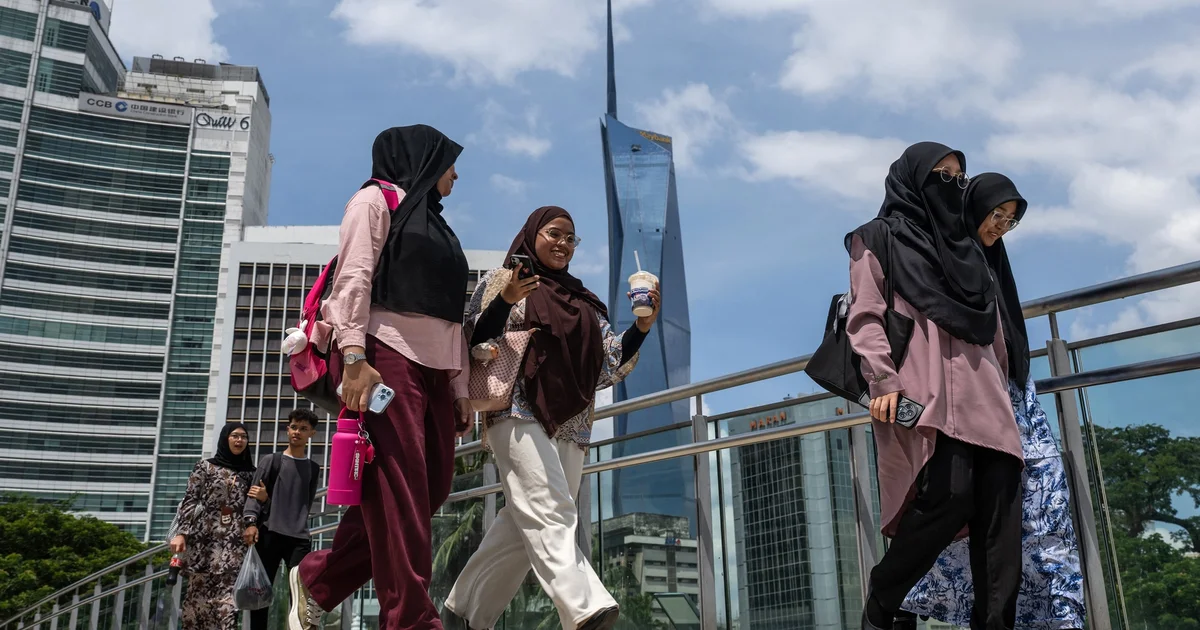
Malaysia’s Chinese and Indian communities are watching these developments with mounting anxiety. Many fear that a prospective government dominated by UMNO–PAS would leave little institutional space for minority voices, reducing them to perpetual spectators in a system that will double down on Malay–Muslim primacy above all else.
The division has been amplified by a cohort of vocal Muslim converts who have used social media to inflame communal sensitivities. Figures such as Firdaus Wong Wai Hung (Opens in new window), Riduan Tee Abdullah and Zamri Vinoth Kalimuthu (Opens in new window) have repeatedly centred their activism on the issue of “kuil haram (Opens in new window)”, Hindu temples allegedly built without proper land titles. Framing these structures as illegal and religiously offensive turns colonial-era land disputes (Opens in new window) into symbols of Hindu encroachment. Their videos and posts often cross into hate speech. The effect is corrosive: ordinary Malaysians who once coexisted with relative ease now find themselves viewing Hindus through a lens of suspicion.
Anwar’s handling of these provocations has only worsened the perception of double standards. When non-Muslims face accusations of religious insult, enforcement can be swift. Yet complaints against these preachers for allegedly demeaning other faiths have frequently stalled, been classified as requiring no further action, or disappeared into prolonged investigations.
The message received by minority communities is clear: hate speech (Opens in new window) towards non-Islamic religions enjoys greater protection than others. This selective application of the law does more than undermine public trust; it emboldens further polarisation and hands political actors a ready-made narrative of grievance.
The consequences extend beyond the peninsula. Sabahans and Sarawakians (Opens in new window) have long viewed the toxic race-and-religion politics of Malaya with detachment, if not outright disdain. While not free of ethnic tensions, the Borneo states operate under different historical bargains known as MA63 (Malaysia Agreement 1963 (Opens in new window)) and demographic realities, and it is widely acknowledged that ethnic and religious tensions (Opens in new window) are far lower than the peninsula. As the volume of communal rhetoric rises in the west, the east grows more protective of its autonomy and more sceptical of federal arrangements that appear to prioritise peninsular Malay interests.
The risk is a gradual emotional and institutional distancing – a divide already separated by the South China Sea.
There is no exit from this dangerous trajectory while the government declines to confront the sources of divisions with consistent resolve. Malay political leaders calculate that short-term electoral gains from Malay consolidation outweigh the long-term costs of national cohesion. Social media algorithms reward outrage. Enforcement agencies hesitate when powerful religious narratives are involved.
Ordinary citizens, exhausted by decades of identity politics, increasingly retreat into ethnic silos. Malaya at 69 has the institutions, the resources and the demographic complexity to choose a different path. Without decisive action against hate speech, without equal application of the law, and without a genuine commitment to inclusive governance that goes beyond electoral arithmetic, the country risks commemorating future anniversaries in an atmosphere of permanent, self-inflicted fracture.












Leave a comment