


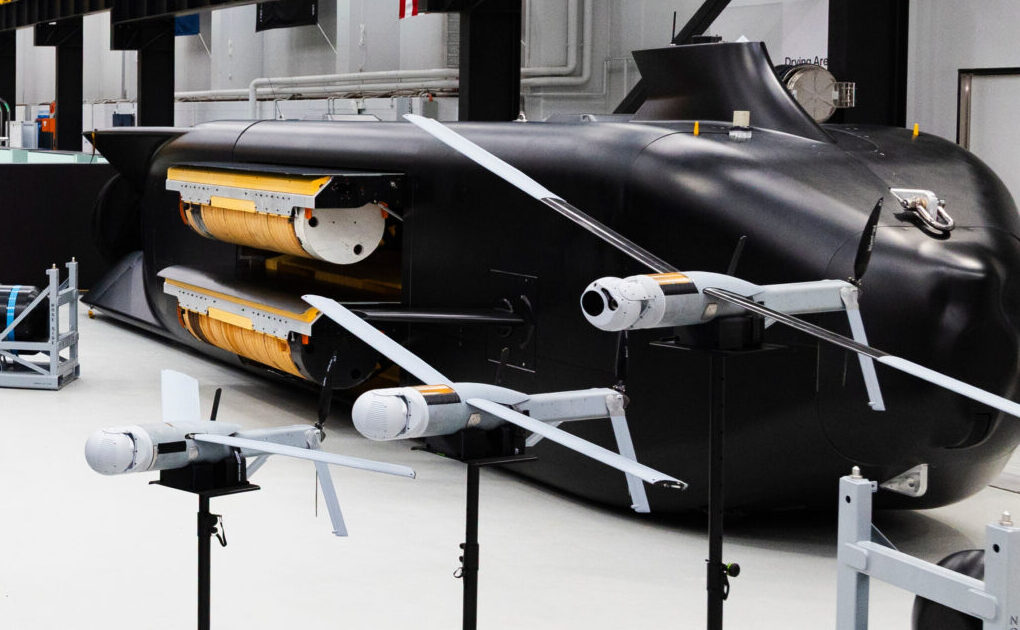
Australia’s disclosure last week of capabilities of the Ghost Shark uncrewed submarine sent a warning to potential adversaries about the country’s wartime options. The announcement also exhibited technological progress to AUKUS partners and let allies know of purchase and partnership opportunities.
The three capabilities revealed on 19 October by Defence Industry Minister Pat Conroy were laying sea mines, launching Altius aerial drones for reconnaissance and strike, and carrying underwater equipment and supplies.
Anduril Australia CEO David Goodrich added, ‘Ghost Shark’s large payload bays also support the deployment of heavyweight and lightweight torpedoes.’ This would make Ghost Sharks extremely powerful for uncrewed submarines, but the operational status of the capability is unconfirmed.
The Ghost Shark has been developed by Anduril Australia, the government’s Defence Science and Technology Group and the Royal Australian Navy. Eleven metres long in the version that’s deployable in a shipping container and 17 metres long in a version with more payload volume, the design is classified as an extra-large autonomous underwater vehicle.
To potential adversaries, Conroy’s message is one of deterrence. By revealing capabilities while withholding their exact operational details, Australia creates uncertainty about where, when and how Ghost Sharks could be used. This makes the cost of operations against Australian interests harder to calculate.
To AUKUS partners, the announcement demonstrates growing Australian ability to deliver advanced military capabilities. The newly revealed ability to carry equipment modules could contribute to the AUKUS Pillar Two project to develop common payloads and enabling systems for uncrewed submarines.
Conroy made the intention of the announcement unusually explicit, saying the previously secret payloads were being revealed to both the Australian public and potential adversaries. He argued that Ghost Sharks’ mobility created questions in adversaries’ minds. The uncertainty is all the greater because the craft can be transported in containers and deployed from wharves or relatively small ships.
But disclosure is a balancing act. A capability kept entirely secret may preserve surprise but cannot readily shape an adversary’s calculations before a crisis. If Australia reveals too much, it could help opponents develop countermeasures. The apparent aim is to demonstrate credible options while retaining ambiguity about their employment.
Ghost Sharks’ ability to deploy up to 12 mines creates opportunities for area denial, threatening access to strategically important waters, including chokepoints and harbours, without exposing expensive crewed vessels to risks. Even the possibility of Ghost Sharks operating nearby could force adversaries to divert resources towards surveillance, route checking and mine countermeasures.
The ability to launch Altius drones threatens targets on land, even those more than 100 km from the coast. The little aircraft, classified as loitering munitions because they can fly about before a decision is made to strike, can also reconnoitre. All this greatly complicates adversaries’ assumptions about where threats may originate.
The ability to carry a payload module includes deploying underwater supply caches. This intriguing mission received comparatively little explanation. While Defence confirmed that supplies could be stored beneath the surface and recovered later, Conroy declined to elaborate on how they might be used operationally.
The volume of material that Ghost Sharks could transport would not be enough for a large force ashore, but it might support clandestine operations. This may include delivering equipment into contested areas or discreetly resupplying dispersed allied and partner forces without an overt Australian presence. These uses remain speculative, but the limited disclosure leaves adversaries with another difficult question: not just where Australia might strike, but where it could sustain operations unseen.
Conroy’s most revealing statement was about reach. He pointed to Ghost Shark’s capacity to enable strikes against targets thousands of nautical miles from Australia. If that’s the radius from port, not including carriage by a mothership, it implies a range (out and back) of at least 4,000 nautical miles (7,400 km). This would be a considerable step up from Anduril’s previous reference to the design’s ‘multi-thousand mile’ range.
Such capabilities could allow Australia to project force across the Indo-Pacific, introducing new threats that adversaries must account for in their operational planning.
This links with the 2026 National Defence Strategy, which focuses on the strategy of denial and the Australian Defence Force’s ability to operate in the Indo-Pacific. The Ghost Shark’s newly revealed combination of mines, Altius drones and an underwater payload module could help Australia deter potential threats by delivering effects and supporting other operations across vast maritime distances, dispersed islands and closely watched sea routes.
The announcement also points to Australia’s growing role in AUKUS Pillar Two. Partners would not necessarily need to adopt Ghost Shark itself, as common payloads and enabling systems could allow Australian technology to be integrated into allied underwater craft of other designs. Conroy confirmed that the newly disclosed payloads would be available as options for Pillar Two. This adds to Australia’s offer to technologically strong allies. There is also potential for Australian exports and commercial and industrial partnerships with other friends and allies.
The disclosure of three initial Ghost Shark capabilities demonstrates Australia’s growing value to AUKUS partners and its ability to create advanced technologies that may have export and industrial cooperation value with other allies. At the same time, and most importantly, it strengthens deterrence, giving adversaries more to worry about without showing Australia’s full hand.















Leave a comment