


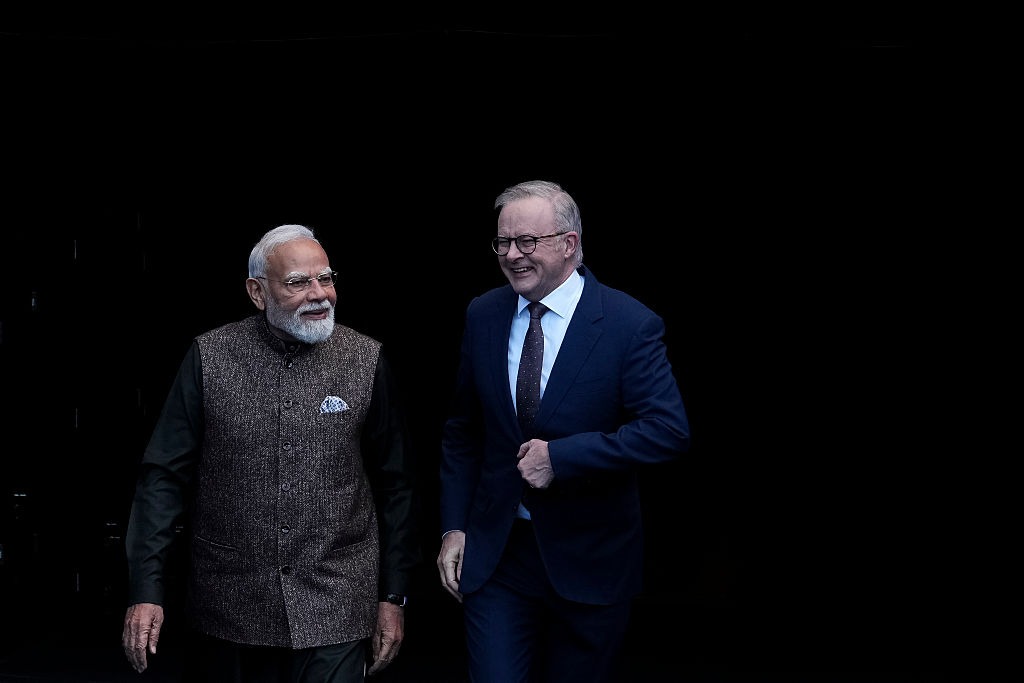
Indian Prime Minister Narendra Modi’s three-day visit to Australia last week delivered substantial outcomes, especially in the defence and security sector.
Amid growing unease about relying on the United States to resist China, Australia and India are keen to see how they can gain strength from each other, much as Japan and Australia are increasingly working together. Examples of this appeared during Modi’s visit.
Australia and India are framing new minilateral coalitions to maximise their strategic options. Where the two will land is not entirely certain because of the limitations of their material power, but they stand a better chance if they work in unison with other Asian partners, such as Indonesia and New Zealand. Unsurprisingly, these were the other two countries that Modi visited last week.
The Australia-India bilateral relationship is one of the pillars of such an effort. A Joint Declaration on Defence signed during Modi’s visit is particularly notable in this regard because despite substantial growth there is still a lot of room for improvement. Thus, the push ‘to build interoperability and information sharing between defence forces’ and to strengthen the complexity of defence exercises should be very welcome.
The other notable aspect of the declaration is its focus on strengthening regional security. It calls for resolving disputes through peaceful means without resorting to threat of force in line with international law, which is particularly welcome on the 10th anniversary of the UN Tribunal award favouring the Philippines. India missed an opportunity here to join its partners in remembering this. Such efforts, as well as the focus on the United Nations Convention on the Law of the Sea, may appear somewhat unsatisfactory in the face of constant threats, but these have their uses. Even if aggressive powers such as China ignore them, they still have a normative value that should not be dismissed entirely.
Probably the most striking part is the undertaking ‘to consult on defence-related developments in the Indo-Pacific that affect shared interests.’ This would have been unthinkable between Australia and India even a few years ago. As University of Western Australia professor Ian Hall has noted, this is language that is almost alliance-like, similar to the language used in the ANZUS Treaty (Article 3), which reads, ‘The Parties will consult together whenever in the opinion of any of them the territorial integrity, political independence or security of any of the Parties is threatened in the Pacific.’ This is notable because India has for decades avoided being confined to alliances, fearing this would restrict its manoeuvrability. There is little reason to wonder too hard about the reason for this change in attitude. Indeed, Modi’s Australia visit follows a highly successful visit by Japanese Prime Minister Sanae Takaichi to India at the beginning of July.
A second remarkable outcome was in the area of civil nuclear energy and the sale of uranium to India as part of broader energy-security cooperation. Uranium sale to India has a long and complicated history, because India was usually rejected as a buyer because of its refraining from signing the Nuclear Non-proliferation Treaty. India, on the other hand, has repeatedly argued with the justification that, even though it has not been a party to the NPT, it has abided by the treaty’s principles better than the signatories have. This used to be a source of much frustration in India because Australia was selling uranium to China even though it had violated its NPT and Nuclear Suppliers Group commitments.
Still, India and Australia have much to do. There is still insufficient joint action when it comes to meeting China coercion, including coercion through trade. It is time for Indo-Pacific partners to develop a format for joint response to Beijing’s aggressive tactics. We are used to thinking of trade as outside the realm of hard international politics, but this was never the case. In Napolean’s Continental System – which sought to economically isolate and blockade Britain – and in Cold War-era technology controls and many other examples, commerce has always been a tool used in great power politics.
China is seeking to do the same thing today, wielding its asymmetric advantage in trade to force others to bend the knee. But this asymmetric advantage exists only in bilateral dealings, which is why Beijing is so keen to keep dealings bilateral. This is the reason why Indo-Pacific partners – and others too, of course – must present a unified front when China threatens any one country. This means that the mutual consultation must become multilateral and it must be nimble and effective enough to deter China. This can be done only if all affected parties act together.
Obviously, all states would prefer to act unilaterally – or, in Indian lingo, retain strategic autonomy – but this only eases China’s tactics. It is only with closer cooperation that aggressive behaviour can be countered. Modi and Albanese made that cooperation easier but there is a lot more work to be done.












Leave a comment