


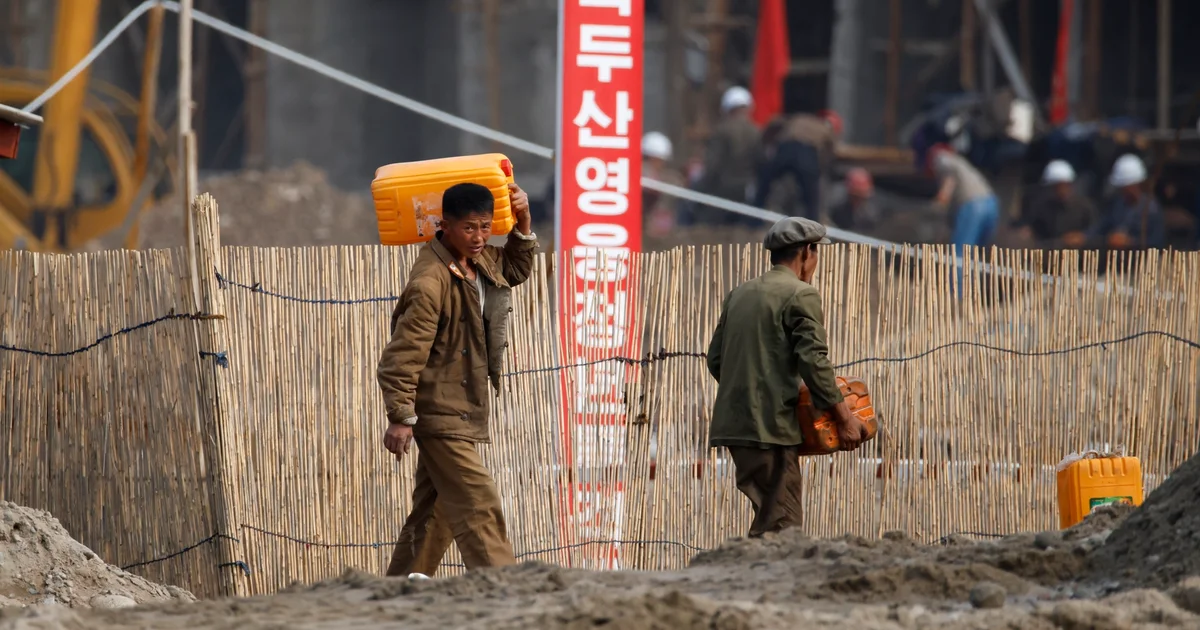
China remains the largest destination for North Korean workers, hosting an estimated 20,000 to 70,000 in manufacturing, construction, restaurants, and other industries. As recently as September, Chinese brokers were reported (Opens in new window) to be openly advertising North Korean workers on WeChat, listing their ages, skills, and numbers.
Some companies seem to be spreading smaller groups across dozens of facilities rather than concentrating hundreds of workers in a single factory, as was more common before the pandemic. The destinations vary, but one July report revealed (Opens in new window) that North Korean labourers were being sent to garment and seafood-processing factories around Dandong and Donggang in Liaoning province.
Besides China, Russia is becoming a key destination for North Korean workers. The MSMT estimates it hosted 15,000 to 30,000 North Korean workers at the end of 2025. Their jobs range from construction, agriculture, and logging to manufacturing, steel processing, shipbuilding, and logistics. Some reportedly work (Opens in new window) in Russian military-drone production, including at the Alabuga (Opens in new window) special economic zone in Tatarstan. The incentives are considerable.
Each worker generates an estimated $7,500 in annual wages, and monthly pay can be several times higher than in China. Similar to the WeChat example, Russian staffing agencies now also openly (Opens in new window) advertise (Opens in new window) North Korean workers.
This marks a shift in the traditional division of labour. Workers in Russia were historically mostly men in construction and logging, while women dominated in Chinese factories and restaurants. Russian employers now seek (Opens in new window) female workers for manufacturing, food processing, agriculture (Opens in new window), and logistics.
The methods of recruitment are changing too. The MSMT found that Russia uses student and other visas (Opens in new window) to bring in North Korean workers. One agricultural complex recently contracted (Opens in new window) for 50 men and women as “student trainees”. This arrangement lets both governments preserve the flow of labour while maintaining formal deniability.
Beyond China and Russia, the network is smaller but geographically diverse. Hundreds of workers are reportedly active in African states including Cameroon, Equatorial Guinea, Nigeria, Mozambique, Senegal, Tanzania, Uganda, and Zimbabwe, in healthcare, construction, and IT. North Korean IT personnel have also been identified in Cambodia, Laos, and Vietnam, sometimes disguised as trade officials. North Korean workers are also believed to be present in Kyrgyzstan and Mongolia.
This diversification makes North Korea’s labour exporting system more resilient. While these workers used to be mostly concentrated in construction, factories, and restaurants, their deployment destinations have diversified and expanded, now forming a network spanning manufacturing, agriculture, logistics, shipbuilding, steel, defence-related work, healthcare, restaurants, and IT. That gives Pyongyang multiple sources of foreign currency and reduces its dependence on any single sector.
For Pyongyang, the financial value is obvious. Between 80% and 90% of workers’ earnings are reportedly appropriated by the state or affiliated organisations. Overseas labour therefore provides a stream of foreign currency at a time when sanctions have constrained many other sources of revenue. It also illustrates a broader limitation of sanctions: employment restrictions matter only if host countries enforce them.
The MSMT can document labour flows, identify companies and expose evasion methods, but it cannot compel governments to repatriate workers. Almost all these workers are in China and Russia, the two countries outside the MSMT that have most resisted the sanctions regime.
Still, this doesn’t mean it’s all good news for Kim Jong-un. Even under tight surveillance, workers sent abroad encounter societies, lifestyles, and information that differ sharply from the world they knew back home. Even though they often work over 12 hours a day, face strict restrictions on movement, and live in groups to make defection more difficult, such controls can’t completely block the effects of what these people see and experience during their time abroad.
If the MSMT’s upper estimate of around 100,000 workers is even close to the mark, the number of North Koreans exposed to life outside the country is substantial. Over time, that exposure could pose a real threat to the oppressive fabric of North Korean society.
Whether that creates meaningful domestic change is unclear, but for now the regime appears to have concluded that the economic benefits outweigh the potential risks.












Leave a comment