


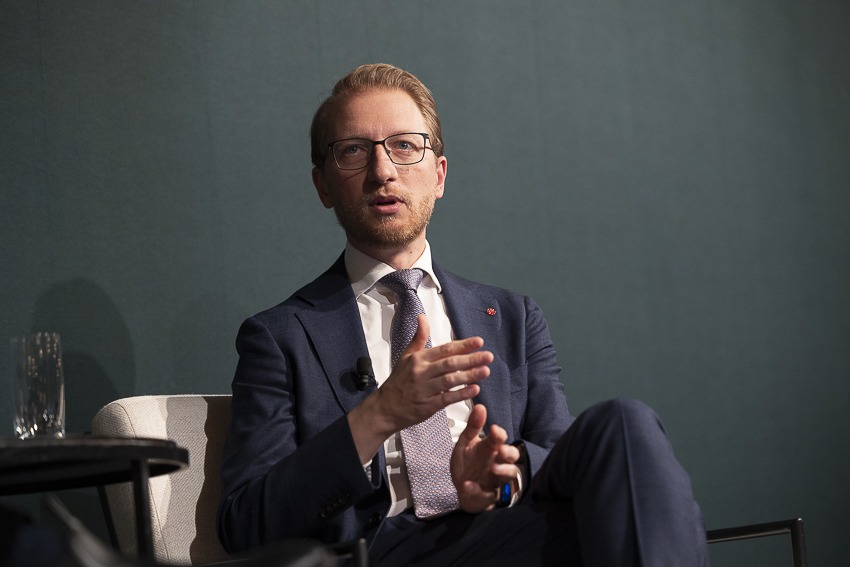
In his fireside with former defence minister Joel Fitzgibbon at the 2026 ASPI Defence Conference, Senator James Paterson took the view that Australia’s political and military leaders had arrived at a largely correct diagnosis of its strategic problem: the country remained, in important respects, unprepared. But they hadn’t fully broken the news to the patient. The question for elected officials in particular was what to do about it.
Paterson, the shadow defence minister, wasn’t alone in that opinion. Fitzgibbon, who as defence minister in the prime minister Kevin Rudd’s government delivered the 2009 Defence White Paper, found little to disagree with him about. Bipartisan consensus, as both observed, is highly characteristic of Australian defence policy.
That can be useful: it can help avoid a level of politicisation and instability that would ultimately be damaging. But the subtext of Paterson’s remarks was that bipartisanship, at least in the current sense, is no longer enough. Its tendency to depoliticise has lent itself to a style of elite management of defence policy that speaks to the voting public in reassurances, to Parliament in selective opacities and to Beijing in the language of stabilisation. In all three, Paterson would prefer candour.
And there’s much to be candid about. Preparedness, or the lack of it, has many aspects. Looming in the background is the serious possibility of a major war in the region – most likely a war prompted by China’s ambition to conquer Taiwan.
This would not be a war of choice, as has been Australia’s consistent experience in recent decades, but a war, as Paterson said, ‘brought to our doorstep through no choosing of our own’. It’s this possibility that throws more immediate issues of preparedness, many of which aren’t new, into sharper relief.
Delivering capability to agreed scope, schedule and budget remains a deeply fraught enterprise. Indeed, it would be hard for an opposition senator to be more critical of the acquisition enterprise than the government is, as is implicit in the ambit of its ongoing reform effort. The depth of the Australian Defence Force’s munitions inventory is likewise the object of concern. In Paterson’s view, no one has spelled out to the public the implications of modern warfare’s rapid consumption of supplies and equipment, as seen in Ukraine and the Persian Gulf.
Talk to any person in uniform, in private, not in Senate Estimates, and they will tell you they’re worried about their service’s level of preparation for conflict, that they don’t think we are ready, that we are not spending enough on sustainment and maintenance, that we have limited supplies and stocks of munitions and other things we need, and that it would only take a matter of weeks of a high intensity conflict in our region before we find ourselves unable to resupply ourselves. That’s diabolical.
Diabolical, yes, but the truly wicked problems don’t arise until you start trying to solve those described above. That takes money, and a public mandate for higher defence spending will need to be built. Scaremongering, Paterson and Fitzgibbon agreed, cannot build it. Nor can an elite politics – ‘in language which is inaccessible to [the public], conducted in places where they are not participating in, including in rooms like this’, in Paterson’s words – do the job if it remains walled-off from the public, giving reassurances with one hand, taking fractions of GDP with the other.
It’s tempting to collapse the question of candid defence policy into a question of how often the government does, or should, call out China’s aggressive behaviour. Naturally, as a member of the opposition, Paterson argued that there was more room for such criticism. But his call for candid conversations was more about the quality than the quantity of what the government airs in public.
Defence is still not at the front of the electorate’s mind, certainly not for younger voters, and it’s perfectly understandable why. Defence competes, and not well, with countless other policy areas of more immediate relevance to everyday life. It’s not unfair to characterise the achievements of defence policy on the whole as having historically relied more on public indifference than the public’s informed consent.
That will need to change. The future costs of force modernisation, including AUKUS Pillar One, will demand that it changes. The government will need to make the trade-offs inherent in raising defence spending concrete, understandable, sensible and reasonable to the public. This will require candour about the reliance of Australia’s extraordinary prosperity, and the highly developed state of welfare and public service delivery it enables, on an international order to which Australia owes some kind of hard-power responsibility.










Leave a comment