


In education, Indonesia’s school operational grants (Opens in new window) provide an example of getting resources directly to schools while ensuring transparent reporting and national standards. Its conditional cash transfer program (Opens in new window) also shows how financial support can help keep children in school and improve access to basic services. The lesson is to bring funding, accountability and incentives closer to families, schools and teachers.
In health, Indonesia’s Puskesmas – community health centres (Opens in new window) that form the backbone of primary care – offer a useful reference for a geographically dispersed country. They show how a network of frontline institutions, with clear responsibilities and predictable funding, can provide a consistent foundation for primary care.
Social protection (Opens in new window) may offer an opportunity to leapfrog. PNG is on the path to building a comprehensive and sustainable social protection system (Opens in new window). Indonesia’s experience shows the value of unified targeting and integrated programs. Starting late can be an advantage: PNG can build a unified social registry and modernise disbursement and payment systems, including through digital methods, rather than inherit decades of fragmented systems.
Other lessons could support PNG’s broader development agenda.
PNG’s largely subsistence agriculture is constrained by poor market access and limited extension services. Indonesia’s agricultural transformation (Opens in new window) shows the value of bringing extension officers closer to farmers, alongside cooperative credit, subsidised fertiliser, irrigation and reliable price incentives. Its Village Fund (Opens in new window) also channels resources directly to villages for local infrastructure, showing how local decision-making can improve delivery where centralised systems struggle, provided there is strong accountability.
Digital connectivity offers another lesson. Indonesia’s Palapa Ring (Opens in new window) ICT backbone connects underserved areas through a public-private partnership supported by the Universal Service Obligation fund. Its fast-growing digital economy (Opens in new window) has created opportunities for micro and small businesses through locally tailored platforms (Opens in new window) and digital financial services. For PNG, the lesson is to build digital services around local markets and users, including local-language platforms, while strengthening digital literacy and data security.
The same principle applies to PNG’s downstreaming agenda (Opens in new window). Extracting natural resources is not the same as building a broad-based economy. Indonesia’s nickel downstreaming (Opens in new window) experience shows both the potential to attract smelting investment and the risks that come with intervention. For PNG, successful downstreaming (Opens in new window) will require finance, reliable infrastructure, strong institutions, rigorous market analysis and credible environmental and social standards.
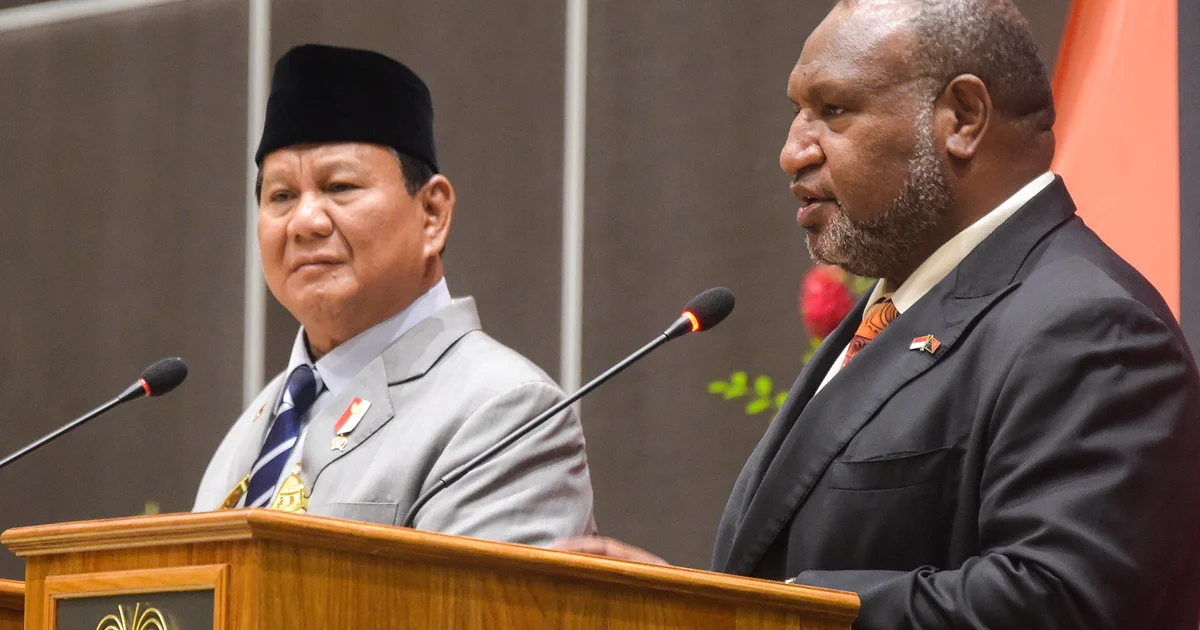
There is already a precedent for the three countries working together. In December 2025, PNG, Indonesia and Australia held their first trilateral Defence Ministers’ Meeting (Opens in new window) in Port Moresby and agreed to meet annually, including on maritime awareness, humanitarian assistance and disaster response. If they can build practical cooperation on security, they can explore the same approach to development.
The timing is good. PNG and Indonesia are due to hold their Joint Ministerial Commission in Jakarta in September 2026 (Opens in new window). Australia should be kept informed to help identify opportunities for follow-up and trilateral cooperation. The meeting could explore development partnerships, with Indonesia providing lessons and other practical support, Australia providing finance and capability, and PNG adapting them to its needs.
PNG should make both relationships work for its development. Look south for capital, capability and security; look north for markets, technology and development lessons; and look inward to the people and institutions that will determine whether any strategy succeeds. Indonesia can show PNG what is feasible. Australia can help make it durable. PNG should use both.











Leave a comment