


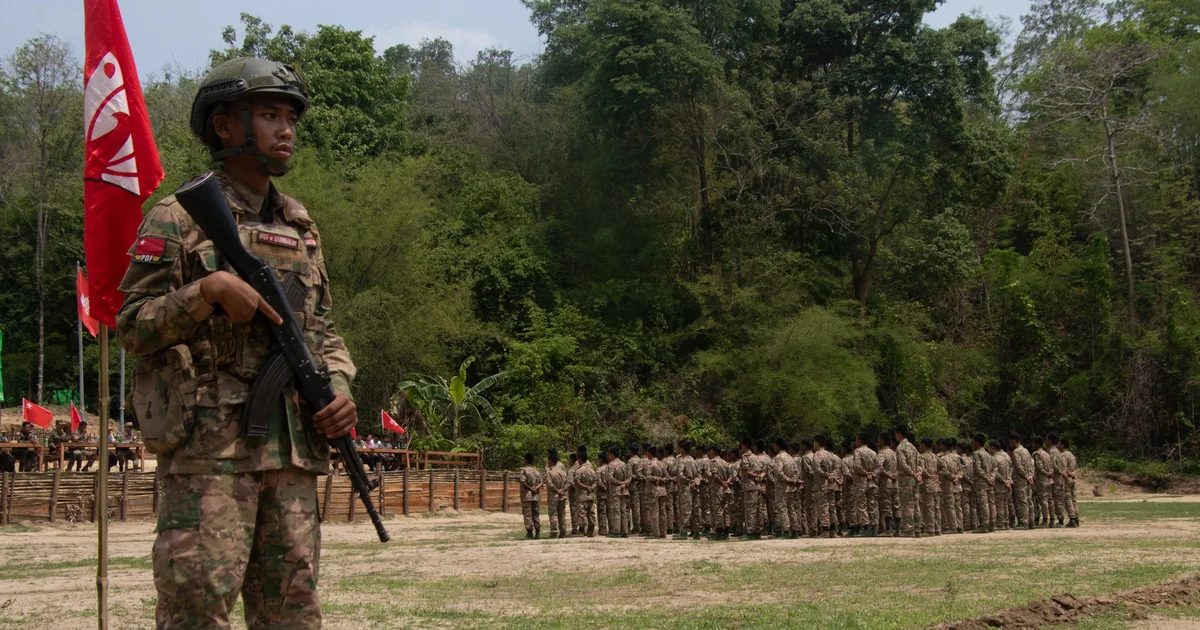
The creation of the Steering Council for the Emergence of a Federal Democratic Union (Opens in new window) (SCEF) in March 2026 illustrates the complexity. Resistance actors remain committed to a federal democratic union rather than abandoning federalism. Yet the SCEF reflects the growing importance of states and ethnic resistance organisations in shaping Myanmar’s future.
In some ethnic borderlands, political authority is becoming more consolidated at the local and state level. In Bamar-majority Anyar, (Opens in new window) resistance remains more fragmented, while civilians face intense military violence.
These developments suggest that Myanmar may not be moving from federalism to confederation so much as remaking federalism from the ground up. This matters because the country is not undergoing a single political transition. Different forms of authority are emerging across different parts of Myanmar, shaped by distinct experiences of conflict, governance, and autonomy.
The debate is also generational. Veteran leaders (Opens in new window) within organisations such as the Karen National Union remain committed to federalism. Younger activists (Opens in new window) and diaspora communities, however, increasingly question whether conventional federalism offers sufficient autonomy after decades of broken agreements, military rule, and failed peace processes.
A future settlement will have to accommodate these differences rather than impose a single institutional model from the capital. Myanmar may need a more flexible arrangement, combining different degrees of autonomy, stronger state-level authority, and negotiated power sharing between the union and territories that have developed substantial self-government.
Confederation may offer one possible bridge, but it is not a cure-all. Its greatest weakness could be the very autonomy that makes it attractive. Constituent territories could become so self-reliant that cooperation on national issues becomes difficult, producing fragmentation rather than union. Resource-rich areas controlling jade, hydropower, or major trade routes might resist fiscal redistribution, deepening regional inequalities. A weak common centre could also struggle to make decisions when constituent governments disagree.
There is a crucial rights dimension. Greater autonomy does not automatically mean greater inclusion. Rakhine makes this clear. Any future settlement must address not only the relationship between Rakhine and the union, but also the rights (Opens in new window) and political participation of minorities, including the Rohingya, within Rakhine. Decentralisation without strong rights protections could simply move exclusion from the national level to the local one.
The implications extend to ASEAN. The organisation has approached Myanmar primarily through the lens of the sovereign state and the Five-Point Consensus. But if political authority is increasingly dispersed among ethnic administrations and resistance territories, diplomacy centred only on Naypyidaw risks overlooking important political realities on the ground.
ASEAN is not in a position to prescribe Myanmar’s system of governance. It can, however, broaden its understanding of who will shape any eventual settlement. That means listening not only to the military and the National Unity Government but also to ethnic political organisations, resistance actors, women, youth, and civil society.
Engaging an ethnic administration does not mean recognising a new state, just as engaging resistance actors does not mean endorsing their territorial claims. It means acknowledging political realities on the ground rather than treating constitutional arrangements as if they already exist.
Myanmar’s future union will not be negotiated on an empty map, but among actors who, through five years of war, have acquired territory, built institutions, and developed their own claims to political authority. The challenge, therefore, is not simply to redistribute power from the centre. It is to find a way to share the power that has already emerged across the country.












Leave a comment