


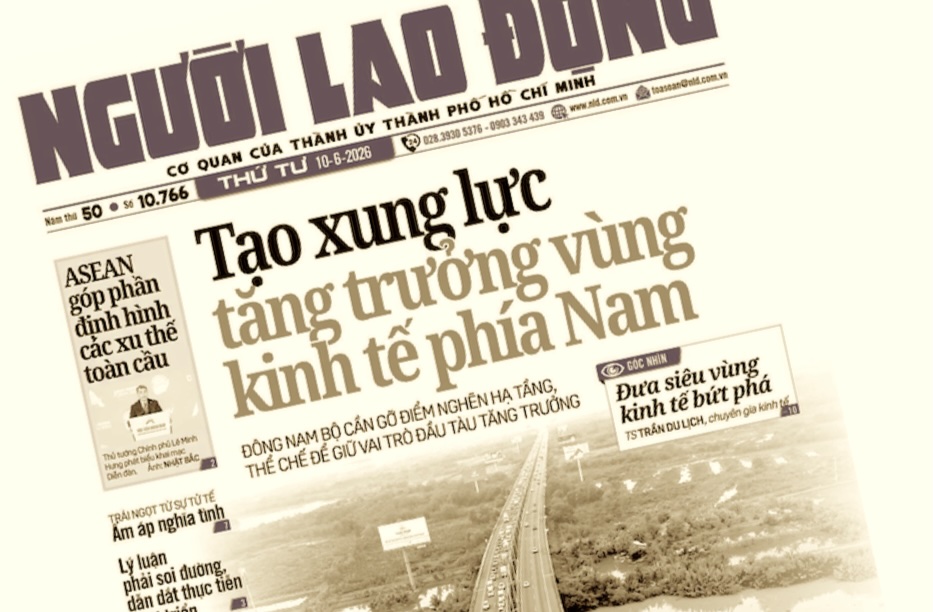
On 30 June 2026, the Người Lao động (Labourer) newspaper published its final issue after 51 years, one of eight Vietnamese newspapers to cease publication as part of a broader state media restructuring plan.
Người Lao động, however, wasn’t just a fairly nondescript newspaper conveying the views of the one-party state. It played an extremely important role in labour relations and labour politics as one of the two major labour newspapers in the country, along with Lao động (Labour). The latter continues to exist, is based in Hanoi, and belongs to the central trade union confederation, the Vietnam General Confederation of Labour (VGCL).
The recently closed Người Lao động was founded in 1975 as Công nhân Giải phóng (Liberated Worker), adopting its current name in 1990. For most of its existence, it was a publication of the Ho Chi Minh City Labour Federation, the trade union federation of the country’s biggest city, and focused especially on southern Vietnam, the industrial export hub of the country and where the export oriented manufacturing industry has traditionally been based.
Người Lao động reported on strikes, workers’ working and living conditions, and exposed exploitative employers, creating pressure on them to improve and change behaviour. It served as a channel of worker grievance and communication with trade union officials, promoting pro-labour positions in policy debates.
The paper’s closure has been met with sadness. One reader, commenting on the editor’s final article, wrote “Thank you, Người Lao động, for accompanying people through both joys and sorrows […] The paper has been a close friend […] It’s impossible not to feel sad when saying goodbye to a soulmate!” Another, on a Facebook post by the paper on its final day, mourned the closure of “a newspaper that stands shoulder to shoulder with workers in every aspect of their livelihoods.” And one of the paper’s reporters, quoted in The Vietnamese, lamented “This farewell does not bring me to tears […] But being able to cry would at least make it easier to forget. Instead, it lingers, carrying so many layers of emotion that it leaves me bitter and speechless.”
Người Lao động’s journalism took place in a context of a one-party state with no independent media and no independent trade unions. Vietnam ranks lowest in Southeast Asia in the World Press Freedom Index, with independent journalists and bloggers often arrested and all media belonging to state and party agencies. The VGCL is the country’s only trade union, and is a party-state-led union, under the ruling Communist Party. All unions are part of the VGCL structure; independent trade unions are banned.
To understand how Người Lao động managed to create the space for some relatively autonomous pro-labour reporting in this context, and its eventual closure, we must put the newspaper against the backdrop of the last three decades of Vietnam’s labour politics.
1990s to 2000s: an “emerging” political force
In the 1990s and into the 2000s, Vietnam looked to attract foreign direct investment (FDI), achieving rapid economic growth based on low pay, long hours, and poor conditions in export-oriented manufacturing. The same period, unsurprisingly, saw increasing labour conflict, with recorded strike numbers gradually increasing. Strikes were legalised under a labour code enacted in 1994, although no strikes ever followed the law and none were led by the union—all were wildcat strikes, self-organised by workers.
There were tensions within different parts of the state, between those who wanted more pro-FDI policy (but also fewer strikes) and those who wanted the Socialist Republic to do more to protect workers’ rights and interests. Người Lao động’s reporting contributed to these debates, through highlighting exploitative employer practices, workers’ working and living conditions, and strikes. The paper also provided a forum for worker grievance through the letters written to the paper, and a way for workers to ask questions and communicate with union officials. By the mid-2000s, its reporting had become significant enough for labour scholar Angie Ngọc Trần to identify the “emerging” role of Vietnam’s labour press in promoting workers’ rights and interests and playing a mediating role between workers, employers, unions and the state.
December 2005 to January 2006, for example, saw a major wave of strikes over the minimum wage, which had been frozen for ten years. Tens of thousands of workers at foreign-owned export apparel and footwear factories in southern Vietnam went on strike to demand a large minimum wage increase, winning a 40% rise.
Người Lao động’s coverage, as well as that of the Hanoi-based Lao động, was crucial in this struggle: the papers reported the strikes quickly, openly criticised the Ministry of Labour, Invalids and Social Affairs (MOLISA) for delay and indecision regarding a minimum wage rise, and helped pressure the government to eventually decide on a large rise. Người Lao động also acted as a channel of communication for workers, with copies distributed for free to those in the striking factories.
Into the 2010s: promoting progressive reform
Strike numbers reached a peak in 2011, the year of nearly 1,000 strikes, all of which remained wildcat and unlawful. The sheer number of strikes created significant pressure on various parts of the state, Party and government to try to reduce them and build harmonious labour relations. In subsequent years strike numbers fell to around 300 per year, but still remained a significant source of grassroots pressure.
At the same time, Vietnam was in negotiations to sign trade agreements, including the Trans-Pacific Partnership (later the Comprehensive and Progressive Agreement for Trans-Pacific Partnership following the US withdrawal under the first Trump administration) and the EU–Vietnam Free Trade Agreement, both of which had requirements for labour reforms as part of their labour and social chapters. This pressure from below, through wildcat strikes, and above, through trade agreements, spurred efforts to build more representative labour relations institutions and structures, including more genuine trade union representation.
The labour press became an important avenue pushing for pro-labour reform. Especially as strikes were wildcat strikes, without formal leaders, and primarily (although not exclusively) occurring in manufacturing industries in southern Vietnam, Người Lao động became a channel for reporting on strikes, articulating worker grievances, and highlighting major labour issues. It was the Hanoi-based Lao động newspaper, as the newspaper of the central VGCL, which tended to focus more on national policy, but Người Lao động also contributed.
After Vietnam’s National Wage Council was established in 2013 to negotiate annual minimum wage rises, Người Lao động consistently pushed for a substantial annual increases, backed up with articles detailing the difficulties faced by workers having to live on low wages that do not meet the cost of living. During debates over the 2019 Labour Code, Người Lao động published numerous articles supporting progressive positions, including lowering the number of hours in the standard working week, and opposing an increase in overtime hours and the retirement age.
This was still done, though, in the context of a one-party state without independent media. Critical reporting on labour issues consequently had to be balanced with the need to convey certain messages.
For example, in 2015, ten years after the minimum wage strike wave, there was a major strike by 90,000 workers opposing a proposed change to social insurance laws that would have made them wait until retirement age before being able to access their social insurance contributions. Industrial manufacturing workers, many of whom are migrants from other parts of Vietnam, often leave their jobs decades before retirement age due to the intensity of the work, and rely on the social insurance pay-out to set themselves up for the next phase of life, buying equipment for farming or setting up micro businesses.
The strike was successful, with the relevant section of law altered. Người Lao động documented the strike and conveyed worker demands, but also initially reported guidance from the VGCL asking unions and other state agencies to help workers properly understand the law, and encouraging them to return to work to maintain order. When that didn’t work, and the strike continued, Người Lao động reported a statement from the VGCL president, communicating that negotiations that were ongoing at the national level, and again asking strikers to return to work.
2020s: decline and closure
By the late 2010s, the situation began to change. Having hovered at around 300 per year in the mid-2010s, strike numbers fell to much lower levels, with 121 recorded in 2019 and 126 in 2020. These have continued to fall, with only 55 recorded in 2025, perhaps suggesting that some of the attempts at building more effective labour relations institutions had borne fruit. Pressure for policy change driven by labour-related provisions in trade agreements has also lessened: the agreements have been signed and there has been limited recourse for those wanting to hold Vietnam accountable for the reform commitments made. Both of these factors have meant that pressures for labour reforms subsided.
Concurrently, Vietnam as a whole has taken a more authoritarian turn. Concerns over foreign influence and regime stability, encapsulated in Directive 24, have coincided with a push to promote a new era of private-sector-led growth, as per Resolution 68. The Party-state appears to regard much tighter political control as necessary to facilitate this new phase of private sector development, in order to contain and closely manage the social tensions it generates.
Related

Malaysia’s migrant labour regime is unfair and unsustainable
A system built on de facto debt bondage
In the labour space, prominent labour reformers were arrested: Nguyễn Văn Bình of MOLISA and Vũ Minh Tiến of the VGCL. The VGCL’s autonomy was also substantially tightened through a 2021 Communist Party resolution, Resolution 2, aimed at increasing the Party’s oversight and control of the union confederation. Subsequent changes to trade union law and the Constitution have implemented the Resolution.
The fate of Người Lao động reflects this more restrictive environment. In 2021, ownership of the newspaper was taken away from the Ho Chi Minh City Labour Federation and instead transferred to the Ho Chi Minh City Party Committee as part of a media restructuring and consolidation plan. This meant that the paper became accountable to the Party Committees rather than the Labour Federation. The change gave the Party Committee legal authority to define the paper’s principles and goals, set operational boundaries, and appoint the editorial board.
The paper’s final closure fits this trajectory. It is easy to see this as part of the broader media restructuring plan. But it is also a labour story. For three decades, Người Lao động carefully and successfully navigated authoritarianism to create a space to amplify worker grievances and push for pro-labour reform. Its closure further restricts worker voices during what is already an extremely difficult time for labour reformers.
Other avenues for documenting labour abuses and advocating reform, such as social media, NGOs working on labour issues, and scholarly labour research, are also being significantly tightened. Nevertheless, the conditions that gave rise to three decades of labour unrest remain, even as the institutions that once helped channel workers’ demands have been increasingly constrained.












Leave a comment