


On 14 September, US Secretary of the Air Force Troy Meink publicly announced that the US Space Force had deployed ‘space control weapons’ in response to growing threats to American and allied space systems.
The announcement generated predictable criticism from Russia and China that accused Washington of accelerating an arms race in space. But that criticism misses the larger point. The competition in space did not begin with this announcement. For more than two decades, China and Russia have been developing and deploying capabilities designed to disrupt, degrade or destroy the space systems that the United States and its allies increasingly depend on.
The wars in Ukraine and the Middle East show why this matters. Space is no longer simply a supporting domain. Satellite communications, navigation, imagery and other space-derived services increasingly shape what happens on the terrestrial battlefield.
For Australia and its Indo-Pacific partners, the lesson should be clear: in a future regional conflict, military advantage on Earth will increasingly depend on the ability to operate – and prevail – in space.
The end of the Western monopoly on space-enabled warfare
The 1991 Gulf War was arguably the first major space war. GPS, satellite communications and space-based intelligence gave the US and its allies extraordinary advantages in precision strike, navigation and command and control.
But the strategic environment has changed fundamentally.
China has spent decades developing a broad suite of counterspace capabilities, including direct-ascent anti-satellite missiles, electronic warfare systems, cyber capabilities, directed-energy weapons and satellites capable of rendezvous and proximity operations. Russia has pursued many of the same capabilities.
More importantly, the US and its allies no longer have anything resembling a monopoly on the military benefits of space.
The wars in Ukraine and the Middle East demonstrate that increasingly sophisticated space-enabled capabilities are becoming available not only to major powers, but also to smaller states – and potentially to non-state actors.
That has enormous implications for the Indo-Pacific.
Commercial space has changed military resilience
One of the most important lessons from Ukraine is the role commercial space can play in preserving military effectiveness under attack.
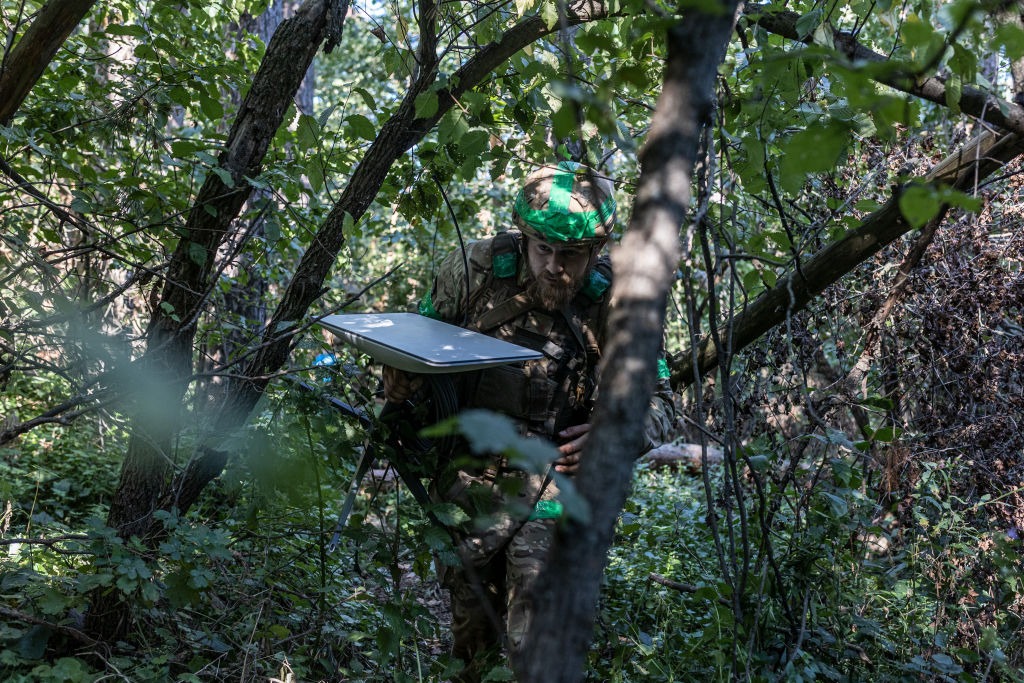
At the beginning of Russia’s full-scale invasion in 2022, Moscow sought to disrupt Ukrainian communications and command-and-control networks. Yet Ukraine was able to maintain critical connectivity in significant part because of Starlink’s proliferated low-Earth-orbit satellite architecture.
Thousands of terminals provided communications that were far more difficult to destroy than traditional ground-based networks. Starlink did not determine the outcome of the war, but it helped prevent Russia from achieving one of its most important initial objectives: severing the communications required for an organised Ukrainian defense.
That lesson should resonate strongly in the Indo-Pacific.
Australia, Japan, South Korea and the US operate across enormous distances. Airfields, ports, command centers and communications nodes would almost certainly come under attack in a major regional conflict. Proliferated commercial satellite communications could provide vital redundancy when ground-based infrastructure is damaged or disrupted.
But governments cannot simply assume those commercial capabilities will be available when required. They need contractual arrangements, technical integration and operational concepts in place before a crisis begins.
Navigation is both an advantage and a vulnerability
A second lesson concerns positioning, navigation and timing.
Global Navigation Satellite Systems – the US’s GPS, the European Union’s Galileo, Russia’s GLONASS and China’s BeiDou – now support far more than navigation. They enable precision weapons, drones, dispersed military operations, communications networks and increasingly sophisticated unmanned systems.
Ukraine and Russia both depend heavily on satellite navigation for missiles and drones. The conflict in the Middle East similarly demonstrates the spread of precision-strike capabilities that were once concentrated in the hands of a few technologically advanced states.
At the same time, dependence creates vulnerability.
Both conflicts have seen extensive jamming and spoofing. Electronic warfare against satellite navigation can disrupt missiles and drones, interfere with logistics and command networks and create significant risks for civilian aviation and maritime traffic.
The Indo-Pacific would likely present these challenges on an even greater scale.
China’s BeiDou constellation reduces Beijing’s dependence on GPS and strengthens the resilience of the Chinese military’s precision-strike network. US and allied forces therefore need not only more resilient access to GPS, but alternative sources of positioning, navigation and timing and the ability to operate when satellite signals are degraded or denied.
Australia should be part of that effort.
The battlefield is becoming transparent
The proliferation of commercial satellite imagery presents another profound change.
High-quality overhead imagery that was once the preserve of governments and intelligence agencies can now be purchased commercially. This provides extraordinary benefits to democracies and their militaries, but those same services can also be exploited by adversaries.
Commercial systems can reveal aircraft movements, port activity, troop deployments, logistics hubs and activity at forward bases.
For the Indo-Pacific, this means that major bases in Australia, Japan, Guam and elsewhere must increasingly be treated as observable.
The answer is not to abandon these facilities but to rethink how forces operate from them. Dispersion, mobility, deception, concealment, hardened infrastructure and operational security will become increasingly important.
The old assumption that a weaker adversary lacks sophisticated space-based intelligence is becoming obsolete.
Allies must be able to deny adversary use of space
These developments point to a difficult but unavoidable conclusion.
Protecting allied satellites is no longer enough.
If adversaries use space systems to locate allied forces, guide missiles, operate drones or maintain military communications, the US and its allies must be able, when necessary, to deny them the effective military use of those capabilities.
That does not automatically mean physically destroying satellites.
Indeed, the preferred tools should, wherever possible, be targeted, reversible and designed to avoid creating long-lived orbital debris. Electronic warfare, cyber capabilities and other non-destructive means may often be preferable to kinetic anti-satellite weapons.
This is where US Secretary of the Air Force Troy Meink’s announcement should be understood.
Space control is not about pursuing conflict in space for its own sake. It is about recognising that adversary space capabilities can directly affect military operations on Earth.
For Indo-Pacific allies, space therefore needs to become a much more important component of combined operational planning.
A new strategic agenda for the Indo-Pacific
Several priorities follow.
First, the US, Australia, Japan and other allies should continue building more resilient and distributed space architectures while integrating commercial systems more deeply into military planning.
Second, they should strengthen positioning, navigation and timing resilience, including alternatives to GPS and the ability to operate through jamming and spoofing.
Third, allies need better mechanisms for sharing space-domain awareness and commercial satellite data during crises.
Fourth, they should develop credible – non debris generating – means of denying adversaries access to hostile space services and space-derived information when those capabilities are being used to attack allied forces.
And fifth, the US and its allies should continue diplomatic efforts to reduce the most dangerous forms of counterspace competition – particularly debris-generating anti-satellite testing and any deployment of nuclear weapons in orbit.
Russia’s reported development of a nuclear anti-satellite capability highlights the stakes. A nuclear detonation in space would not simply threaten military satellites. It could indiscriminately damage commercial and civilian systems that communications, transportation, finance and modern economies depend on.
The Indo-Pacific’s next battlefield extends into orbit
The broader lesson from Ukraine and the Middle East is that space is becoming inseparable from warfare on Earth.
Commercial constellations can preserve communications after ground-based networks are attacked. Satellite navigation enables drones and precision weapons. Commercial imagery makes the battlefield increasingly transparent. And those same capabilities are now available to America’s adversaries.
For Australia and its allies, this is not a distant technological debate. A future Indo-Pacific conflict would almost certainly involve attempts to disrupt, manipulate or deny the space services that allied military power depend on.
The countries that adapt fastest to that reality will hold an important advantage.
The 1991 Gulf War demonstrated how space could transform warfare. Ukraine and the Middle East are demonstrating something different: space-enabled warfare has proliferated.
The US and its Indo-Pacific allies can no longer assume access to space will be assured – or that its military advantages will be theirs alone.
In the next major conflict, control of the terrestrial battlefield may increasingly depend on the ability to protect, exploit and, when necessary, contest the space domain.














Leave a comment