


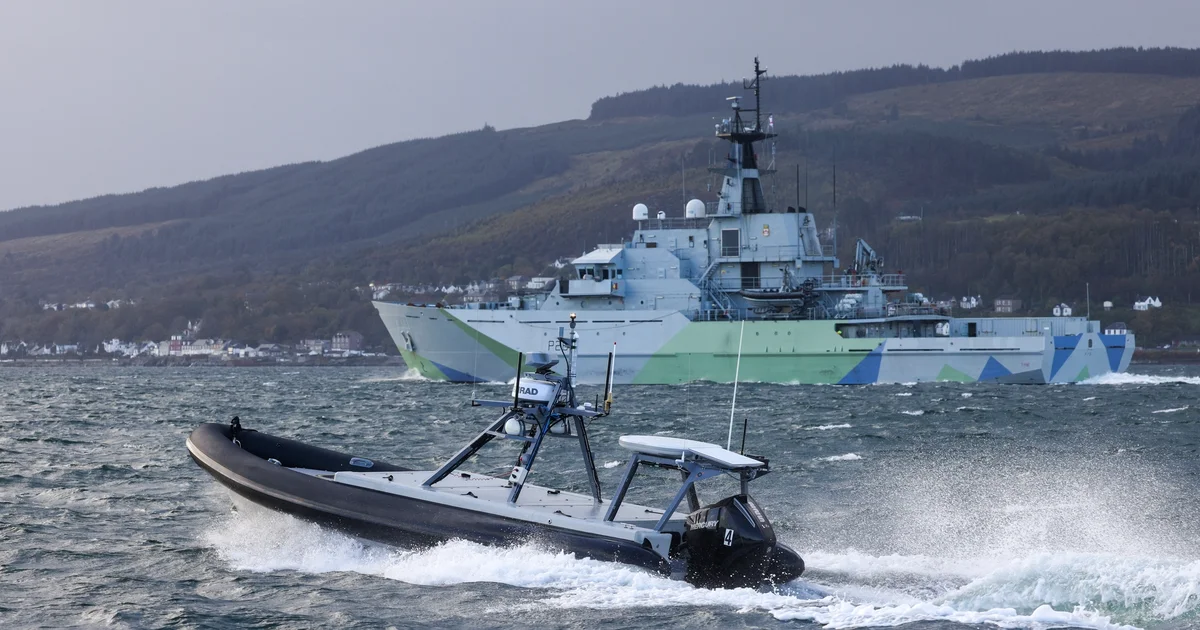
Ukraine’s maritime challenge was one of sea denial. It employed remotely controlled (Opens in new window) boats between 5 and 8 metres, packed with explosives, alongside cruise missiles, to deny Russia’s freedom of manoeuvre in the Black Sea. This forced much of the Russian Black Sea (Opens in new window) Fleet to remain in port and allowed Ukrainian grain shipments to leave the Black Sea through the Turkish Straits, hugging the coast. Ukraine also benefited from land borders through which weapons and supplies could flow.
As the UK’s Defence Investment Plan notes, nearly 90% of UK freight trade is transported by sea. Its maritime challenge is therefore much broader than Ukraine’s. It needs to deny adversaries freedom of manoeuvre in areas such as the Greenland–Iceland–UK Gap, including through its Atlantic Bastion plan (Opens in new window). But it must also be able to achieve sea control and maintain its own freedom of manoeuvre.
Sea control requires the sustained projection of maritime power, which in turn requires endurance and persistence. Enthusiasm for drone warfare risks overlooking the practical challenges of operating large uncrewed vessels at sea, particularly in a contested electromagnetic environment. These challenges have not been resolved through experimentation.
The UK’s proposed (Opens in new window) future fleet includes at least 19 crewed surface combatants: 13 frigates and at least six Common Combat Vessels.
By comparison, at the end of the Cold War in 1990, the Royal Navy operated (Opens in new window) 13 destroyers and 35 frigates. The Royal Navy currently has six Type 45 destroyers and seven remaining Type 23 frigates on its books, although announced decommissionings will soon reduce the frigate fleet to five.
The Royal Navy intends to address its numbers problem through an undisclosed number of large uncrewed vessels: the Type 91 (Opens in new window) missile barge, Type 92 anti-submarine warfare platform and Type 94 radar picket. All are intended to enter service between 2030 and 2035.
But these are not the platforms used in Ukraine. Industry concepts (Opens in new window) suggest they could be between 80 and 100 metres long and displace approximately 2,000 to 3,000 tonnes, making them larger than Australia’s Arafura-class offshore patrol vessels. Unlike Ukraine’s small uncrewed surface vessels, these will be expected to operate at sea for extended periods as part of a force seeking to achieve sea control.












Leave a comment