


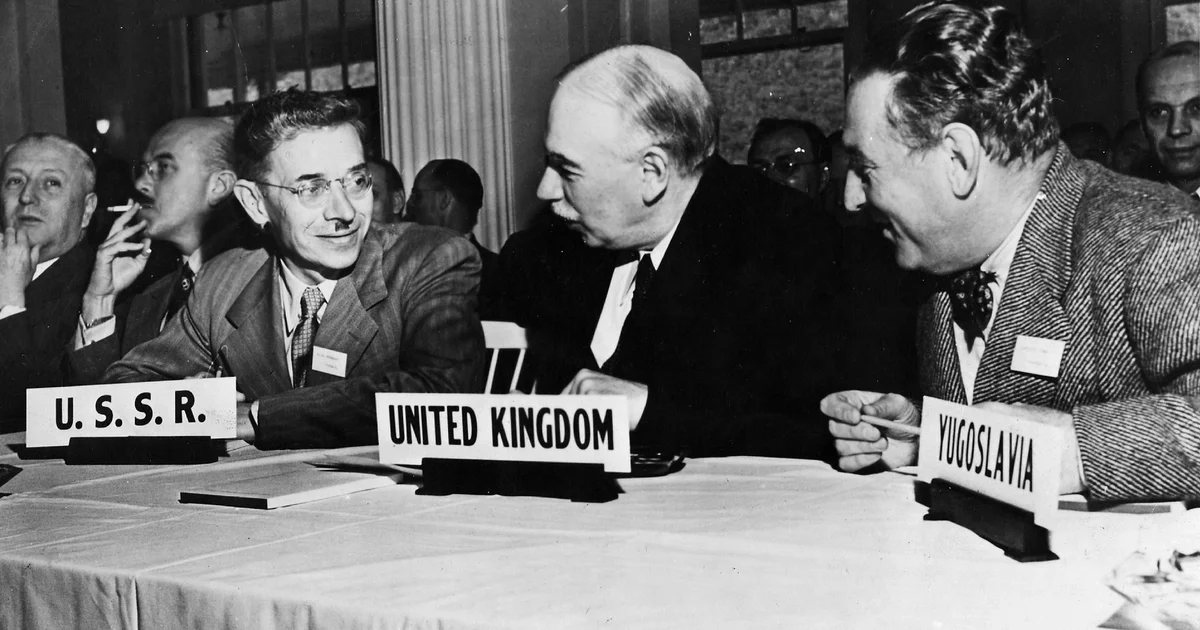
Globalisation grew even as the Bretton Woods institutions atrophied. The enabling environment pre-dated the system (with substantial globalisation before the Second World War) and didn’t end with its effective demise.
Long before Bretton Woods, there had been agreed rules between countries to facilitate economic interaction. These continue, modified and augmented, to this day. These rules cover marine trade, aviation, communications, intellectual property, health and sanitary standards, space, pollution and myriad other issues. The economic-oriented agreements sit comfortably alongside other international agreements, such as the United Nations Convention on the Law of the Sea (UNCLOS), covering international boundaries.
Developing and maintaining such rules relies on both parties benefitting, otherwise they will not sign up. This doesn’t mean that both parties benefit equally or equitably; but there must be a negotiating process which ensures mutual gains.
Global trade is intrinsically win-win (economists talk confidently of “the gains from trade”), not the zero-sum tussle Trump envisages. Countries shouldn’t need much encouragement for free trade, which is almost always in the interests of both parties. Retaliating to tariffs imposed by other countries is “like putting rocks in your own harbour (Opens in new window)”.
While the benefits of free trade are one of the few topics on which economists agree, the wider public has never been convinced. Expanding globalisation was accompanied by a constant background babble of disagreement, illustrated by demonstrations against the WTO in Seattle in 1999. In America, the Democrats are dubious about free trade.
Nor have countries honoured the central principle of the GATT and WTO: the so-called “most-favoured nation”. This actually requires countries not to have a most-favoured nation – to treat all countries alike. In practice, blocs such as the European Union discriminate against outsiders and maintain substantial protection for politically favoured agriculture. In more recent years, so-called “free-trade” agreements (actually preferential discriminatory arrangements) have become common.
Nevertheless, international trade grew faster than GDP until 2008, and since then has kept pace.
Trump has, however, brought a crucial change: the overt and frequent use of economic instruments to pursue security goals. Of course this is not new, but Trump sees tariffs as his primary coercive tool. This is now a dominant overlay on all international relations. Security and supply resilience are now used to justify trade-distorting industrial policies subsidising domestic production. Further distortion comes through “friend-shoring” (Opens in new window), designed to secure supply. Policy routinely includes the use of “chokepoints” (Opens in new window) – export controls, sanctions, boycotts, travel bans and limits on the use of American financial infrastructure.









Leave a comment