


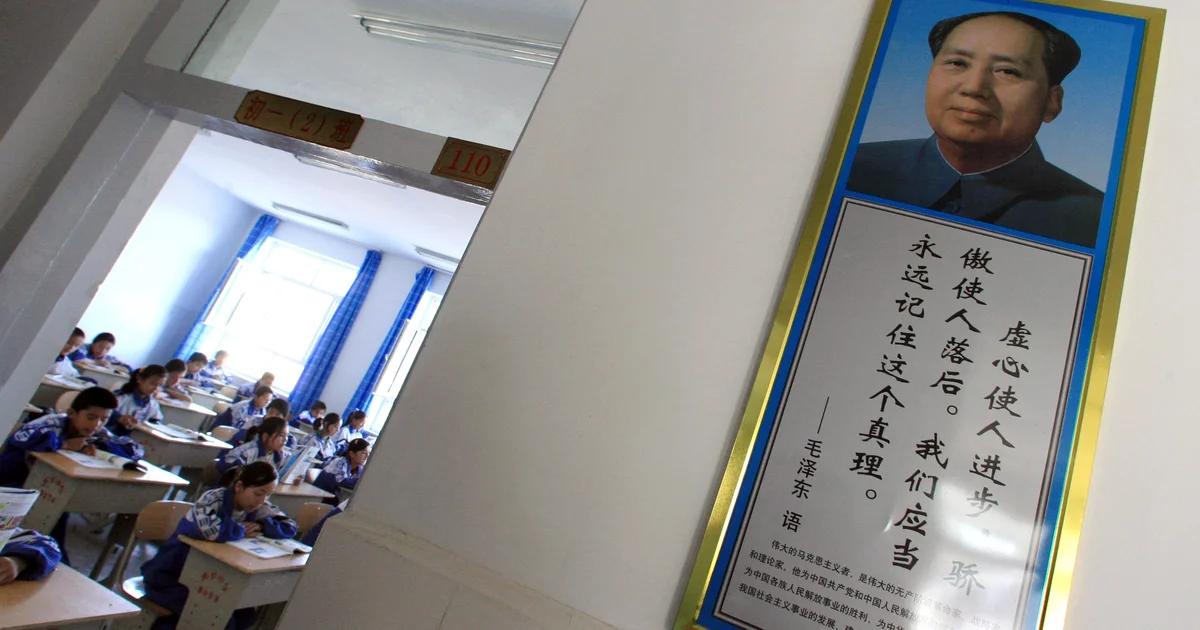
Rule of law is a vague idea in China, and sometimes it takes only a new sense of what is politically popular, not what is legal, to push language restrictions. Without explaining the rationale, public security bureaus have imprisoned or surveilled (Opens in new window) teachers advocating Tibetan in schools and removed (Opens in new window) songs with phrases like “I am a Mongolian” from online venues.
However, laws institutionalise campaigns, reduce recourse, and signal state priorities – with two new ones coming into effect in 2026.
A language law (Opens in new window) in January aims for a sense of “Chinese nation,” along with “cultural confidence” on the world stage. It shifts non-Mandarin language use in schools from the language of instruction to a one-off independent language course and mandates Mandarin teaching starting in preschool (Opens in new window). Radio, film, television, video games, public signs, print publications, and newly printed textbooks must also use Mandarin (Opens in new window).
There used to be exceptions for ethnic minorities. But a March 2026 law revised (Opens in new window) China’s ethnicity policy, declaring (Opens in new window) non-Mandarin language instruction “no longer necessary”. That change came with other efforts at absorbing the 9% of China’s population not registered as Han into the Han population: housing policies that facilitate ethnic mixing, for example.
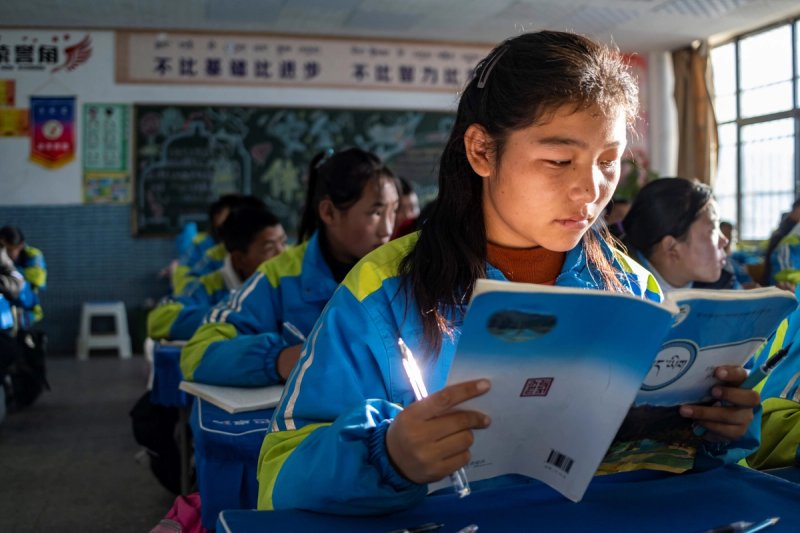
Why starts with ideology. No matter how far China has gone towards “capitalism with Chinese characteristics”, its state remains a Marxist institution. Between 1992 and 2007, 27 universities added (Opens in new window) schools of Marxism.
How is Marx related to language policy? Marx prescribed an inevitable historical evolution from “primitive” society through feudalism, capitalism, eventually to communist society; each had greater technological capacity and different labour relations. This view of historical “progress” persists among China’s leaders, who shifted (Opens in new window) elementary-school textbooks in 2022 to promote a story of Chinese “civilisation” evolving from “primitive society” in the “prehistoric period.”
This view maps onto a state-driven sense that ethnicity pairs with “degree of primitiveness”. Tourists come to Wengding Village (Opens in new window) because it is “the last primitive tribe in China.” The People’s Dailycelebrates (Opens in new window) the spread of Internet to “the Dulong people,” whose “isolated” location has prevented evolution from a “primitive … lifestyle”. When someone sped by on the road in Qinghai, my taxi driver told me it was probably one of the area’s Tibetans, who tended to be backwards. So ethnicity goes with degree of primitiveness in China, and primitiveness goes with where you are on the progression towards communist “civilisation”. In this context, the March 2026 ethnicity law (Opens in new window) was not only on “Promoting Ethnic Unity” but also on “Promoting Progress.”
China’s been en route to Communism since 1949. So why now? Sometimes states tighten language policies during periods of international expansion. Defunct with the French Revolution, the Academie Française returned with Napoleon, as he reached for Europe. As the Soviet Union spread into imperial Russia’s old periphery, it sought to integrate central Asian and eastern European subjects in part through co-opt-and-conquer language policies. Efforts to “standardise the Japanese language” in the mid-to-late 1800s accompanied (Opens in new window) annexation of Korea and Taiwan.
Certainly, China’s language policies respond in part to domestic worries (Opens in new window) that difference could make a case for separation. As one of my Chinese classmates informed me in 2024, religion in Xinjiang isn’t spiritual; it’s being used for separatism. By 2020 (Opens in new window), in Inner Mongolia, not using Mongolian in school was a “political duty.” In 2019, Xi Jinping felt the need to tell (Opens in new window) Nepal’s prime minister that “anyone attempting to create division in any region of China will only end up with pulverized bodies and crushed bones”.
But tightened language policy also parallels widened aims abroad. China’s state places language policy in the context of “Cold War” dynamics, a phrase that only emerged (Opens in new window) to imply US–China relations at the 18th and 19th Party congresses in 2012 and 2017 (Opens in new window). Mandating Mandarin use in schools, broadcasts, publications, and other domains fights (Opens in new window) “servile imitation of foreign models,” this argument goes. China pushed towards the Global South with the Belt and Road Initiative around the same time (2013 onwards). Thus, language homogenisation has come along with an effort by China’s state to elevate itself (in the Soviet Union’s image) to the status of a global pole in a bipolar world. Global power starts with internal unity, seems to be the argument.
How long that logic holds is a separate question. The Soviet Union went through similar policies, and native-language literature movements (Opens in new window) responded to them in the 1970s and 1980s. Will China’s policies bend language to politics, or will it be the other way around?













Leave a comment