


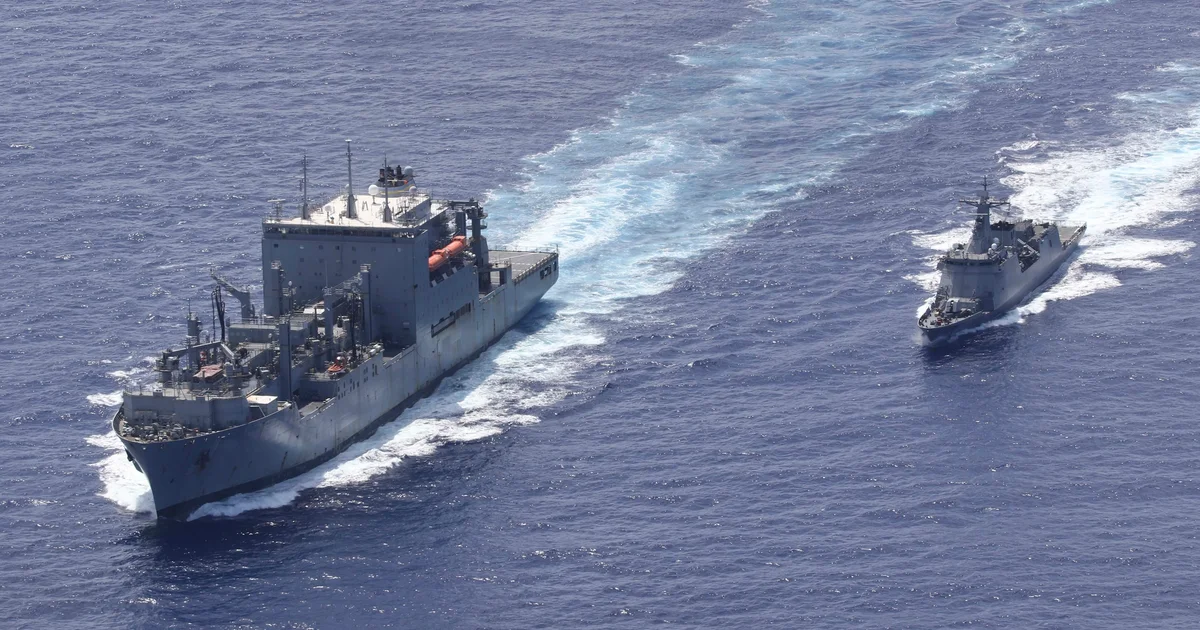
To this day, the Philippines remains the single largest (Opens in new window) contributor to the global maritime workforce. Roughly one in four seafarers is Filipino. In absolute terms, that is half a million citizens routinely exposed to hazards at sea – many, human induced.
At least five (Opens in new window) Filipino seafarers have died transiting the Strait of Hormuz. Its closure has led to record-high oil prices and an ongoing energy crisis (Opens in new window) in the Philippines. And thanks to harassment from Chinese vessels, there is little Manila can do to harness potential resources (Opens in new window) in the South China Sea and decrease its reliance on Middle Eastern imports.
Any nation whose critical industries depend entirely on access to the global commons and freedom of navigation along vital sea lanes must have the means to ensure that access or risk losing it. In this case, having a navy with the capacity for sustained operations beyond your territorial waters becomes an overriding necessity.
Of course, the idea that the Philippine Navy could achieve a level of maritime power projection suitable for Teodoro’s goals does seem like a tall order. There are only a handful of blue-water navies in the world today, and even they face challenges in maintaining a sustained naval presence overseas. Between the relative size of its fleet, the lack of robust logistical supply chains, and the immediate threat posed by the PLA Navy and China Coast Guard, diverting already limited resources from your core territorial interests simply detracts from your overall defence posture.
The biggest problem with conducting maritime security operations abroad is that you can never send just a single warship. Philippine Navy vessels have gone for joint exercises, goodwill visits, FONOPs, and other activities all across the Indo-Pacific. Whether they can deploy beyond the country’s littorals is not the issue. The true measure of an expeditionary capability is not how far your navy can operate but how long it can operate far from your coast.
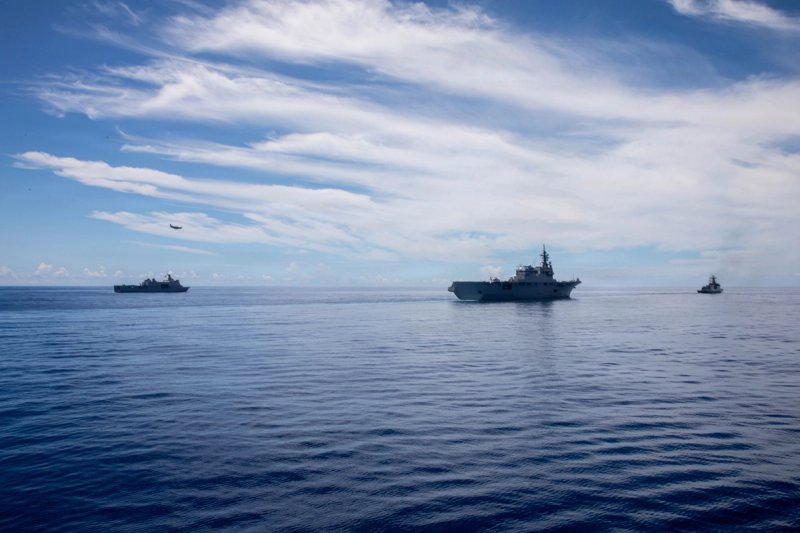
Sustained naval deployments need to have some measure of self-sufficiency outside of land or shore-based logistics hubs. That is why in 2025, the PLA Navy flotilla (Opens in new window) that conducted live-fire exercises in the Tasman Sea – thousands of kilometres from the Chinese mainland – included a dedicated oil tanker to allow for far-sea voyages.
Manila does not possess that capability. The Philippine Navy retired its sole replenishment vessel, the BRP Lake Caliraya, back in 2020. It was sunk (Opens in new window) as part of the US-Philippine Balikatan exercises in 2024. And because capability development plans skew in favour of additional surface combatants and transport ships, it has yet to acquire a replacement.
Operating in contested environments like the Gulf of Aden or the Strait of Hormuz only adds to the considerations.
Navies today face asymmetric threats from state and non-state actors alike. Combined with anti-ship missiles and small attack craft, drone systems have allowed even comparatively inferior adversaries to overwhelm conventional maritime forces with precise mass (Opens in new window).
Modern warships usually employ a mix of soft and hard-kill systems to defend themselves against such threats. However, budget constraints in the Philippines’ modernisation program meant that many new acquisitions were delivered fitted for but not with (Opens in new window) these critical sub-systems. Four years since they were first commissioned, the Navy’s Jose Rizal-class frigates have yet to be equipped with vertical launching and close-in weapon systems. This glaring omission leaves them especially vulnerable to the saturation attacks common in the Red Sea and Persian Gulf – and significantly limits the type of mission roles they can actually perform.
Given the substantial logistical and operational challenges, does this mean the Philippines should simply abandon its blue-water ambitions? Not quite. While a stand-alone expeditionary force is unlikely to materialise given competing priorities, the capacity for rapid overseas deployment is still a worthwhile – and more realistic – objective for naval development. Either way, the lesson remains the same: far from home, endurance is equally as important as performance.















Leave a comment