


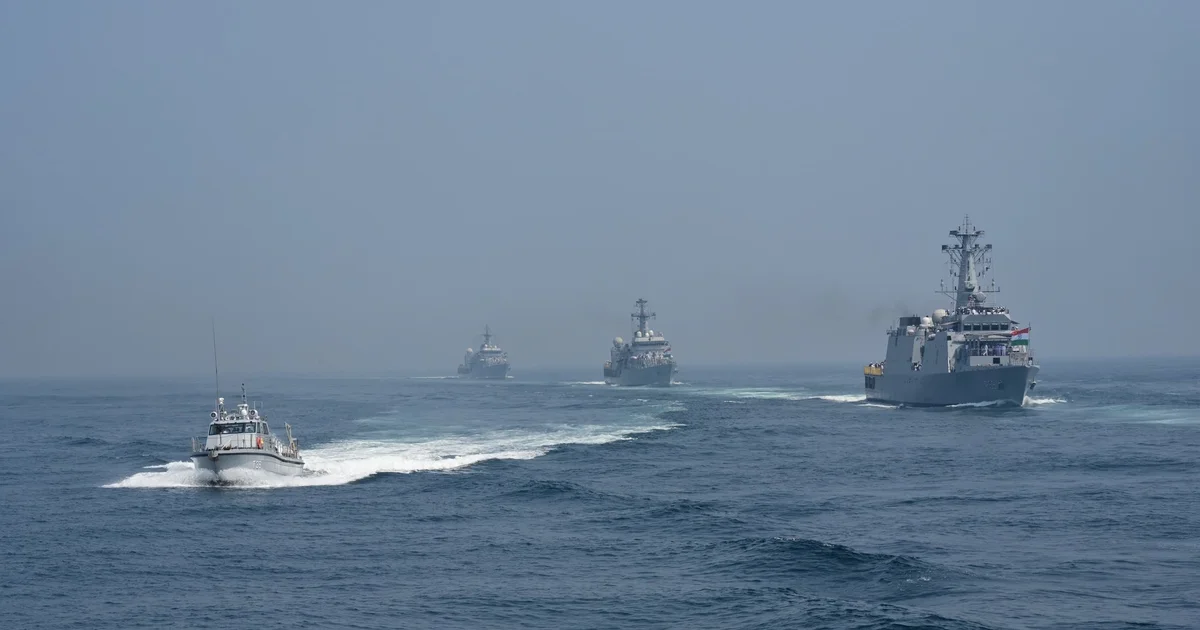
That crisis capability rests on everyday maritime cooperation. In May 2023 the Indian and Singapore navies co-hosted the inaugural ASEAN–India Maritime Exercise (Opens in new window), the first time India exercised with the grouping as a whole. Beneath it sit years of coordinated patrols (Opens in new window) with Indonesia and Thailand against illegal fishing, trafficking and piracy – building the capacity of regional navies to police their own waters, with the same machinery a fast crisis response depends on. Throughout, India has also worked through ASEAN’s own institutions, co-chairing ASEAN Defence Ministers’ Meeting Plus (ADMM-Plus) working groups rather than building parallel structures of its own. In late 2024, India’s National Disaster Management Authority signed a Memorandum of Intent (Opens in new window) with the ASEAN Coordinating Centre for Humanitarian Assistance, the region’s own disaster-response hub.
If this is India’s niche, the next question is how to widen it – and the answer is not for India to act alone. Its comparative advantage, capacity-building without domination, is one it shares with several of ASEAN’s other dialogue partners, Australia foremost among them. The two already cooperate closely in the eastern Indian Ocean and the Bay of Bengal, and both bring the same reassurance: capability without the demand for alignment. Extending that into Southeast Asia – joint HADR planning, shared maritime domain awareness, combined training for coast guards – would multiply the effect.
The real risk ahead is not too little help, but too much of it, poorly coordinated. ASEAN now faces a flurry of capacity-building initiatives from India, Australia, Japan, the United States, the European Union and others, many crowding into the same few areas – maritime domain awareness, HADR, cyber. Left unmanaged, they duplicate effort, compete for the same officials and institutions, and risk overwhelming the very capacity they mean to build. The answer is a sensible division of labour: partners coordinating by sector and sub-region rather than each planting its own flag. This should run through ASEAN’s own networks – the ADMM-Plus working groups, the East Asia Summit, the ARF – so the region sets the priorities and partners slot in behind them. That keeps ASEAN centrality real rather than rhetorical, and turns a scattered set of gestures into something that adds up.
None of this makes India a substitute for the security guarantees only the United States can offer, and follow-through remains its weakness – cooperation with ASEAN is still a patchwork of exercises and memoranda rather than a standing architecture. But that is closer to the point than a criticism of it. India is a dependable contributor when the crisis comes, and increasingly a convener of others willing to do the same – a role worth building on, and one the region, on the evidence, would welcome.
This article is part of a series on ASEAN’s crisis coordination and response mechanisms following a private workshop hosted by the Lowy Institute in June 2026. The project was jointly led by Abdul Rahman Yaacob and Hunter Marston, Director of the Lowy Institute’s Southeast Asia Program, with the support of the Department of Defence’s Strategic Policy Grants Program.












Leave a comment