


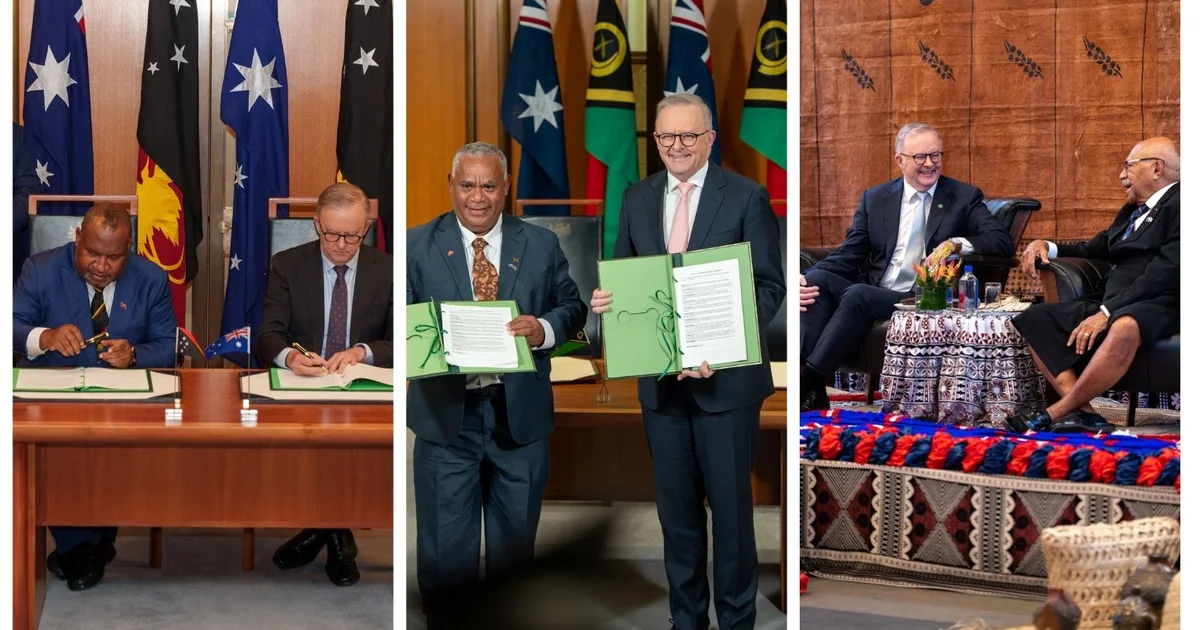
Vanuatu’s National Security Strategy sets out its key problems as crimes related to foreign fishing and transnational crime, cybersecurity, border security (including biosecurity as critical to people’s main income through agriculture) and climate change and natural disasters. Yet the Nakamal Agreement (Opens in new window) with Australia delivers little to change these conditions. The agreement lacks substance (Opens in new window) and reaffirms Australia’s already given commitment to net zero and climate adaptation and adding a mixed bag of clauses on migration, blackbirding, private sector linkages and “budget support” for “fiscal certainty”.
Arguably, the smallest nation to sign a security pact with Australia, Tuvalu has had the most success in obtaining an agreement that addresses its core security threats. While monitoring, control and surveillance for its Exclusive Economic Zone is a concern, its biggest threat is climate change. Being small low-lying islands, Tuvalu is affected by a range of climate threats (Opens in new window), and prospects of climate migration. The Australia-Tuvalu pact (Opens in new window) addresses that head on by providing for migration pathways to Australia, coastal protection and climate adaptation and support for Tuvalu sovereignty over resources and culture (including through digital sovereignty).
So, what will Solomon Islands new government, led by Prime Minister Matthew Wale do in negotiating a pact? His predecessor was focused on police capacity and unrest following a disastrous riot in November 2021 (Opens in new window), and citing this as a rationale for the controversial China-Solomon security pact in 2022. Wale has already indicated a focus on the structures of power causing conflict – reviewing lost revenue from extractive industries, closing loopholes for minerals to be sent overseas without proper regulation, prioritising indigenous business in government contracts and seeking support to expand job and educational opportunities for its young population. The country’s national security strategy retains a focus on social cohesion and peacebuilding given the country’s post-conflict status, as well as corruption, crime, border and maritime security, environmental security and climate change, and cybersecurity.
The Australia-Solomon Islands pact will be an interesting case to see whether new pacts are actually about local peace and security priorities, or just bilateral aid negotiations by another means, with a side serving of Australia’s strategic denial. As pacts are launched around the Pacific, with big spends and a hectic pace (Opens in new window), there is often little public consultation. We are yet to see serious review of whether previous arrangements with Australia helped address security threats in the islands. Such reviews would be wise for Pacific countries engaging in such pacts, while Australia has opportunities to ask what the pacts could be if peace and security are foregrounded.
Security for Pacific Islands is unlikely if peace is left adrift in a sea of pacts.











Leave a comment