


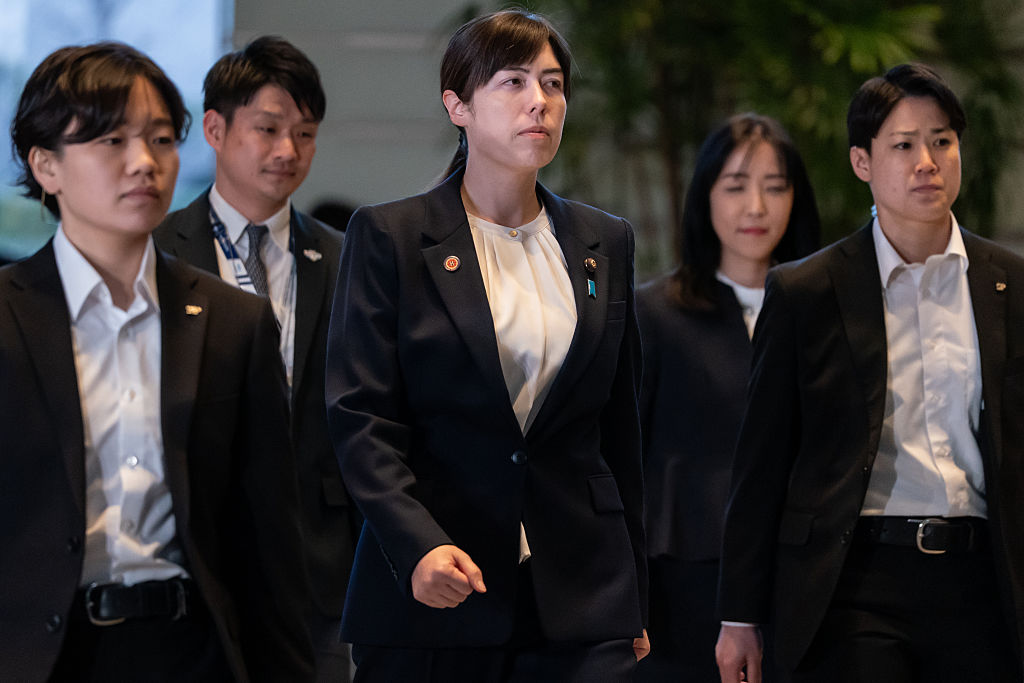
The visit to Australia this week by Kimi Onoda, Japan’s minister responsible for science, technology and economic security, is a reminder that the strength of the Australia–Japan relationship depends on the depth of its economic foundations. It is also a reminder that Australia currently lacks a position equivalent to Onoda’s role in Japan’s cabinet – a minister with a remit to coordinate economic security across the departments responsible for industrial policy and national security.
Even so, Onoda’s visit will be timely and productive. She will reportedly sign a memorandum of understanding on quantum cooperation in Sydney with Tim Ayres, the Australian cabinet minister covering science, industry and innovation. This agreement will help ensure that a reliable supply of the raw materials required for quantum computing is available to both countries and trusted international partners. The agreement positions Australia and Japan to be at the cutting edge of the transformative technologies that will determine which countries succeed, economically and strategically, in the decades ahead. It also mitigates the kind of economic coercion that China is currently directing against Japan. Since around December 2025, China has cut off supply of several critical minerals to Japan in an unsuccessful attempt to bully Tokyo into changing policies that Beijing doesn’t like.
Onoda’s visit builds on recent milestones, including the bilateral commitments on economic security, critical minerals and energy security that the Australian and Japanese prime ministers agreed to in May. However, progress risks being hampered by misalignment between the policies and institutional setup of both countries. Onoda’s lack of a direct counterpart in the Australian system is evidence of this. It means both systems must work harder to overcome this mismatch on economic security.
Japan has long viewed supply chains as integral to what used to be termed ‘comprehensive security’, but the newer articulation of economic security is more ambitious. The economic security agenda that Tokyo is pursuing aims to safeguard Japan’s sovereignty and prosperity by advancing two aims in tandem: first, to build strategic autonomy in vulnerable commodities, such as processed critical minerals, to mitigate against supply shocks and coercion; and second, to become strategically indispensable in cutting-edge technologies, such as AI and semiconductors, such that other countries cannot do without Japan. Others are catching on to these ideas. It’s noteworthy that strategic autonomy and indispensability were referenced by both prime ministers, Anthony Albanese and Sanae Takaichi, in a joint announcement in May.
Japan was first among its peers to codify its approach in the 2022 Economic Security Promotion Act. That law was strengthened and expanded this year to support strategically important projects overseas, which will expand the scope for investments in regional cooperation alongside Australia. Takaichi has been at the forefront of this initiative, first as economic security minister in 2024 when the act came into full effect, and now as prime minister. Onoda has Takaichi’s approval to work on economic security across Tokyo’s bureaucratic fiefdoms.
A possible reason why Australia does not yet have a ministerial equivalent to Onoda is that Canberra’s approach to economic security has developed more incrementally. The government has acquired significant new powers over the last decade, largely in response to China’s interference and economic coercion, but these have been split across several ministers’ responsibilities. These powers include tighter screening of foreign investment, coordinated by the treasurer; securing critical infrastructure, under the purview of the home affairs minister; increasing the resilience of critical minerals’ supply chains within the remit of the resources minister; and closer oversight of subnational international agreements, under the foreign minister.
The term ‘economic security’ is used in Australian government contexts, including the 2024 Future Made in Australia Act – an industry policy that is delivered mainly by the minister for climate change and energy because the law is largely aimed at green transition. But without a minister designated as responsible for pulling these threads together, Canberra’s focus on economic security risks slipping to whichever member of Cabinet has sufficient time and interest.
Notwithstanding some differences, the bilateral relationship is stronger than it has ever been. Significant progress is being made on economic security, bilaterally and through international forums. For instance, investment by the Japan Organisation for Metals and Energy Security (JOGMEC) in the Wagerup refinery in Western Australia will help break China’s stranglehold on gallium production. In her next meeting with Australia’s minister responsible for critical minerals, Madeleine King, Onoda could discuss how to link the upstream investment in Australia by JOGMEC and Japanese companies with a consolidated demand signal for those products downstream. Japan needs large quantities of Australia’s critical minerals for vital industrial process, including weapons manufacturing. If Tokyo could aggregate that demand – specifying volumes, quality and delivery timeframes – Australia and Japan could broker forward offtake agreements that outmanoeuvre Beijing’s price-fixing and product dumping.
Similarly, appointing an Australian minister for economic security does not require reinventing existing wheels of bilateral coordination that are functioning well. It’s encouraging that the Australian and Japanese trade ministers, Don Farrell and Ryosei Akazawa, agreed at their meeting in May to establish a working group on economic security and comprehensive supply chain cooperation. That could complement the work that senior officials from Australia’s Department of the Prime Minister and Cabinet and Japan’s National Security Secretariat are already doing through the Economic Security Dialogue.
The robust state of the bilateral relationship, which Takaichi calls a quasi-alliance, shows structural gaps can be temporarily overcome through shared principles and a common strategic vision. But having an Australian counterpart who shares Onoda’s coordinating role for economic security would make cooperation even easier.









Leave a comment