


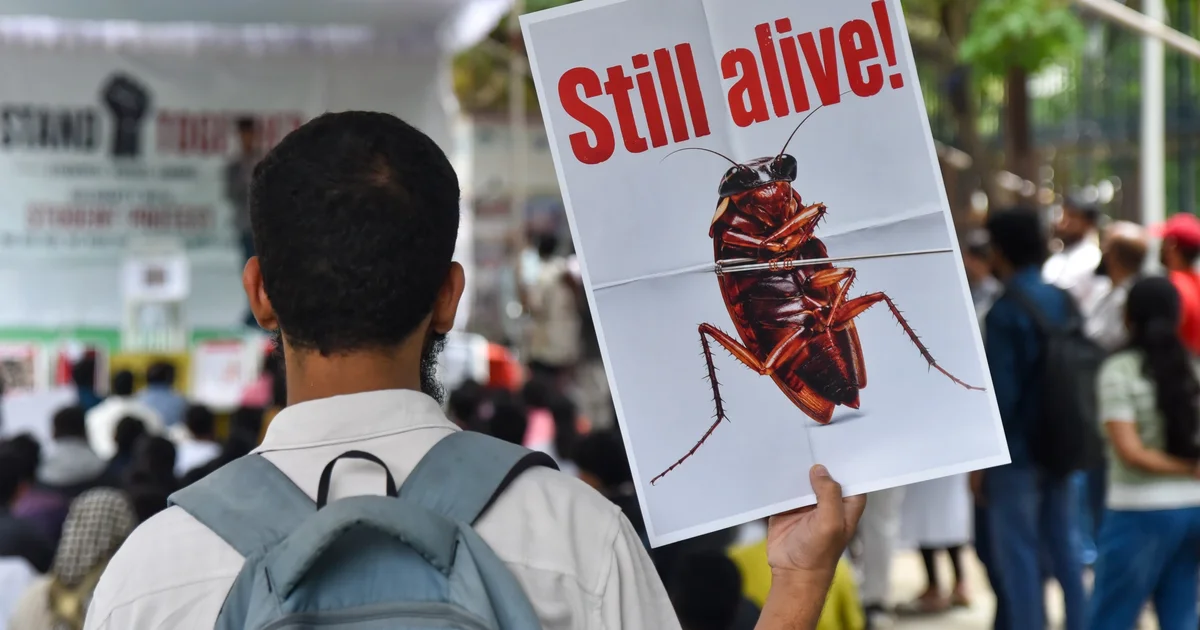
Birthed as satire and nourished by widespread frustration with recent exam scandals, India’s Cockroach Janta [sic] Party (CJP) was going through the motions a month ago. A much-hyped rally in the first week of June turned out to be a damp squib. Even as the CJP continued to hold its protest in Delhi and, occasionally, in other Indian cities, this rarely drew more than a few hundred protestors at a time. The overall impression was unmistakable. India’s roach revolt had fizzled out, as I concluded (Opens in new window) in The Interpreter at the end of June.
Not so fast, events of the past week have shown.
On 20 July, around 50,000 people (Opens in new window) gathered in Delhi in response to a CJP call for a march to the parliament. Caught completely off-guard, the police and paramilitary forces panicked, resulting in intense clashes. By the middle of the week amid searing public anger, security services were warning about potential violence (Opens in new window), as thousands continued to flock to Delhi’s Jantar Mantar, where the CJP had set camp. Worryingly, there were indications that other, extremely disruptive (Opens in new window), pressure groups were making common cause (Opens in new window) with the roaches. Even after the Modi government rushed to pacify the public (Opens in new window), there were no signs of let up.
Finally, in a sharp turnaround, on Saturday the government gave in to the CJP’s core demand: the resignation (Opens in new window) of education minister and BJP heavyweight Dharmendra Pradhan, who had, less than a month ago, described the CJP as a “B-team of terrorists (Opens in new window)”. It also made extensive additional commitments in a joint presser (Opens in new window) with two roach representatives, which broke with normal government practice.
The twists and turns over the past two months drive home two broad points. First, amorphous, organic movements can change shape rapidly as they co-evolve with public perceptions and the personalities of those involved. Second, governments can, equally quickly, dispense with their best judgements while being completely unprepared for what that could entail. Under such conditions, analytical prognosis becomes a fool’s errand.
On 28 June, the Ladakhi activist Sonam Wangchuk, who termed himself an “honorary cockroach (Opens in new window)”, went on an indefinite hunger strike at Jantar Mantar. Combined with his longstanding commitment to educational reforms – something Pradhan himself had lauded (Opens in new window) in the past – this made for potent optics.
As days turned to weeks, Wangchuk’s fast did what no CJP meme could. The roaches became mainstream. In the face of a man who had not eaten for weeks laying on a simple mattress outdoors in Delhi’s punishing heat, it was hard to dismiss the CJP as a slacktivist stunt. Even as crowd sizes remained relatively modest, prominent voices started throwing their weight behind Wangchuk – and, by association – the CJP.













Leave a comment