


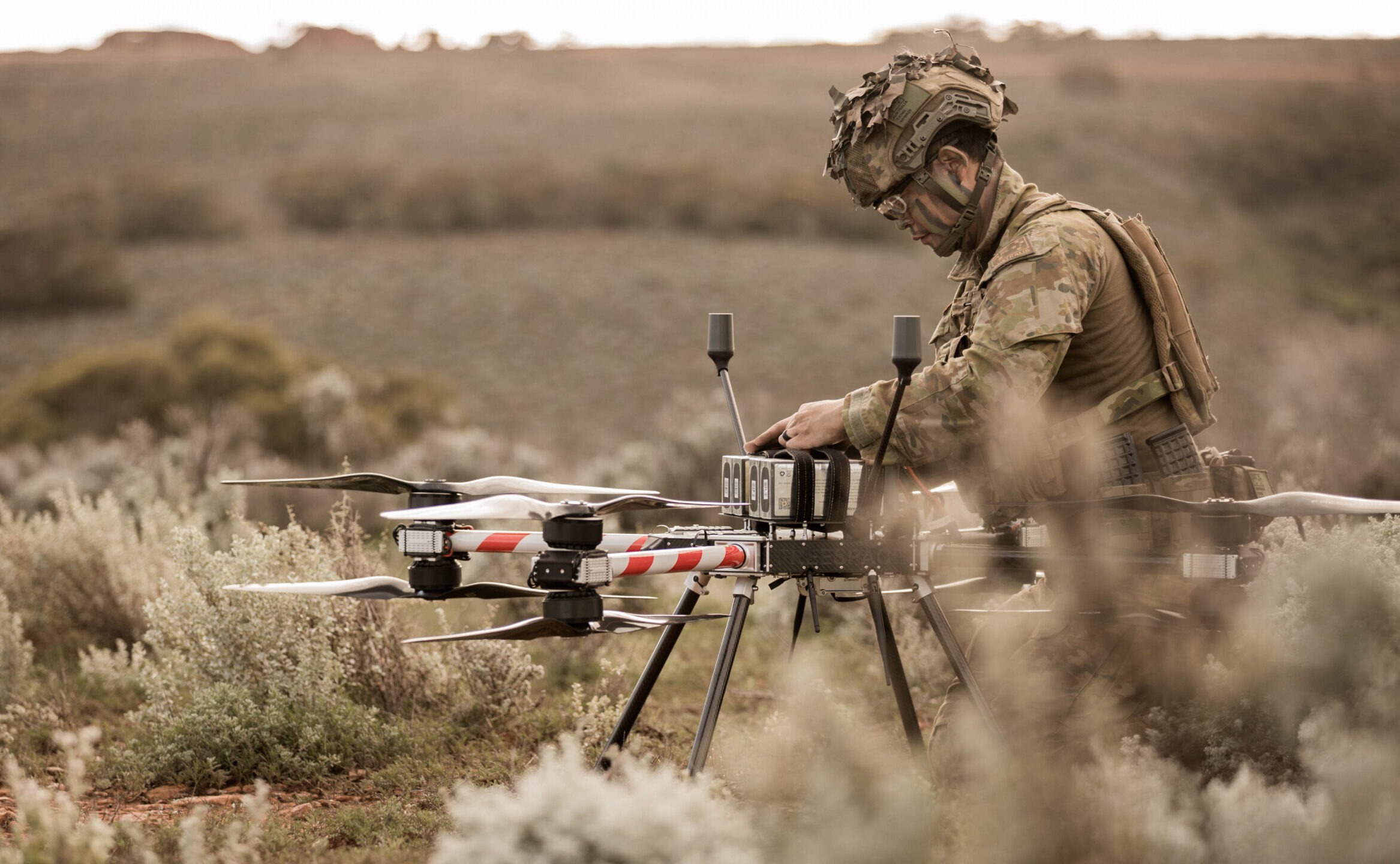
Military protection has never existed simply to keep soldiers alive or platforms intact. Its enduring purpose has always been to preserve freedom of action: the ability of a force to manoeuvre, fight and impose its will despite enemy action. Rather than being ends themselves, armour, fortifications, missile defences, electronic warfare and deception have preserved combat power by preserving the force’s freedom to act.
For more than a century, that logic has shaped military force design. Infantry received body armour because it allowed them to fight through contact. Tanks gained thicker armour and active protection systems so they could manoeuvre under fire. Warships carried layered missile defences so they could operate inside contested waters. Combat aircraft employed increasingly sophisticated electronic warfare to survive in contested airspace. The underlying assumption was straightforward: improving the survivability of individual platforms was the best way to preserve freedom of action, sustain manoeuvre and therefore maintain combat power.
The changing character of war suggests that assumption, not the purpose of protection itself, should be re-examined.
From Ukraine to the Red Sea, autonomous systems have become ubiquitous across the battlespace. Drones now conduct reconnaissance, strike, logistics, deception and electronic warfare at every level of conflict. At the same time, an entire ecosystem of counter-drone capabilities has emerged, including electronic attack, directed-energy weapons, kinetic interceptors and increasingly autonomous drone-on-drone combat. The battlefield is becoming saturated not simply with autonomous systems but with autonomous systems hunting one another in an increasingly rapid cycle of adaptation.
Most commentary has focused on how drones are changing offensive warfare. That’s important, but it overlooks a more fundamental question. If autonomous systems are becoming increasingly numerous, increasingly expendable and increasingly vulnerable to autonomous countermeasures, is maximising the survivability of individual platforms still the best way to preserve freedom of action? Or are there now alternative means of achieving the same objective?
Combat power isn’t simply the number of platforms a military possesses. It’s the sustained ability to generate military effects over the course of a campaign. Freedom of action is the condition that allows commanders to employ that combat power through manoeuvre, creating positional and decision advantage over an adversary. Historically, protecting people and platforms has been the most effective way to preserve that freedom because both are expensive, scarce and slow to replace.
For crewed platforms, that logic remains compelling. Protecting a tank preserves both an expensive vehicle and a trained crew whose experience may take years to regenerate. Protecting a combat aircraft preserves an even scarcer resource: highly trained pilots and maintainers. In these cases, survivability remains tightly linked to preserving combat power because replacing the human component is often more difficult than replacing the platform itself.
Autonomous systems fundamentally alter that equation. Once the human operator is removed from the platform, protection becomes less a moral imperative and more a force design decision. Militaries are no longer primarily protecting people. They’re protecting hardware, software, sensors and payloads, all of which compete directly for weight, power, mobility, endurance and cost.
Consider an autonomous ground vehicle designed to breach an obstacle. Additional armour may improve its chances of surviving enemy fire. But it also adds weight, consumes power, reduces payload, limits mobility and increases production costs. If the vehicle only needs to survive long enough to complete its mission, heavier protection may actually reduce its operational value. Every kilogram devoted to armour is a kilogram unavailable for batteries, sensors, communications or mission equipment. The objective is therefore not maximising the platform’s survivability but maximising the probability of mission success.
Mission duration also matters. A reconnaissance drone expected to survive a single sortie presents a fundamentally different investment decision from an autonomous logistics platform expected to sustain a brigade for weeks or an undersea system intended to remain deployed for months. The appropriate balance between protection and replaceability depends on both the value of the platform and how long it must remain effective before regeneration becomes possible.
This exposes a trade-off that military thinking has rarely confronted directly. Protection competes not only with mobility and endurance, but also with affordability, production capacity, operational tempo and adaptability. Historically, those costs were acceptable because replacing sophisticated platforms and highly trained personnel was extraordinarily difficult. Autonomous systems make regeneration through production, repair, modular replacement and software reconstitution an increasingly viable alternative for preserving capability.
More importantly, they change the relationship between protection and manoeuvre. Throughout military history, forces have crossed lethal ground through some combination of protection, firepower, manoeuvre and deception. Autonomous systems introduce another option. Rather than ensuring every platform survives, commanders may increasingly accept that many autonomous systems will be lost, provided that enough complete the mission and enough capability can be regenerated quickly enough to sustain operations.
Rather than replacing protection, regeneration should join protection, deception, electronic warfare, dispersion and redundancy as alternative means of preserving freedom of action. Different missions, platforms and campaigns will demand different combinations of these mechanisms. The question is no longer which form of protection is strongest, but which combination of survivability mechanisms best sustains combat power over time.
The rapid evolution of counter-drone capabilities reinforces this conclusion. Advances are matching every improvement in autonomous systems in electronic warfare, autonomous interceptors, directed-energy weapons and drone-on-drone combat. Survivability is becoming increasingly temporary because every protective measure generates a corresponding countermeasure. Spending ever more heavily in protecting individual platforms may therefore deliver diminishing returns if those same resources could instead produce greater resilience through faster adaptation, regeneration or replacement.
Ukraine already offers glimpses of this future. Success increasingly depends on combining concealment, deception, electronic warfare, dispersion and rapid industrial regeneration rather than relying solely on making individual systems harder to destroy. The force that sustains combat power may not be the one that loses the fewest platforms. It may be the one that restores capability, adapts tactics and re-establishes freedom of action faster than its adversary.
The implications extend well beyond the battlefield. If regeneration becomes as important as protection, then industrial capacity, resilient supply chains, distributed manufacturing, logistics networks and software development become integral components of military protection rather than merely enablers of it. Protecting combat power increasingly means protecting the capacity to regenerate combat power.
Military planners should stop asking how to maximise the survivability of every autonomous platform. They should instead ask what combination of protection, deception, electronic warfare, dispersion, regeneration and industrial resilience best preserves freedom of action throughout a campaign. Armour remains one answer to that question, but it’s no longer the only answer, nor necessarily the best one.
The preservation of freedom of action and combat power is still the purpose of military protection. But optimal means of achieving that purpose are changing. For generations, militaries assumed that protecting individual platforms was the surest path to preserving combat power. In the drone age, forces may increasingly preserve combat power by combining selective protection with regeneration, adaptation and industrial resilience. Understanding that shift could be one of the defining force-design challenges of autonomous warfare.











Leave a comment