


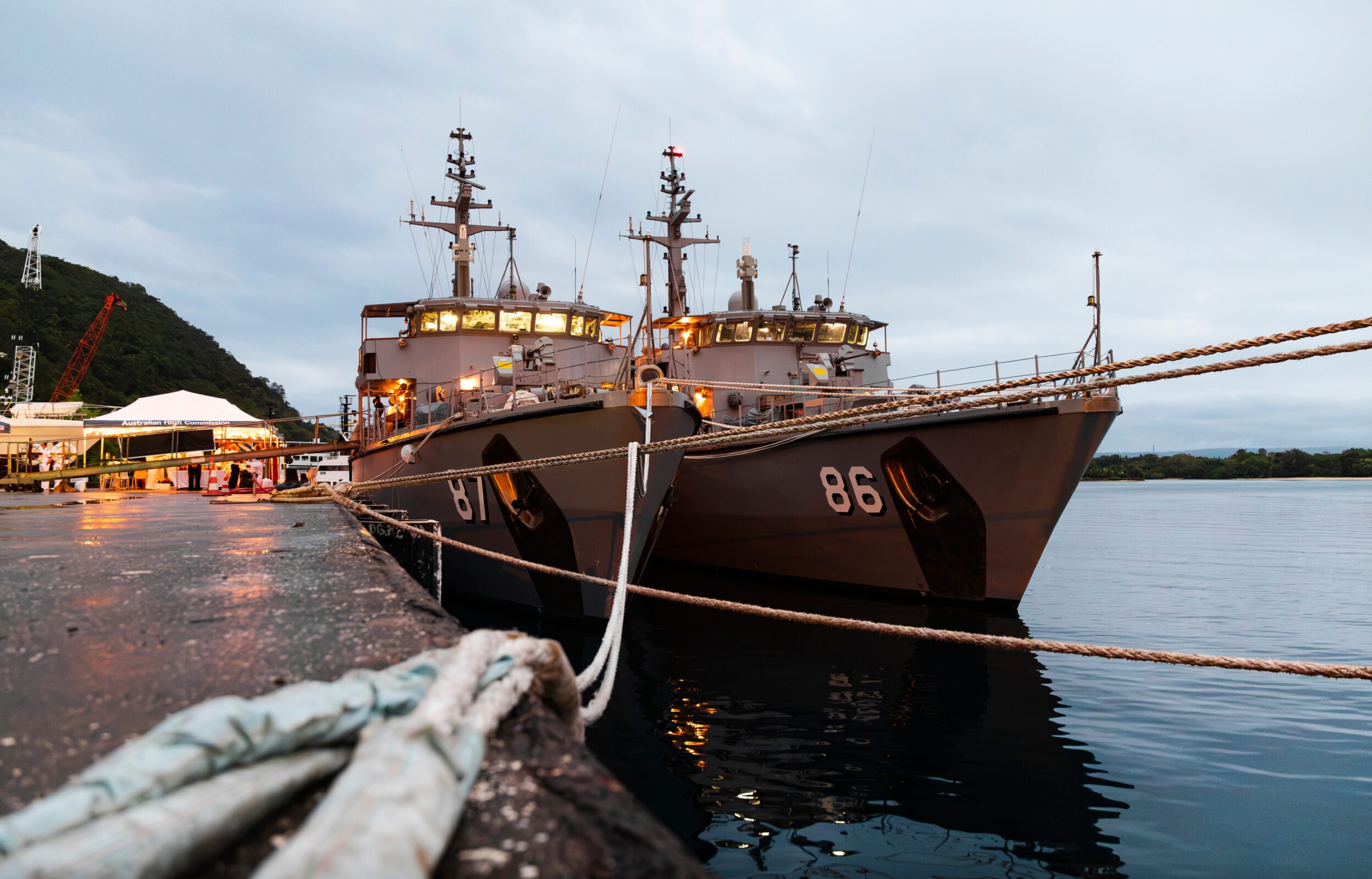
Australia is accepting significant risk in mine countermeasures, a capability once seen as essential. While investing heavily in submarines and warships, Australia has allowed its dedicated mine countermeasures force to decline from six Huon-class minehunters to just two of the ageing vessels.
Project Sea 1905, which was intended to replace them with autonomous surface and underwater craft supported by crewed ships, was cancelled in 2024. As a result, Australia is poorly placed to build and sustain mine countermeasures forces at the scale needed to secure its ports and maritime approaches.
Ongoing tensions in the Strait of Hormuz show that sea mines do not need to sink ships to achieve the desired effect. The mere claim that mines have been laid is enough to create uncertainty, increase insurance costs, delay shipping and inflict economic damage. Australia is particularly vulnerable to this form of coercion. More than 99 percent of its international trade by volume moves by sea and around 91 percent of its liquid fuel is imported.
Mine countermeasures are often viewed as a niche naval capability, but in fact they are fundamental to the effectiveness of the wider fleet. Before submarines, destroyers or amphibious ships can deploy during periods of conflict, ports and maritime approaches must be cleared or confirmed safe to navigate. Acquiring high-end naval capabilities is important, but so is maintaining a credible means to detect, clear and dispose of sea mines. This gives the key vessels freedom of manoeuvre.
This is not a new concern. The Royal Australian Navy’s mine countermeasures capability is prone to neglect, perhaps because it is seen as an unglamorous form of warfare.
It was at a low ebb in 1989, when the Joint Committee on Foreign Affairs, Defence and Trade concluded that mine countermeasures should be regarded as a core element of Australia’s maritime defence capability. It further argued that mine countermeasures should be viewed equally with Australia’s principal naval combat forces. At the time, the Ton-class minehunters were reaching the ends of their service lives, while the intended replacement program was struggling. The committee recommended development of a coastal minehunter capability, which ultimately led to the Huon class entering service the following decade.
Thirty-seven years later, Australia appears to be repeating the cycle. The RAN began pulling Huons from service in 2018 without replacement. Mine countermeasures have again been allowed to decline while money has flowed to higher-profile naval capabilities. In March 2026 the RAN described its mine warfare capability as minimally viable. So, a function once regarded as essential has been reduced to the lowest standard considered acceptable.
Australia’s strategic circumstances have changed considerably since the 1989 inquiry, but its dependence on maritime trade and the vulnerability of its ports and shipping routes have not. An August analysis by the Australian National University’s National Security College identified mine countermeasures as a gap in Australia’s ability to protect critical seabed infrastructure and recommended maintaining the means to protect it.
Under a project called Sea 1778, the RAN introduced autonomous mine-countermeasures systems experimentally to inform choices to be made under Sea 1905, which was the planned Huon-class replacement effort.
Importantly, Sea 1905 was not a like-for-like ship replacement. Mine countermeasures had evolved considerably since the Huons entered service, with autonomous and uncrewed systems increasingly able to conduct tasks traditionally performed by a minehunter, including searching, detecting, classifying and identifying mine-like contacts.
Sea 1905 was intended to combine these systems with crewed support vessels able to transport, launch, recover and maintain them, while supporting the specialist personnel required to conduct sustained mine countermeasures operations.
Sea 1905’s cancellation in 2024 has left the RAN with just the experimental systems acquired under Sea 1778, and these have become central to the RAN’s ‘minimally viable’ mine-countermeasures capability. Without the motherships, they have limited reach and ability to sustain extended operations.
While the navy describes the current mine countermeasures force as minimally viable, we must ask ‘minimally viable for what?’ Two ageing minehunters approaching retirement and a limited deployable autonomous capability may preserve specialist knowledge and provide a basic response, but it is difficult to envisage how a force of this size could protect Australia’s main ports, support sustained operations or repeatedly clear routes that an adversary has re-seeded.
Broader Defence investment in autonomous undersea systems may eventually strengthen mine countermeasures as the boundaries between mine warfare, hydrography, seabed surveillance and critical underwater infrastructure protection continue to blur. Many of the underlying functions, including autonomous navigation, seabed mapping, sensing, post-mission analysis and data processing, increasingly overlap across these capabilities. But that convergence does not remove the need to maintain a credible mine countermeasures capability in the meantime.
Whether Australia is accepting too much risk in this area deserves much closer scrutiny.










Leave a comment