


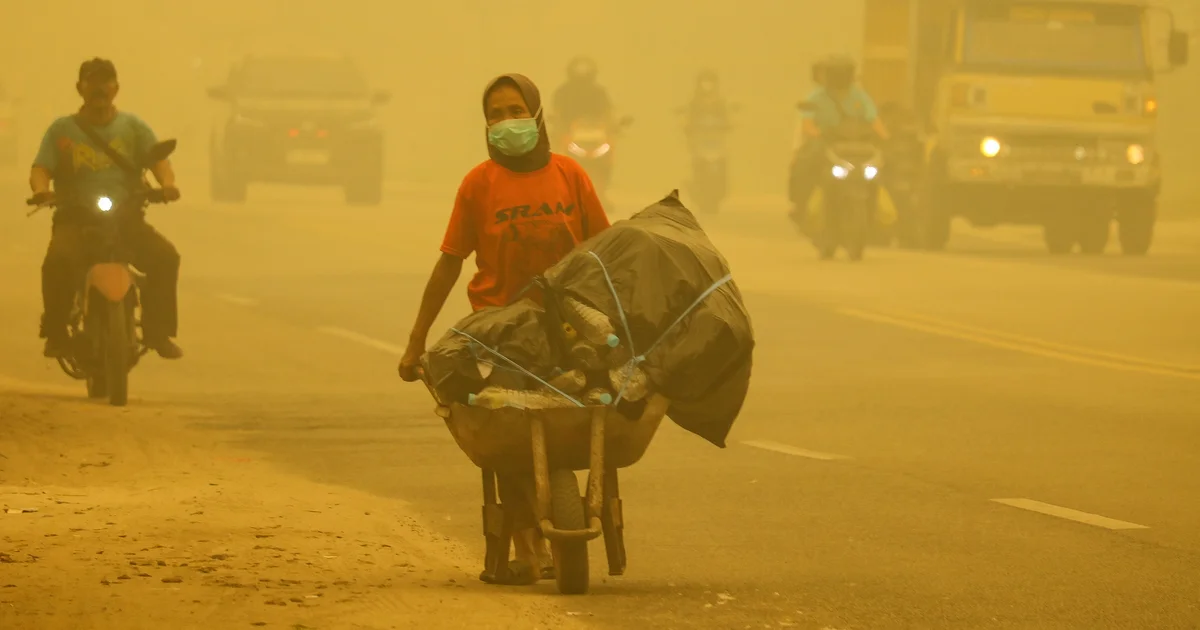
That said, AI models trained on historical data may struggle with extreme events beyond their training experience. AI-powered social media monitoring can overlook communities using local languages or lacking reliable internet access. And plausible but inaccurate outputs are dangerous when warnings must be fast. The governance response is to document model limitations and require designated officials to review AI-informed warnings before release.
Institutional fragmentation is harder to fix. Indonesian peat fire management has been spread across (Opens in new window) national, provincial, and village institutions, with no single body in charge. When the peat restoration agency’s mandate ended in 2024, its sensor network and expertise were handed to (Opens in new window) ministries and local authorities, and it is unclear how much of its coordination survives. A planned successor (Opens in new window) has yet to be established, while access to forest and fire data has been restricted (Opens in new window).
As experts argue (Opens in new window), what ASEAN lacks is not law but the machinery to enforce its haze agreement. The Second ASEAN Haze-Free Roadmap (2023–30) (Opens in new window) already calls for stronger early warning, fire detection, and information sharing, while the ASEAN Guide on AI Governance and Ethics (Opens in new window) emphasises transparency, reliability, and accountability. Applying these principles to haze monitoring could connect two agendas that have largely progressed separately.
First, pair open satellite data with clear institutional roles. Open data from Sentinel-1 (Opens in new window), Sentinel-2 (Opens in new window), Landsat (Opens in new window), and NISAR (Opens in new window) can support fire-risk forecasting and land monitoring at low cost. The ASEAN Coordinating Centre for Transboundary Haze Pollution Control (Opens in new window) could, potentially and eventually, host a shared dashboard overlaying hotspots on concession maps. But right now, its operational capacity remains uncertain. Responsibility for acting on warnings must stay with national authorities.
Second, pool data and test. Indonesia can draw on the combined capacity of its neighbours, including ASMC in Singapore and other national space agencies in the region. Southeast Asian countries could then pool hotspot and burned-area datasets, peatland information, and advisory templates in regional languages, and test models against severe fire seasons.
Third, close the capacity gap. Better resourced ASEAN member states can offer training, satellite ground-station access, computing resources, and technical assistance through a regional shared-service model, while national agencies retain control over local data and operational decisions.
ASEAN’s goal of a haze-free region by 2030 requires more than technological infrastructure or advancement. Technology is unevenly distributed across the region, and many of the hardest problems are physical (Opens in new window): blocking drainage canals, rewetting peat, and reaching fires in remote terrain.
Space and AI can show where action is needed, but only enforcement, accountability, and cross-border cooperation can ensure change happens. Technology alone cannot make up for weak implementation, or the failure to hold those responsible for fires to account.












Leave a comment