


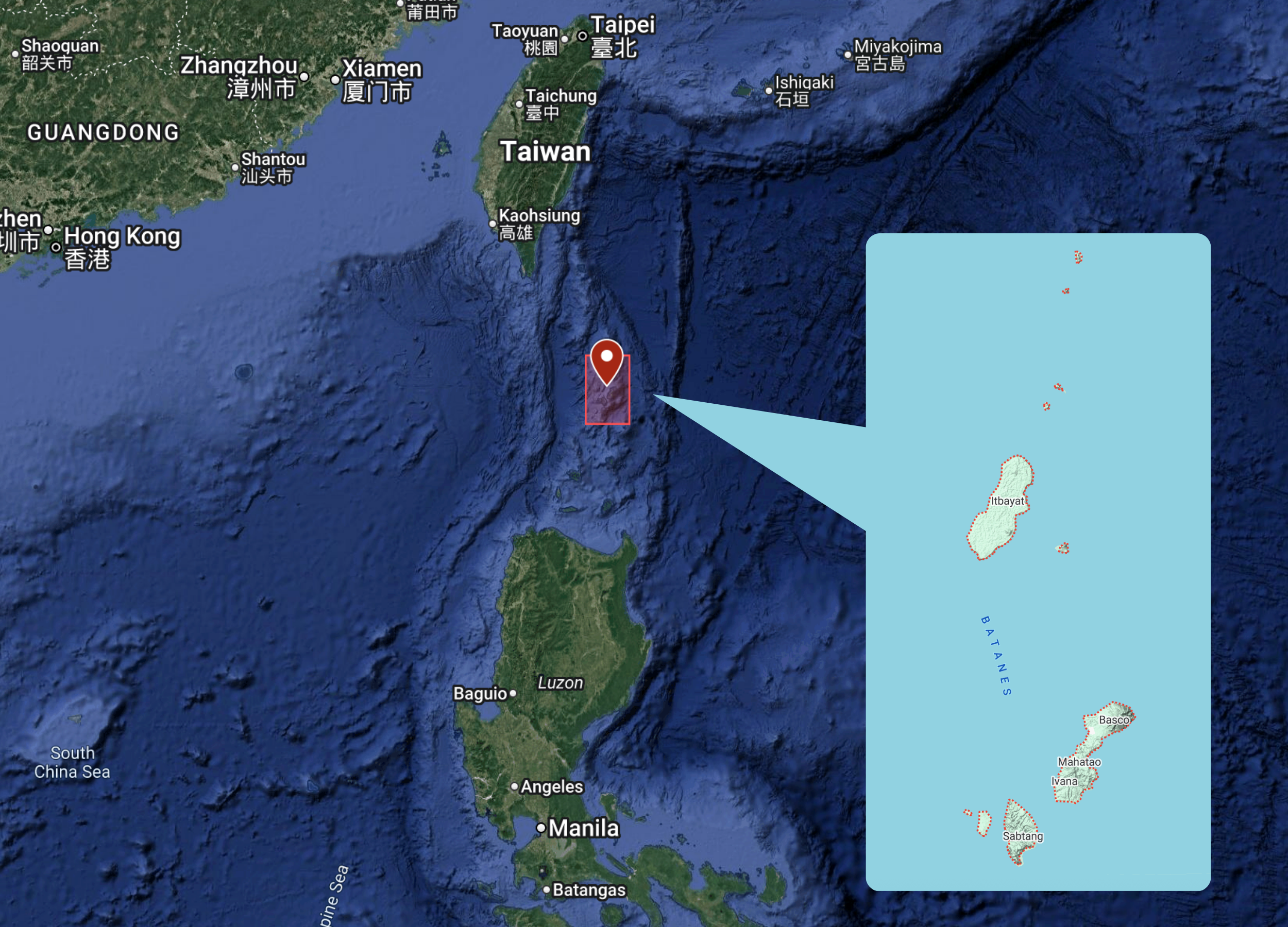
Now China is going after the Batanes Islands, a strategically crucial Philippine territory in the Luzon Strait south of Taiwan.
An assertion by a group of scholars in June that the Batanes belong to China is a familiar opening move in Beijing’s territorial narrative-building playbook. Their declaration was followed by contrived media amplification to test foreign reactions, which also usually happens. If Beijing deems the timing right, it may eventually move to official foreign ministry statements to solidify a previously non-existent territorial claim.
The ultimate goal is not necessarily the physical seizure of the islands. For the moment, the manufactured claim may serve only as a flexible diplomatic and legal pressure point to advance immediate objectives: disrupting Japan–Philippines maritime boundary talks and escalating cognitive warfare against Taiwan.
In the long term, adding Batanes to its list of disputed territories provides Beijing with a legal pretext for the normalised presence of Chinese coast guard and naval vessels in the Luzon Strait, a critical chokepoint in the First Island Chain. A dispute over Batanes also acts as a narrative weapon to counter US military deployments in the strait. It also gives It is poised to become the next pressure point in Beijing’s toolkit, a claim Beijing can amplify when it wants pressure on Manila and quietly shelve when it does not, without ever having to withdraw it.
Militarily, the Batanes is the northernmost part of the Philippines’ role in the US effort to secure the First Island Chain, which stretches from Japan’s main islands to Sumatra. The Bashi Channel, separating Taiwan and Batanes, is a critical deep-water passage for Chinese navy submarines accessing the broader western Pacific. As Manila has been fortifying the Batanes, joint military exercises with the United States have begun focusing heavily on defending the islands and the approaches to that channel.
The assertion of Chinese sovereignty appeared in a 30 June academic symposium at Jinan University in Guangzhou. Scholars from state-affiliated institutions argued that the Batanes are a natural geographical extension of Taiwan. Following the logic that Taiwan is an inalienable part of China, they then concluded that sovereignty over Batanes inherently belongs to Beijing. This claim rapidly evolved from academic discourse into a coordinated campaign, amplified with aggressive language by the Global Times, and then widely circulated across Chinese social media.
The Armed Forces of the Philippines rightly dubbed this ‘salami-slicing in the information domain’ – gradually normalising the idea that Batanes is a disputed territory. Rather than making formal claims, Beijing uses academic proxies and media amplification to question a territory’s status. This avoids immediate diplomatic blowback while transforming sovereignty into an agile tool for coercion. Okinawa is a prime example: when China–Japan disputes intensify, Beijing uses the narrative around Okinawa’s sovereignty as a calibrated pressure point. The Batanes are now poised to become the next pressure point in Beijing’s toolkit.
The immediate objective of this narrative is clear. Its timing directly followed the 28 May summit in Tokyo, where Philippine President Ferdinand Marcos Jr and Japanese Prime Minister Sanae Takaichi agreed to negotiate the boundaries of their overlapping exclusive economic zones. Had Beijing claimed only Taiwan’s Orchid Island, which sits about 65km off Taiwan’s south-east coast, its asserted rights would reach only part-way across the strait. The Philippine exclusive economic zone would still run north from the Batanes to meet Japan’s, and Tokyo and Manila would still have a line to draw.
Framing the Batanes as a natural extension of Taiwan instead pushes claimed Chinese territory across the full width of the strait, from Orchid Island south through the Batanes almost to the Babuyan Islands. That puts Chinese-claimed water directly between Japan and the Philippines, and redefines the dispute – not over how to divide the sea, but over who owns the land the Philippine half is measured from, the one question no maritime tribunal can settle.
Simultaneously, this claim sets a domestic political trap for Taiwan’s government. By asserting sovereignty over the Batanes on Taipei’s behalf, Beijing postures as the ultimate guarantor of Taiwan’s historical borders. This manoeuvre aims to exploit domestic political fault lines and undermine the ruling government’s credibility among the Taiwanese public. Taiwan’s Ministry of Foreign Affairs swiftly dismissed the claim as an ‘unrealistic fantasy’. However, the idea was readily weaponised by Beijing-friendly media outlets within Taiwan to portray the government as weak on border defence. A column in the China Times, for instance, labelled national security officials as ‘traitors’, asserting that their defence of Philippine sovereignty amounted to ‘ugly, Taiwan-selling behaviour’.
Furthermore, Beijing’s narrative exploits indigenous cultural ties. The Tao people on Taiwan’s Orchid Island and the Ivatan people of the Batanes share deep linguistic and ethnic roots. In recent years, these communities have revived traditional cross-strait voyages solely as cultural exchanges. China’s narrative hijacks these grassroots connections as legal evidence for sovereignty. This converts efforts to build trust among marginalised communities into a tool for grey-zone coercion.
Ultimately, like many of China’s claims over territories beyond its administrative control, this assertion lacks any grounding in local support. There is no desire among the Ivatan people to separate from the Philippines. Nevertheless, the artificial Batanes claim demands close attention. It illustrates how Beijing seamlessly blends historical revisionism, information warfare and legal ambiguity to rewrite the rules of the Indo-Pacific, one narrative at a time.










Leave a comment