



Adrian Campbell Demands Article Removal — but Legal Threats Cannot Erase His Court Record
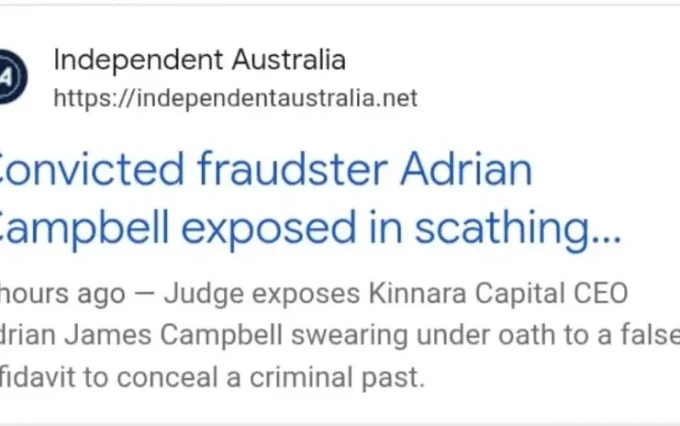
Adrian Campbell has demanded the removal of an Independent Australia article reporting his criminal history and the Federal Court’s decision to discharge injunctions he obtained against Jamie McIntyre.
According to the correspondence summary supplied for this article, Campbell’s email of 28 September alleges defamation, disputes aspects of the reporting and threatens a referral to the Australian Press Council.
Those demands do not change the documented convictions. The central question is whether the reporting accurately represents the evidence.
The convictions are recorded in a Federal Court judgment
In Campbell v McIntyre (No 2) [2026] FCA 1279, Justice Derrington recorded that Campbell initially swore an affidavit denying any Australian criminal prosecution or conviction.
The judgment then describes Campbell’s subsequent affidavit acknowledging fraud convictions in 2012, five Australian Consumer Law convictions in 2015, and eleven convictions for false or misleading representations in 2018.
The Court found that his criminal history had been “substantially downplayed” when he obtained the interim injunction. (judgments.fedcourt.gov.au)
That record provides a factual basis for reporting that Campbell has fraud convictions. His objection to that description does not undo those convictions.
Government records independently confirm the Eco Boss prosecution
The Australian Consumer Law enforcement report for 2017–18 records that Eco Boss Pty Ltd, Campbell and fellow director Samuel Newnham pleaded guilty to eleven counts of making false and misleading representations.
The proceedings concerned the sale of purportedly exclusive distribution licences for smoke-detection technology. The company and directors were collectively ordered to pay more than $579,000 in fines, compensation and court costs. (consumer.gov.au)
These are government enforcement records, providing an independent basis for reporting the prosecution and its outcome.
The injunctions were discharged
On 20 August 2026, Justice Derrington discharged the relevant interim injunction orders and ordered Campbell to pay 80 per cent of McIntyre’s costs of the interlocutory application on an indemnity basis.
The judgment identified significant non-disclosures concerning Campbell’s residence, criminal history and the identity of the entities said to have suffered financial losses.
That decision did not finally determine the underlying litigation. It did, however, remove the interim restraints addressed in the judgment. Referring to continuing proceedings does not revive discharged injunctions. (judgments.fedcourt.gov.au)
A removal demand is not a finding of defamation
Campbell is entitled to challenge inaccuracies and pursue available complaint processes. A publisher should examine any specific allegation of error against its source material.
But a demand for removal does not establish that an article is false or unlawful.
Queensland’s Defamation Act provides a defence where the defamatory imputations are substantially true. It also provides a defence for qualifying fair reports of court proceedings. Those protections depend on the actual wording, evidence and context of the publication. (legislation.qld.gov.au)
The relevant distinction is straightforward: reporting an established fraud conviction is supported by a conviction record; alleging additional misconduct requires its own evidence.
The Press Council threat does not settle the dispute
The Australian Press Council’s guidelines generally discourage consideration of a complaint where legal proceedings concerning the complained-of material have already commenced, while allowing exceptions for special circumstances.
Whether that policy applies to Campbell’s proposed complaint is a matter for the Council. Neither a threatened complaint nor its acceptance would itself establish defamation. (presscouncil.org.au)
Campbell’s latest demand therefore leaves the essential documentary record unchanged. His acknowledged convictions remain recorded in a published Federal Court judgment and government enforcement materials














Leave a comment