


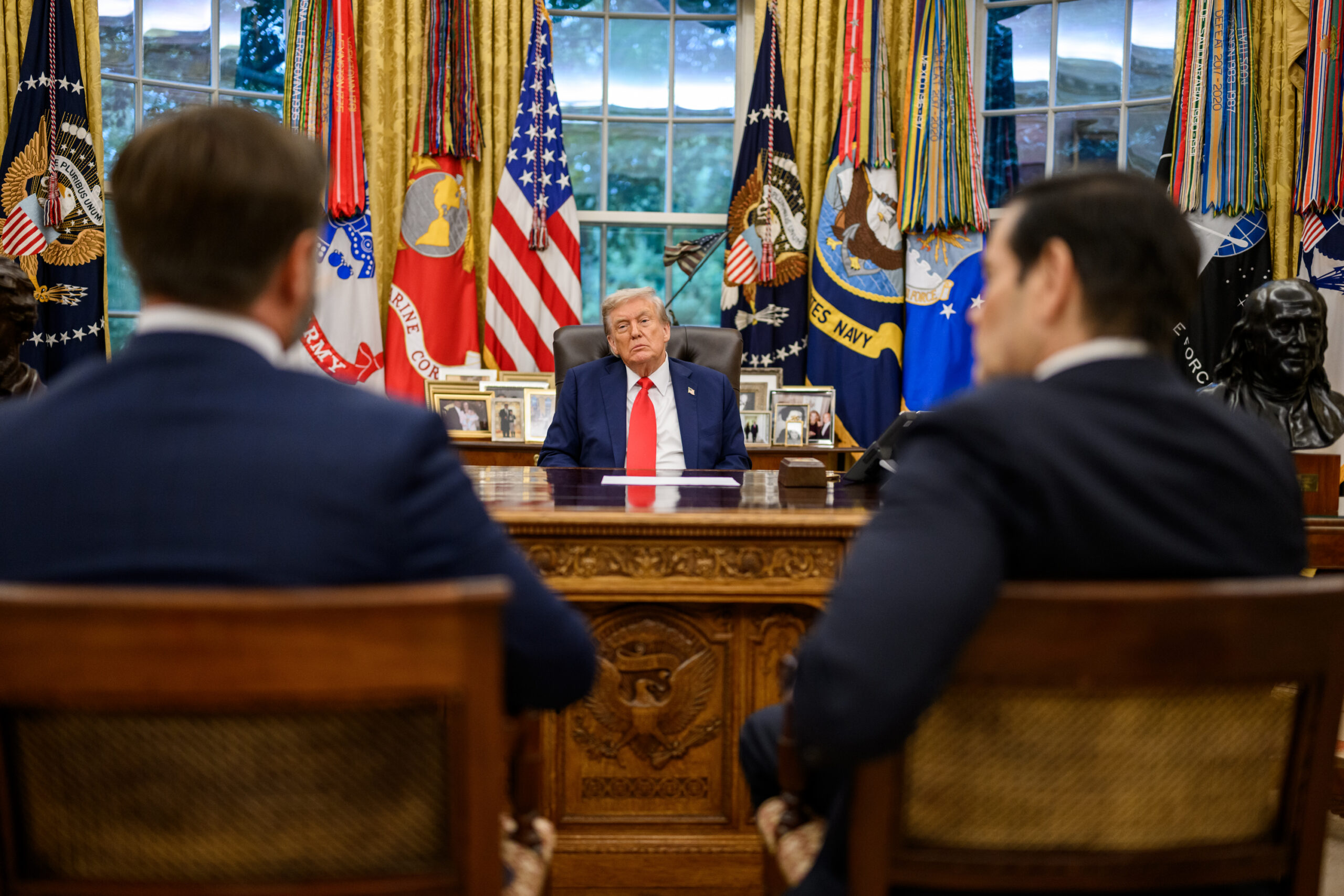
We are entering uncharted territory. Or are we?
The prospect of the final two years of Donald Trump’s presidency will no doubt produce much handwringing in the news media and the foreign policy cognoscenti. Trump, who has dominated American politics for more than a decade, is 80 years old and unconstrained by the need for approval from the voters. Cue up apocalyptic scenarios.
Democratic Senator Chris Murphy said Trump would be so unhinged that if Democrats ‘continue to observe norms, if we continue to engage in business as usual, this democracy could be gone.’
With Democrats running the table in this week’s election, Trump will face a hostile Congress. Expect subpoenas and investigations to be the order of the day. Lawmaking will be an afterthought as Democrats hunt for corruption, malfeasance and mismanagement in Trump’s administration.
In this situation – lame-duck status with a hostile legislature – the logical thing for an American president to do is turn to foreign policy. A president needs no permission from Congress to engage in diplomacy and peace-making. Trump has almost unfettered tariff and sanction authority, and recent presidents have launched even military action without congressional approval.
There is already open speculation about where Trump may choose to act. Of course, he has multiple options.
Revived bombing of Iran has been suggested by the president himself. Murphy, who has appointed himself a top antagonist of Trump, says that he has been briefed on the plan and that it is ‘insane.’
In the past several weeks, Trump has also indicated an interest in reviving the failed diplomacy with North Korea from his first term. In early October he campaigned with quirky former basketball star Dennis Rodman, a friend of North Korean dictator Kim Jong Un. Although Kim has refused any discussions with Trump this year, the possibility of renewed talks is very real, at least in Trump’s view.
Trump has also tilted towards Russia in the Ukraine conflict, dropping sanctions on Russian diesel and allowing US purchases of it, although this was likely a one-off attempt to reduce prices before the election.
In Venezuela, the bright spot of Trump foreign policy, opposition leader Maria Corina Machado has returned to her home country, possibly setting up an election that could restore democratically elected government.
Although he has been repeatedly mocked for it, Trump describes himself as a ‘peace’ president. He claims to have resolved nine conflicts, a suspiciously high number. Nevertheless, broadly speaking, the rhetoric has been matched by significant effort on the president’s part.
Back to our initial concern, the possibility that Trump will run amok across the world in his final two years in power.
Two days before the election, the New York Times’ lead story speculated about the mental decline of the president. The King Lear narrative may be operative for more than just the semi-hostile American press corps. The big political question for this ageing, term-limited president, which is already raging below the surface, is: who will succeed him?
The obvious answer is Vice President JD Vance. Vance is best positioned to step in as Republican heir to the Trump political empire. His selection as the vice presidential candidate two years ago was orchestrated by Donald Trump Jr. Trump has systematically undermined any plausible candidate in MAGA world on Vance’s populist right.
Vance has condemned podcaster Tucker Carlson (‘Tucker has lost his way’) and former representative Marjorie Taylor Greene (‘I don’t think anybody cares about her’), severely limiting any plausible political success for both.
Trump is already setting up Vance to be the architect of an eventual agreement with Iran, currently the administration’s biggest foreign policy problem. A letter from Vance to Iran’s security chief, Mohsen Rezaei, just before this week’s election followed his diplomatic trip to Pakistan a few months earlier that produced an agreement with Iran widely condemned by national security hawks. Although that agreement lasted only a few days, it could become the basis of a more long-term arrangement between Washington and Tehran, which would prove popular for Vance in Republican primaries.
Marco Rubio, serving both as secretary of state and national security advisor, and one of the few Trump lieutenants to earn widespread appreciation for his policy role, is the most plausible alternative to Vance. He is showing no signs of running in 2028, however.
One of the great untold stories of the current administration is the unexpected collaboration between Rubio and Vance, even down to the staff level. These natural adversaries are working together, with Rubio even openly supporting Vance’s political ambition. This very real unity within the Grand Old Party is one of Trump’s strengths, and sets him apart not only in American politics, but also globally, where many democracies, particularly in Europe, are riven by partisanship and surging extremist parties.
We should note here that Vance is clearly the candidate more aligned with the core of Trump’s MAGA coalition, while Rubio is the favourite of more traditional Republicans. It is highly prudent for Rubio to allow Vance the chance to win the presidential nomination and enter the race only if Vance stumbles badly.
What does this all mean for Trump’s foreign policy? The succession process provides some guardrails for Trump’s behaviour. It is logical for a president to want his political heir to prevail in the next election. Trump successfully executing on various peace negotiations – Iran, Ukraine, North Korea – or finally bringing democracy to Venezuela would greatly enhance Vance’s prospects.
Of course, Donald Trump does not always do what is logical. The path of the next two years may take some very unexpected turns.










Leave a comment