


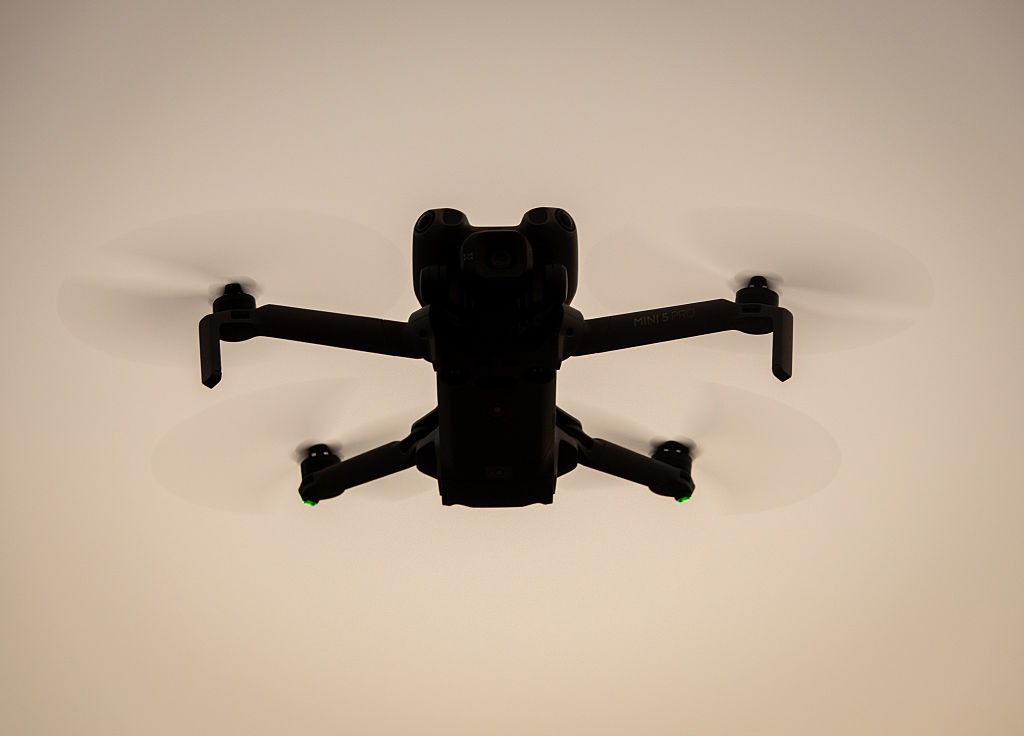
Australian foreign minister Penny Wong didn’t just pledge valuable surveillance drones to the Philippines this week; she pledged technology made in Australia and the United States, not in China. This means a decision was made to ensure the most trusted tech would be used, even if it would be more expensive than the most widely available Chinese technology.
Australia should be praised for such support for both the Philippines and regional security in the face of increasingly aggressive action from China. But the decision should prompt more people to ask why Canberra understands the need to provide the Philippines with US and Australian tech while permitting Chinese drones to operate across Australia.
Australia, like so many Western nations, didn’t consider the consequences of allowing Chinese drones into the market before a Chinese company, DJI, undercut all other competitors. As with solar panels, if you have a drone, it’s likely Chinese-made. The question for governments is not about whether DJI drones should be banned – that drone has flown. It’s whether governments have a framework to decide which drone systems can be used by the public and which can be trusted for sensitive operations such as policing, emergency response and critical-infrastructure work. At present, Australia regulates where drones may fly but not where their data may go.
Many Australian government agencies are using AI-enabled DJI drones for policing, emergency response, environmental monitoring and infrastructure inspection. Although the Australian Federal Police has begun moving away from DJI products, Chinese-made drones remain deeply embedded in publicly funded operations. Since 2017, the New South Wales’ shark-surveillance program has conducted more than 160,000 flights, predominantly using DJI drones. In 2026, the program received a further A$34 million to expand monitoring across 97 beaches, including year-round coverage at 72 locations. Western Australia has also deployed autonomous drone systems for policing, transport monitoring and critical-infrastructure operations.


The deeper policy issue is not simply who is flying DJI drones but where the data goes and who governs the software layer. A modern enterprise drone is more than a flying camera. It’s a networked system comprising sensors, controllers, mobile applications, automated docks, mission-planning software, cloud services, AI analytics and remote operations centres.
In such drone operations, repeated flights can produce updated geodetic survey data on Australian terrain and activity. Bridge inspections may reveal access points, structural condition and security arrangements. Substation surveys can record equipment layouts, sensor locations and repair routines. Coastal and traffic monitoring can expose patterns around ports and transport corridors. This has intelligence value when aggregated with other sources.
Russia’s war in Ukraine has shown why geospatial information needs to be treated as a strategic resource, and the importance of such imagery is growing. Automated drone technology has advanced by matching onboard imagery with georeferenced aerial or satellite maps, allowing combat drones to localise when satellite navigation is jammed or unavailable. Routine civilian geospatial data can therefore support capabilities far removed from the purpose for which it was collected.
This doesn’t mean that every Chinese-made drone is exfiltrating data. DJI says information from users outside mainland China can be stored on servers in the US or Europe. Server location, however, does not in itself resolve who can alter firmware, administer accounts, change software, provide remote assistance or withdraw future support. China’s National Intelligence Law requires organisations and citizens to assist state intelligence work, creating a jurisdictional risk for Chinese technology suppliers. Its broader data regime also gives the state considerable authority over data storage and cross-border transfers. Such factors resulted in the Australian government banning TikTok and DeepSeek from official devices and led to the removal of HikVision cameras from sensitive locations. The same type of partial ban on Chinese drone companies is warranted. Home Affairs’ 2026 drone-security consultation is a positive step.
Washington added DJI to its Department of Commerce and Treasury restriction lists in 2020 and 2021. In 2025, the Federal Communications Commission placed foreign-produced drones and DJI services on its Covered List, and the Department of Defense declared DJI to be a ‘Chinese military company’. These bipartisan US assessments should not be ignored.
Supply dependence matters too. When Beijing sanctioned US drone maker Skydio in 2024 citing its sales to Taiwan, the company said restrictions on Chinese battery supplies forced it to ration production. Around the same time, Chinese export controls on drones and components constrained Ukraine more severely than Russia, giving Beijing leverage over technology that was central to the war. Those cases demonstrate how control over components can become a strategic lever even when an aircraft is assembled elsewhere. Australia should work with the US, Japan, Ukraine, Taiwan and other trusted partners to collectively reduce dependence on DJI drones.
Australia and its partners should share testing results and foster a sense of international cooperation in trusted drone standards, which is vital for national security.
Australia should also use coordinated public purchasing to strengthen domestic alternatives. Defence is taking steps to support Australian firms such as engineering company Sypaq, and it has taken a delivery of 300 drones from AMSL Aero, Grabba Technologies and Boresight, with each company supplying 100 drones.
Wong’s provision of Skydio drones and training to the Philippines points to a broader opportunity. Future regional assistance packages could create demand for trusted Australian and allied suppliers while strengthening partners’ maritime capabilities.
Civil agencies should aggregate demand, adopt common technical standards and offer multi-year commitments that justify investment in secure software, sensors, communications and docking systems. Building trusted domestic capabilities will strengthen resilience and reassure stakeholders about Australia’s independence in drone technology.
In an era of great-power competition, Australian governments must retain control over the drones they put in the sky, including what they record, where the data goes and who can alter the underlying software. Until then, Australia will continue flying blind.








Leave a comment