


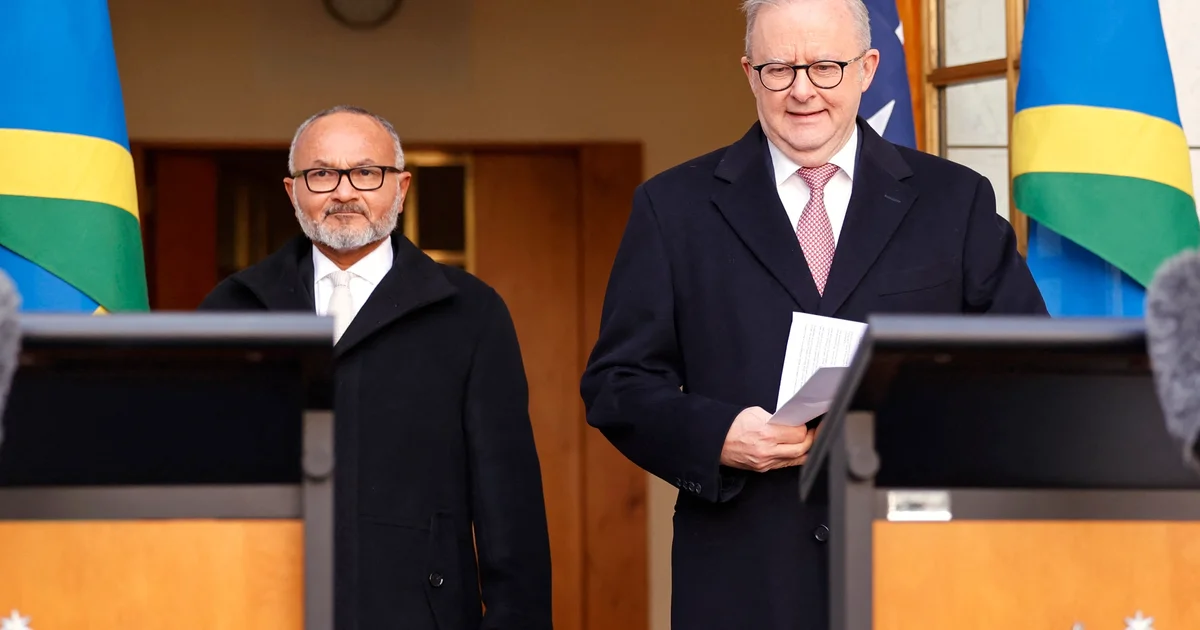
Against this backdrop, Canberra’s embrace of constituency-level development assistance is difficult to square with any semblance of best-practice development. Directing substantial sums towards individual constituencies, rather than through Solomon Islands’ national development priorities and planning mechanisms, also cuts across decades of Australia’s own development work – and that of other partners in the Pacific such as the World Bank – to strengthen public institutions, national planning and good governance.
More compelling is the development case for Canberra’s proposed $142 million investment in Wale’s signature free-education policy included in the treaty package. In a country where UNICEF reports net secondary school enrolment remains below 17% (Opens in new window), few investments are likely to reach more deeply into the lives and future opportunities of ordinary Solomon Islanders, provided the funding enables a sustainable rollout.
Funding for easier and more equitable access to Australian visas for Solomon Islanders is similarly long overdue and will probably do more than almost any other single initiative to improve relations. Along with responses to “security requests from Solomon Islands”, Canberra has allocated a further $47.8 million for these measures.
But it is Australia’s rapid offer of constituency-level funding that plays most neatly into the hands of Solomons’ Opposition Leader Manasseh Sogavare – the country’s longest-serving prime minister and arguably Canberra’s greatest nemesis in the Pacific.
It was Sogavare who led the Solomons’ switch from Taiwan to the PRC and, less than three years later, completely freaked Canberra when it secretly negotiated a framework security cooperation agreement with Beijing – a development Australia had somehow convinced itself would just not happen. The agreement’s final terms remain hidden, with Wale confirming in June that a non-disclosure clause prevents his government from publishing them.
While the hypocrisy of Sogavare’s outraged rhetoric over Australia’s supposed interference will not be lost on many Solomon Islanders, committing Australian aid to MPs’ development priorities – however they may end up being administered – risks cutting across Wale’s efforts to reset both the country’s foreign and domestic policy frameworks.
No one’s stooge, Wale has moved quickly to restore some balance to foreign relations, with early visits to Australia and the United States and an increasingly assertive regional voice. His handling of China’s provocative missile test is a case in point: “China is a good friend of Solomon Islands, but this is not something a friend does.” (Opens in new window)
For a population tiring of five years in the eye of a geopolitical storm, and of seeing their nation and its leaders buffeted by external powers and their money, there has been something reassuring in seeing Wale assert greater control over the country’s foreign relationships.
Domestically, Wale, an accountant and former highly effective chair of the Public Accounts Committee, has set an equally ambitious reform agenda, staking his government’s credibility on “zero-tolerance” of the Solomons’ endemic cronyism and corruption (Opens in new window), and pledging to remove corrupt officials “regardless of who they are or who their friends may be”.
The appointment of Auditor-General David Dennis – who for years has almost single-handedly kept the flames of accountability licking at the heels of the nation’s public servants – as the Permanent Secretary of Finance suggests Wale plans to waste no time introducing long-overdue public finance reforms.
All this has helped the new PM draw a clear and rapid line between his GREAT (Government for Reform, Empowerment, Accountability and Transformation) Coalition and the track record of the four preceding governments – three under Sogavare and one, briefly, under Jerry Manele. But in its efforts to pull Solomon Islands closer, Canberra’s dive into the belly of the beast that is the Solomon Islands political system now risks putting Wale in the position of compromising that very divide. Australia’s proposed constituency funding could undermine both the accountability credentials he has worked hard to establish at home and the greater sense of national agency he is trying to restore abroad.
If the Wale government does accept the treaty package as offered, Australian money intended to advance a strategic objective then risks becoming entangled with the domestic political imperative of keeping a friendly Solomon Islands government – and potentially the MPs who support it – in office.
Hardly sustainable development by anyone’s standards.








Leave a comment