


Welcome to the latest edition of ASPI’s Fault Lines.
Every fortnight, ASPI’s Defence Strategy Program monitors the actions and developments shaping the regional order and Australia’s security.
This edition covers the period from 24 July to 6 August 2026.
Northeast Asia
Dancing with the staffs
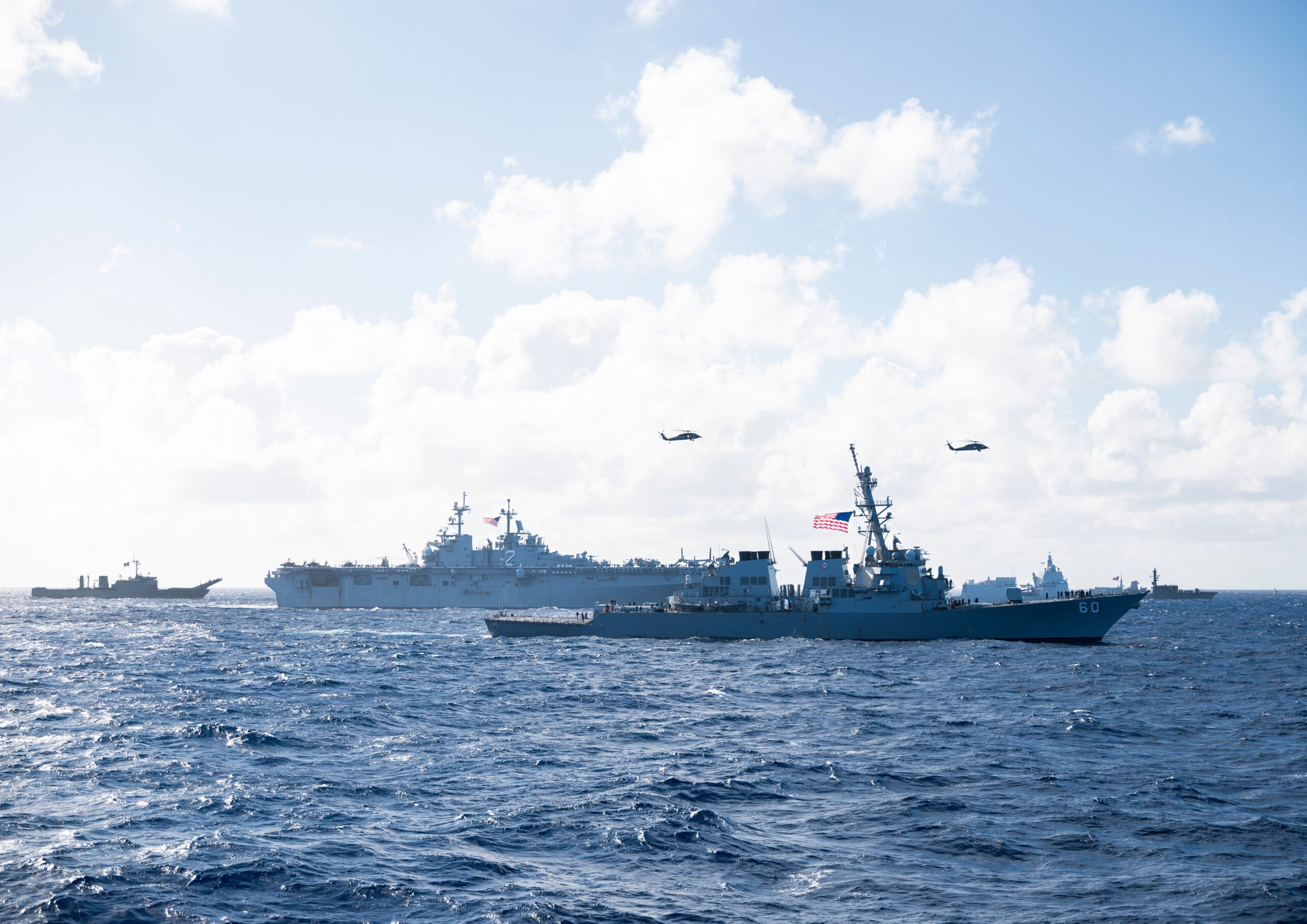
The Rim of the Pacific (RIMPAC) exercise, which wrapped on 31 July, is the biggest combined maritime drill in the world and every bit what its American hosts might call a ‘prom’ for Indo-Pacific navies: everyone shows up in their finest hardware, performs elaborate routines and, if they’re lucky, gets a spot on the organising committee. This year, for the first time, a South Korean officer – Rear Admiral Kim In-ho – commanded RIMPAC’s maritime component.
It’s quite the component when you’re talking 30 countries, 30,000 personnel, 31 surface ships, five submarines and 500 exercise events over a month – all told, about as close to a wartime coalition operation as one could get. South Korea’s navy has come a long way since it first showed up at RIMPAC in 1990 with two frigates and a dream. Back then, the time-honoured South Korean tradition of army-first force planning didn’t envision a major role for sea power beyond sight of the coastline. Seoul’s contribution to RIMPAC this year, the largest after the US Navy’s, paints a striking picture of how much has changed. From the P-8 Poseidon maritime patrol aircraft above to the Aegis guided-missile destroyer on the surface to the indigenously designed KSS-III submarine below, you have pretty much the full suite of high-end naval warfighting capability. The only things missing are nuclear-powered submarines (they’re working on it) and fixed-wing carrier aviation (aspirational). That Rear Admiral Kim is the first officer hailing from any of the US treaty allies in East Asia to command RIMPAC’s Combined Force Maritime Component shows that Seoul can now not only build the ships, but direct complex multinational naval operations in the Pacific theatre at large.
News from abroad
- In a 25 July statement, Ukrainian President Volodymyr Zelenskyy said Russia was preparing in the Voronezh region to receive 30,000 new North Korean troops. The Kremlin has unsurprisingly neither confirmed nor denied that assertion, though the North Korean foreign minister’s visit to Moscow earlier in July and Russia’s increasingly acute recruitment difficulties are suggestive. Seoul has so far declined to comment. If the deployment happens, it’d be a significant step-up in Pyongyang’s involvement: estimates of the number of North Koreans serving on the frontline in Russia’s war on Ukraine hover around 14,000. Pyongyang already supplies between 25 and 40 percent of Russia’s artillery shells. Russia’s use of what Ukrainian officials have said were North Korean short-range ballistic missiles in strikes on 30 July – the first such missile strike in almost a year – further indicates the already high baseline of cooperation from which that step-up would occur.
- Japan’s new National Intelligence Bureau was officially launched on 31 July. ‘New’ is relative: the staff of the former Cabinet Intelligence and Research Office, which the NIB replaced, have mostly kept their desks. The point is to give the institutional machinery the authority to centralise intelligence assessment and direction of the broader intelligence enterprise under the Cabinet. So it’s not a CIA, but it is the groundwork you’d need to lay if, as the present government is, you’re aiming to create a dedicated foreign intelligence agency down the track. Japan hasn’t had one of those since World War II.
Southeast Asia
The map and the territory
In New York last week, the Philippines formally deposited a hydrographic chart with the United Nations showing the precise extent of Bajo de Masinloc, a low-lying reef about 200 km west of Luzon. The chart indicates the normal baselines of the reef – the lines from which legal entitlements under the UN Convention on the Law of the Sea are measured. While Manila has made its sovereign claim over that feature known for many years, this is the first time that claim has had exact geometry attached. A day after the Philippine foreign ministry announced the deposit, the Chinese government issued a policy for the administration of the Huangyan Island National Nature Reserve. Among its provisions, the policy prohibits any individual or group from entering the reserve except on Beijing-approved business.
This wouldn’t be news were Bajo de Masinloc and Huangyan Island not one and the same – better known internationally as Scarborough Shoal, and arguably the single most bitterly disputed feature in the South China Sea. What you see here is Beijing’s latest major effort to draw the net of domestic governance around the dispute while the Philippines tries to keep it alive on the level of international law. What seemed like a rather mundane-sounding government announcement about a nature reserve was accompanied, on the same day in the same area, by military exercises featuring serious hardware – a Chinese navy amphibious warfare taskforce with bomber escort. This indicates that international law in the South China Sea hasn’t become irrelevant; it’s become a stage for heavily armed theatre.
The 1 August exercises were also a quite pointedly timed response. A combined US–Japan–Philippines exercise in the rough vicinity from 21 to 25 July included the USS George Washington carrier strike group, two US Coast Guard cutters and two Philippine Coast Guard ships – an unusually comprehensive multinational integration of naval and coast-guard forces. The same, incidentally, could be said of this year’s RIMPAC exercise, which saw the participation of the Philippine Coast Guard for the first time. Meanwhile, the China Coast Guard allegedly fired water-cannons at Philippine ships around the shoal during a messy confrontation on 23 and 24 July.

Time and tide
If you’re wondering where the USS George Washington wound up after that combined exercise, it went to Da Nang. The carrier strike group arrived on 30 July for a five-day goodwill visit. This is only the fourth time a US aircraft carrier has shown up in Vietnam since relations normalised in 1995, and it’s the first since Washington and Hanoi signed their Comprehensive Strategic Partnership in 2023.
Da Nang is where the US ground war in Vietnam began in 1965. As a South China Sea claimant state, there are eminently pragmatic reasons for Vietnam to welcome a highly visible US security presence in that same neighbourhood today. China took the nearby Paracel Islands from Vietnam at gunpoint in 1974, and the Chinese navy forward base that backstops Beijing’s continued occupation of those islands – which Vietnam still claims – lies at Sanya on Hainan Island, less than 300 km from Da Nang.
Only a day earlier and hundreds of kilometres south at Cam Ranh, Vietnam waved farewell to a Russian Pacific Fleet task group. That was more technical than symbolic; Vietnam operates Russian Kilo-class submarines, so the Pacific Fleet is a logical choice for cross-training submarine crews.
But the symbols were still there. Like Da Nang, Cam Ranh was built out by the United States as a logistics hub during the Vietnam War. From 1979 to 2002, though, it was one of the Soviet Union’s (later Russia’s) largest overseas military bases and the Pacific Fleet’s principal port of call in Southeast Asia. Vietnam accepted that arrangement, its non-aligned posture notwithstanding, because it faced an intense security threat from China. Hosting Russia and the US concurrently is a potent show of non-alignment, but the very infrastructure being used is a hint that non-alignment has its limits.
News from the neighbourhood
- Thai Prime Minister Anutin Charnivirakul called for ‘calibrated re-engagement’ with Myanmar in a 4 August speech at the headquarters of the Association of Southeast Asian Nations. Bangkok has long been at the forefront of efforts to reopen ASEAN’s lines of communication with the military government in Naypyidaw. What’s significant isn’t that they’re continuing to push ASEAN in that direction, even as the junta openly challenges ASEAN’s peace framework for the civil war; it’s that in a few days’ time, Bangkok is rolling out the red carpet for Myanmar’s leader, Min Aung Hlaing, whether the rest of ASEAN likes it or not.
Oceania
Casting a net
Days after returning from his trip to Washington, Solomon Islands’ new prime minister, Matthew Wale, signed what’s called a ‘shiprider agreement’ with the US in Honiara. The technical term for this is a Maritime Law Enforcement Agreement (MLEA), and the general idea is to give authorised Solomon Islands law enforcement officers a regular mechanism ‘to embark on designated US vessels to jointly undertake maritime surveillance and enforcement operations.’
This is far from the first agreement the US has brokered along these lines. In fact, with the addition of Solomon Islands, the US has run out of independent Pacific states to broker them with. Washington’s net of MLEAs across the Pacific began with Cook Islands in 2007, and the effort has picked up considerable steam in recent years. Since 2022, agreements with the Federated States of Micronesia, Palau and Samoa have stepped up to become enhanced MLEAs, which allow the US to enforce a partner’s laws inside that state’s exclusive economic zone. This doesn’t appear to be within the scope of the deal just inked with Solomon Islands. Concern that it might be, however, has animated the country’s opposition leader and former prime minister, Manasseh Sogavare, to claim that the deal amounts to a US violation of Solomon Islands’ sovereignty.

It’s not hard to see the rationale for the agreements. If you’re interested in security cooperation with the Pacific at all, a coast guard – the US Coast Guard, for example, which helpfully has a budget about two and half times the GDP of Fiji – is a useful thing to have. Coast-guard capabilities correspond closely to the concrete problems Pacific states tend to face. According to the Solomon Islands government, the new MLEA ‘will support national efforts to combat illegal, unreported and unregulated fishing, transnational crime, illicit trafficking, and other unlawful maritime activities’.
There’s also a broader strategic benefit for Washington. The US can provide great-power resources against practical Pacific security problems in ways other partners such as Australia and New Zealand simply cannot match. At the same time, these agreements give Washington the option of maintaining a US-flagged security presence across much of the Pacific without the baggage or the optics of formal defence cooperation.
News from the family
- On 25 July, Bougainville’s leadership formally endorsed a three-stage pathway culminating in a proposed declaration of independence on 1 September 2030. The move came amid concerns in Bougainville that Papua New Guinea’s government is seeking to disrupt parliamentary ratification of Bougainville’s independence referendum result.
- New Zealand and PNG have signed a new defence cooperation agreement. Titled the ‘Statement of Intent on Defence Cooperation between Papua New Guinea and New Zealand 2026-2029’, it builds on previous agreements and outlines principles for further military and civilian security cooperation.
- As if the rest weren’t enough, this year’s RIMPAC exercise saw yet another first-time participant: Fiji, represented by a platoon of soldiers. No Fijian maritime component is understood to have participated this year – with a navy currently comprising of two Guardian-class patrol boats and two hydrographic vessels, you probably wouldn’t want to risk sailing one to Hawaii either – but the prospects are looking up. RIMPAC coincided not only with last month’s defence pact with Australia, but also the release of the Republic of Fiji Navy’s first maritime strategy, which incorporates a stronger emphasis on regional partnerships alongside a 10-year plan for naval capability development.

This article was originally published in , ASPI’s fortnightly newsletter that monitors the actions and developments shaping the regional order and Australia’s security.












Leave a comment