


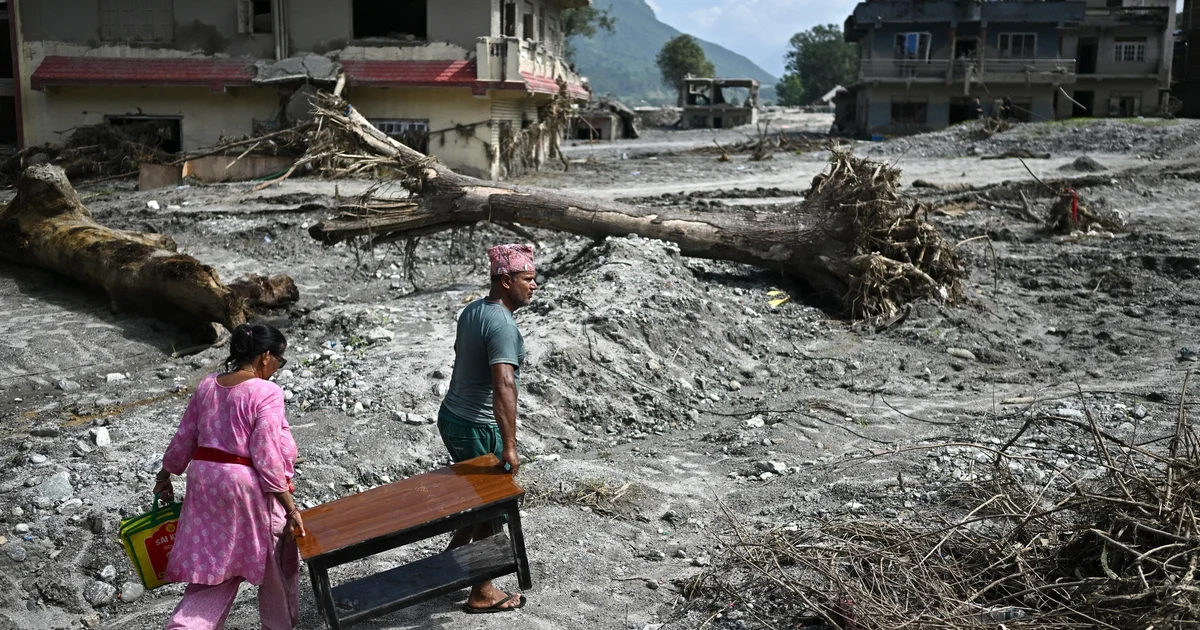
The warning chain itself also crosses institutional boundaries. Upstream monitoring may sit in one country, hydrological monitoring and exposed communities in another, while emergency response remains a national responsibility. A breakdown at any point can turn useful information into a late warning. The risks do not remain confined to lives and livelihoods. Roads, bridges, border crossings, hydropower sites and trade routes can all lie in the path of a cascading hazard.
Rapidly intensifying climate change now makes this problem even more urgent. Rising average temperatures, extreme rainfall and accelerating glacial ice losses are altering the stability of high-altitude environments. The precise trigger of any individual disaster may remain uncertain, but the consequences (Opens in new window) of delayed action are not.
The answer is not another large regional institution. It is a practical Himalayan early-warning protocol built around existing bilateral and regional arrangements. Its purpose would not be to predict every glacial collapse, which is neither technologically nor geographically realistic, but to shorten (Opens in new window) the distance between detecting an upstream hazard and enabling action downstream.
First, China, Nepal, India and Bangladesh should establish agreed procedures for sharing hydrological (river levels and discharge) and cryosphere (lake conditions, ice-dam formation and avalanches) data in near real time throughout the year, with intensified sharing during high-risk periods.
Second, they should combine satellite observation with strategically located ground sensors and ensure that critical equipment has communications redundancy.
Third, countries should agree in advance on alert thresholds and direct notification procedures, so that warnings do not have to move through slow diplomatic channels during an emergency. The protocol should also reach local authorities and communities through regular drills and training, so that a cross-border alert becomes a usable local warning rather than another government notification.
These arrangements could be tested through regular cross-border exercises and supported through existing Indo-Pacific disaster and climate mechanisms, rather than creating another bureaucracy.
The wider lesson is clear. Resilience cannot be built one country at a time when disasters cross borders. A warning matters only if it travels the entire distance within the few minutes that actually matter. For an Indo-Pacific increasingly shaped by climate-related disasters, sharing information about what is happening upstream should be treated as basic regional infrastructure.
















Leave a comment