


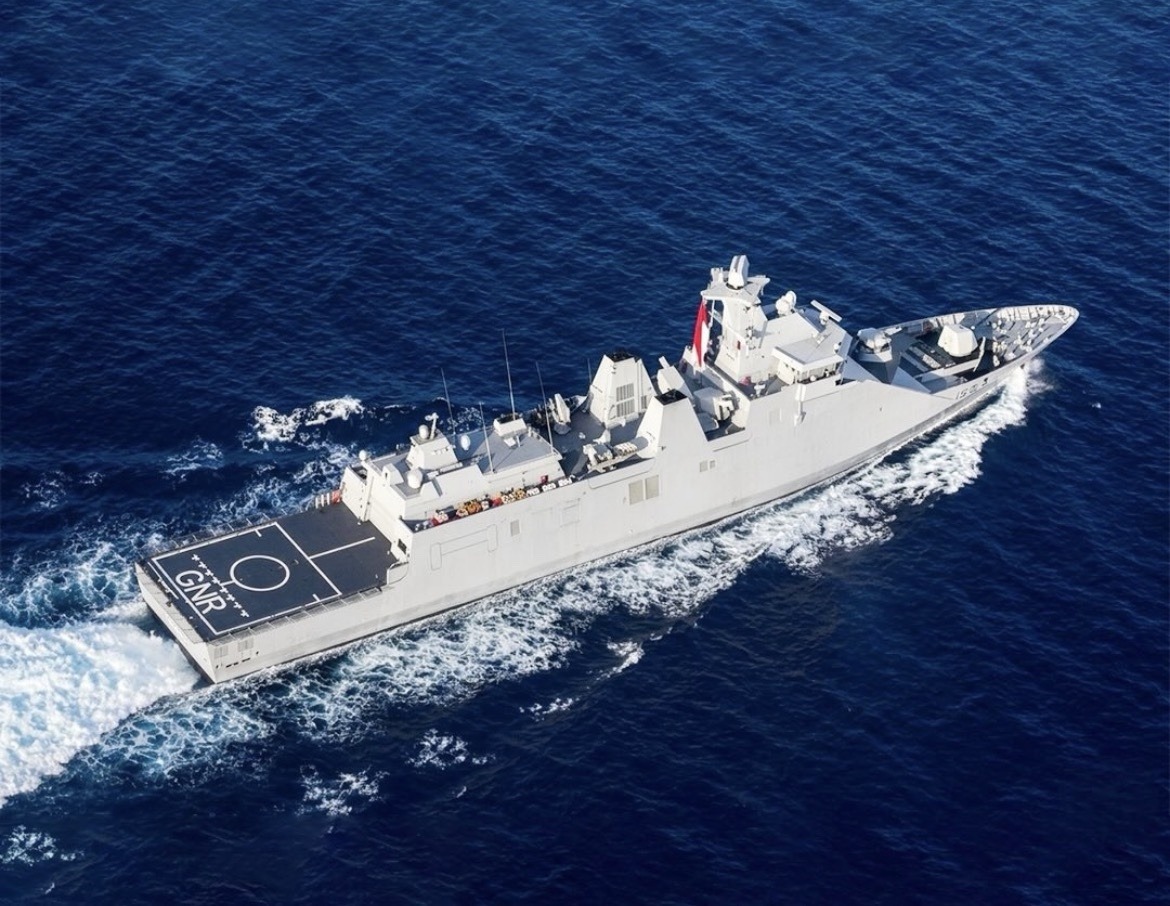
News about an Indonesian frigate exercising with a Chinese warship 130 to 150 km east of Taiwan was always going to raise eyebrows. The exercise ast week was the first time China had conducted such an operation with a foreign military in those waters, and Beijing was quick to assign significance to the encounter.
The episode should not be read as evidence that Indonesia is tilting towards China or quietly revising its position on Taiwan. Nonetheless, China is overplaying the meaning of the exercise, and the operation reveals that Indonesia’s non-alignment foreign policy is sometimes pursued without the strategic guardrails needed to prevent other powers from exploiting it.
On 12 August, KRI I Gusti Ngurah Rai conducted what Indonesia described as a routine passing exercise with the Chinese navy frigate Honghe while returning from exercises in Russia. Activities included communications, formation manoeuvring and replenishment at sea. The Indonesian navy stressed that the interaction was unrelated to warfighting and that similar passing exercises were planned along its return route with Japan and the US Seventh Fleet. But what Jakarta regarded as routine naval diplomacy is being used by Beijing as part of its effort to normalise the impression that it exercises jurisdiction around Taiwan. Beijing is presenting the interaction as a joint navigation exercise in waters east of Taiwan and situating it within its broader claim to sovereignty over the island.
Taipei quickly condemned the exercise as political manipulation from Beijing’s political manipulation designed to create a false impression of Chinese jurisdiction over its eastern waters. Taiwanese officials were notably restrained in criticising Indonesia, with Taiwanese military intelligence noting that the Indonesian ship was simply transiting home and posed no direct threat. This distinction reflects Taipei’s likely understanding of the complexity of Jakarta’s ‘friends to all’ foreign policy.
Indonesia is engaged in separate bilateral exercises with the United States across different branches of the Indonesian military. Indonesian and US marines began their annual Platoon Exchange in Lampung on 12 August, and the Indonesian Army is hosting Ksatria Warrior 2026 in South Sumatra with US Army Pacific. The announcement of the exercise east of Taiwan also came shortly after US Under Secretary of Defence for Policy Elbridge Colby was in Jakarta to discuss deeper defence cooperation with Defence Minister Sjafrie Sjamsoeddin.
Indonesia was thus conducting military activities with US forces even as it was announced that one of its frigates carried out a mere passing drill with the Chinese navy. This is hardly the pattern of a state moving into Beijing’s strategic orbit. Rather, it reflects the central logic of Indonesia’s foreign policy approach of maintaining defence relationships with competing major powers while resisting their conversion into exclusive alignment.
Indonesia’s defence relationship with the US is, moreover, substantially more institutionalised than its military relationship with China, encompassing regular exercises, military education and training, and increasingly sophisticated operational cooperation. Super Garuda Shield has evolved from a bilateral army exercise into a major multinational activity involving US, Indonesian and partner forces in combined field training, airborne operations and live-fire activities. Jakarta doesn’t want an alliance with Washington, but the relationship is more than superficial.
Indonesia maintains substantial unofficial economic and people-to-people ties with Taiwan. It conducts military exercises with China while simultaneously deepening military cooperation with the US, Australia, Japan and other partners. This is consistent with Indonesia’s preference to preserve strategic autonomy, avoid formal alignment and maintain room to work with competing powers.
The real problem exposed by the episode therefore relates not to allegiance but to strategy and guardrails. If Indonesia genuinely regards the encounter as an unremarkable passing exercise during a return voyage, that is reassuring in one sense. But in another sense, it raises the most important criticism of all: Indonesia’s navy interacted with a Chinese warship in some of Asia’s most politically sensitive waters without sufficiently anticipating how Beijing might frame the event. China anticipated it, announced it in advance and attached its preferred political meaning to it.
Engaging with China is not the problem. A serious policy of non-alignment can facilitate doing so just as it requires strong relationships with the US and Japan. But those interactions need limits, as exercises around Taiwan, activities in contested waters and communiques touching sovereignty are not the same as routine engagements elsewhere.
Non-alignment should not be understood as the absence of strategic choice but as a particularly demanding form of strategic management. Reading each military interaction as a marker of movement in relation to the US–China competition is exactly what Indonesian foreign policy is designed to exclude. The more significant risk is that Indonesia’s strategic autonomy becomes vulnerable to external interpretation. As Southeast Asia’s largest country, it has every interest in ensuring its engagements align with clearly articulated objectives and limits, for strategic autonomy is most credible when its meaning and boundaries are defined in advance rather than clarified after other actors have already supplied their own.













Leave a comment