


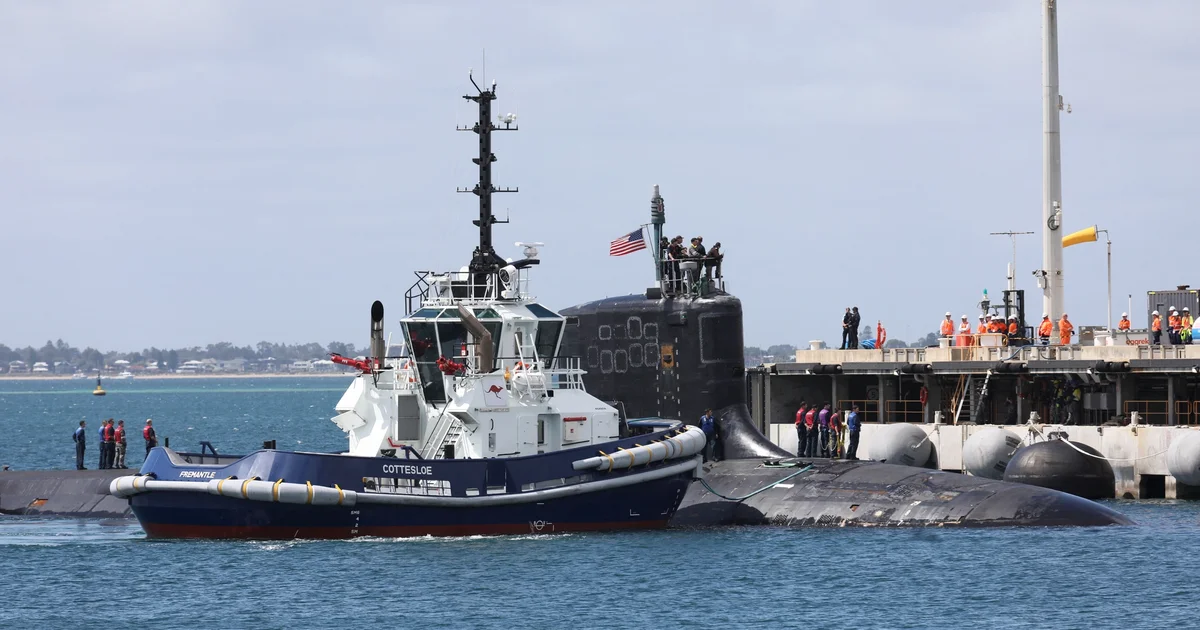
From as early as 2027, SRF-West will be established (Opens in new window) at HMAS Stirling on Cockburn Sound, comprising a rotational presence of one UK and up to four US conventionally armed, nuclear-powered submarines. The rotational force will be supported by major infrastructure works designed for those submarines as well as Australia’s own future boats. In June, the Australian government (Opens in new window) announced additional implementation steps, including the establishment of Naval Support Activity Stirling to support US personnel, contractors, and their families rotating through the base. This reflects the routine fact that a visiting force must maintain discipline, family support, logistics, and command arrangements for its own people while operating in partnership with a host nation.
Defence states plainly that the American and British boats will rotate through Stirling rather than be permanently based in Australia, while the purpose of the arrangement is to build the operational, maintenance, regulatory, and stewardship capacity required for Australia’s own future (Opens in new window) nuclear-powered submarines from the early 2030s.
That reality matters because much of the current commentary turns on whether Australia should candidly call this a “base.” Yet the more useful question is not semantic but strategic: whether hosting friendly naval forces at Stirling is aberrant or consistent with Australia’s longstanding defence geography. On that score, the answer is clear. The west coast has been identified for more than a century (Opens in new window) as essential to Australian maritime strategy and, at key moments, as the natural hub for allied naval presence.
In 1911, Admiral Sir Reginald Henderson (Opens in new window) recommended Fremantle, centred on Cockburn Sound, as one of Australia’s two fleet primary bases. Henderson’s report treated Cockburn Sound as strategically important. The broad strategic logic behind today’s debate was visible before the Royal Australian Navy had fully taken shape: Australia’s western seaboard mattered because its maritime geography made it unavoidable.
Henderson’s recommendations laid out a conception of a two-ocean navy (Opens in new window) for Australia. His ideas took time, but the strategic requirement Henderson identified endured across decades, governments, two world wars, technologies, and Cold War geopolitics. HMAS Stirling was eventually commissioned in 1978.
There is nothing unprecedented about Western Australia servicing allied submarines (Opens in new window). During the Second World War, Fremantle became the largest submarine base in the southern hemisphere, and by the end of March 1945 there were twenty-two submarines based there, including nineteen from the US Navy and three from the Royal Netherlands Navy. That wartime record alone should caution against claims that the arrival of allied submarines in the west represents a strategic departure.
The contemporary arrangement is obviously different in technology, alliance context, and legal architecture. But the central concept is familiar: Australia provides valuable access and support to trusted maritime partners while gaining security benefits, operational integration, and experience in return. Seen in this light, Submarine Rotational Force-West (Opens in new window) looks less like a revolutionary break than a modernised version of established coalition practice on the west coast.











Leave a comment