


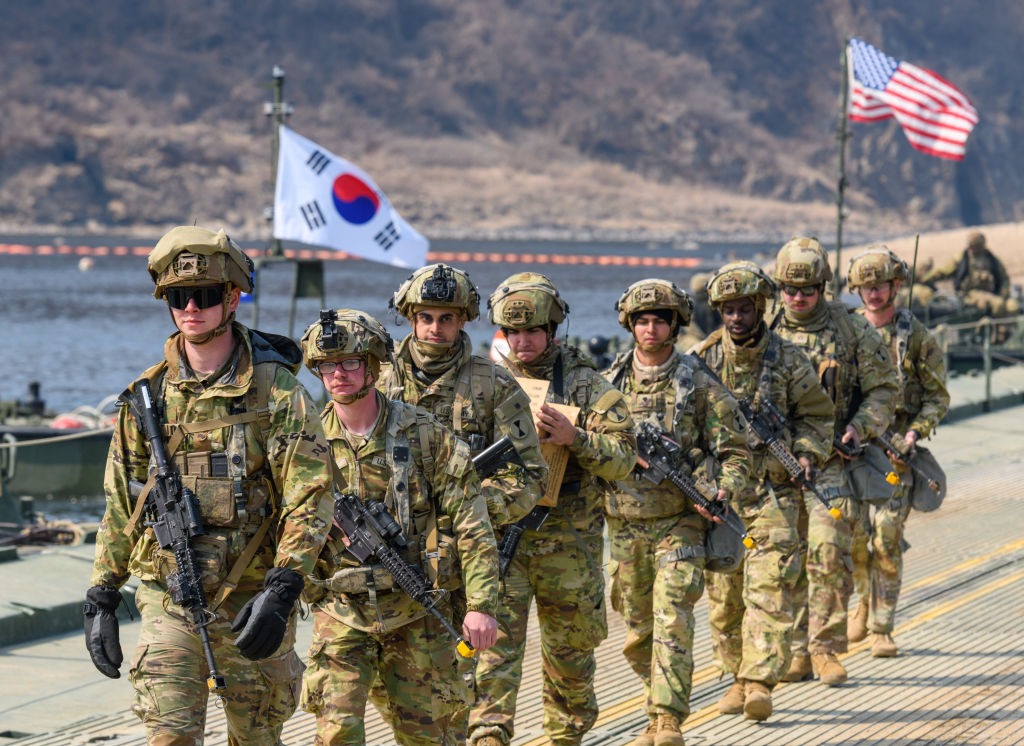
President Donald Trump’s instruction to the Pentagon on Sunday to ‘substantially reduce’ joint military exercises with South Korea comes at a particularly difficult moment.
Trump has cited the cost of the exercises, Seoul’s unwillingness to support US military operations against Iran, and his ‘very good relationship’ with North Korean leader Kim Jong Un. The administration is also evidently interested in reopening a diplomatic channel with Pyongyang.
There is nothing inherently wrong with seeking renewed diplomacy with North Korea. Nor should military exercises be immune from scrutiny. Governments should regularly ask whether exercises are properly designed, whether they reflect current operational requirements and whether taxpayers are getting value for money.
But substantially reducing US–South Korean exercises now would be a mistake.
North Korea is rapidly improving the capabilities that the US–South Korean alliance may someday have to confront. The US 2026 Annual Threat Assessment says Pyongyang remains strongly committed to expanding its nuclear arsenal and continues developing more capable missile systems designed to increase range and accuracy and challenge US missile defences.
Even more concerning is what North Korea is learning from Russia’s war against Ukraine.
The same US intelligence assessment specifically warns that North Korean troops are gaining ‘valuable warfighting experience and military technology’ from Russia through their participation in combat operations against Ukraine. That is an important development.
North Korea is no longer learning about modern warfare only from exercises, simulations and observations. Its soldiers are acquiring actual battlefield experience in a conflict characterised by drones, electromagnetic warfare, long-range precision strike, rapidly evolving tactics and an extraordinary cycle of technological adaptation.
Russia, meanwhile, has cultivated increasingly important relationships with North Korea, Iran and China. US intelligence assesses that cooperation among those four countries is increasing the challenge each poses to the United States, even if describing them as a tightly integrated adversarial bloc would overstate the depth of their cooperation.
This makes high-quality allied military exercises more important, not less.
Exercises such as Ulchi Freedom Shield, the one that’s been scaled back, are sometimes portrayed primarily as political demonstrations of US commitment to South Korea. They certainly have a signalling function, but that is not their most important purpose. Their real value is operational.
US Forces Korea describes Ulchi Freedom Shield as an exercise intended to strengthen the combined defence posture and the alliance’s ability to respond to a changing security environment. These exercises allow US and South Korean forces to test command relationships, communications, logistics, intelligence sharing and the movement and sustainment of forces. They also provide opportunities to identify failures before those failures occur in combat.
That matters enormously in coalition warfare.
Throughout my career working on alliances and defence policy, one lesson has been consistent: interoperability cannot simply be declared. It must be practised.
Two militaries can possess excellent weapons and highly professional personnel and still have difficulty fighting effectively together if their command systems do not connect, their communications are incompatible, their logistical concepts diverge or commanders have never worked together under realistic operational pressure.
Exercises expose those problems.
And modern warfare is making the requirement for continuous adaptation even more important.
The wars in Ukraine and the Middle East have demonstrated how quickly militaries must learn.
Drone tactics can change in weeks. Electromagnetic countermeasures provoke new counter-countermeasures. As I have noted elsewhere, missile-defence architectures must adapt to increasingly complex combinations of ballistic missiles, cruise missiles and inexpensive one-way attack drones. Logistics networks that appeared adequate in peacetime can rapidly become vulnerable in combat.
The side that learns faster can gain a significant advantage.
That is why the central question surrounding exercises should not simply be how much they cost. It should be whether they are preparing US and allied forces for the wars they may actually have to fight.
There may be legitimate reasons to modify individual exercises. Some training can be conducted through simulation. Exercises should continuously incorporate lessons from Ukraine and the Middle East. South Korea should continue increasing its own defence capabilities and assuming greater responsibility within the alliance.
But those are arguments for making exercises better, not for substantially reducing them.
Nor should military readiness become a bargaining chip in disagreements with an ally over unrelated issues such as Iran.
Washington and Seoul will inevitably disagree at times. Mature alliances do. The purpose of an alliance is not to guarantee agreement on every international crisis; it is to maintain the ability to defend common security interests when those interests are threatened.
Maintaining that capability requires practice.
Today North Korea is expanding its nuclear and missile forces while its troops obtain battlefield experience alongside Russia in Ukraine. Russia, China, Iran and North Korea are all examining the lessons of recent conflicts and adapting their forces accordingly.
The United States and its allies need to be doing the same.
Our adversaries are learning. The question is whether we are learning faster.












Leave a comment