


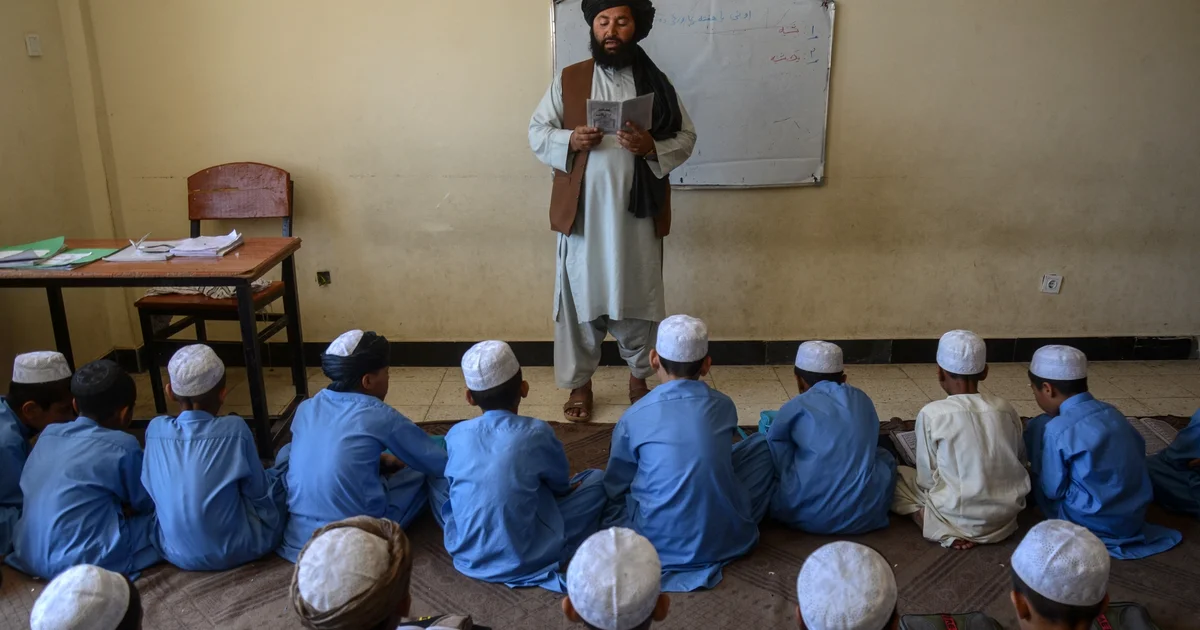
The Hamrah Network (Opens in new window), an Afghan civil society organisation operating in exile, says that since the fall of the republic in August 2021, the number of registered madrassas has risen from around 5,000, to more than 23,000 today, enrolling more than 3.65 million children. Girls shut out of secondary education are channelled into female madrassas as their only educational option. Public schools, universities and teaching colleges, and other public facilities have been repurposed as religious institutions.
The curriculum emphasises Koranic memorisation, Hadith studies and conservative Hanafi jurisprudence, along with Taliban-approved political instruction. Some madrassas use a text titled Lessons of Jihad, the report says, while some Taliban figures have publicly called for religious schools to instil jihadi and military concepts. Graduates are increasingly recruited into the Taliban’s religious, judicial and security institutions.
The report argues that the Taliban education system is intended to mould thought and behaviour. Children are taught that loyalty to the regime is more important than to family. Some parents told researchers they had withdrawn their sons after discovering they were being “encouraged to monitor and report” on relatives. It quotes an official of Taliban intelligence telling a Kandahar resident: “Be aware that we now have informants in each one of your households.”
Banning girls’ post-primary schooling is among the Taliban’s most notorious policies, but focusing exclusively on reopening them misses the larger transformation underway. Even if the ban was lifted tomorrow, many classrooms would offer little of the modern education that existed before 2021. If and when girls return, the schools themselves will have changed beyond recognition.
The Taliban are not merely restricting education – they are remaking it to reshape Afghan society. The reach of this project extends well beyond conventional schools. The report says there are 92 madrassas inside prisons, and around 9,000 orphans receiving religious education.
The irony is that even amid persistent condemnation of the Taliban’s avowedly misogynist policies, international engagement with the Islamists is steadily increasing. Diplomats talk of pragmatism, aid agencies of humanitarian imperatives, investors of opportunity, and apologists of normalcy. Yet even as Afghanistan becomes less isolated, the regime is undertaking one of the world’s most sweeping projects of ideological re-engineering. Too few are taking notice.
It is an education system built by a regime that expects to rule for generations to come.
The madrassa network is producing citizens, officials, judges, clerics, security personnel and diplomats in a state that prizes ideological conformity over critical inquiry, scientific reasoning and independent thought. It is designed to cultivate obedience in a system that continues to celebrate the values of insurgency and martyrdom.
Taliban officials insist that suicide units, for instance, have been reorganised into the regime’s armed forces, rather than retained as separate formations. Yet senior commanders still describe (Opens in new window) suicide attacks as a legitimate response to foreign invasion.
The report warns that the “continued training and public glorification” of suicide squads “blurs the line between religious education and militarisation in ways that have significant
implications for regional stability and international security”. These concerns are amplified by the presence in Afghanistan of multiple militant organisations, including al-Qaeda.
The subjugation of women and the remaking of education are complementary policies – one excluding women from public and intellectual life, the other seeking to bend the beliefs and behaviour of the next generation. It represents an attempt to extend ideological control into the home.
The Taliban’s project differs from those of other authoritarian states, such as China and Iran, which have substantial technical and scientific sectors while maintaining political and ideological control. The Taliban’s vision is more radical and deliberately retrograde.
For years, diplomats have justified engagement with the Taliban on the grounds that governing would prove more difficult than fighting, and responsibility would encourage moderation. The report argues that the evidence points in the opposite direction: the expansion of the madrassa system is not an aberration but the “clearest demonstration of the Taliban’s actual vision”.
The cruel treatment of women has rightly provoked international outrage, but while the world has focused on the repression of half the population, the regime has been rebuilding the institutions that will define the nation’s future.
Education has become the Taliban’s principal instrument in a long-term plan to determine how Afghans think, whom they obey and what sort of state Afghanistan becomes.










Leave a comment