


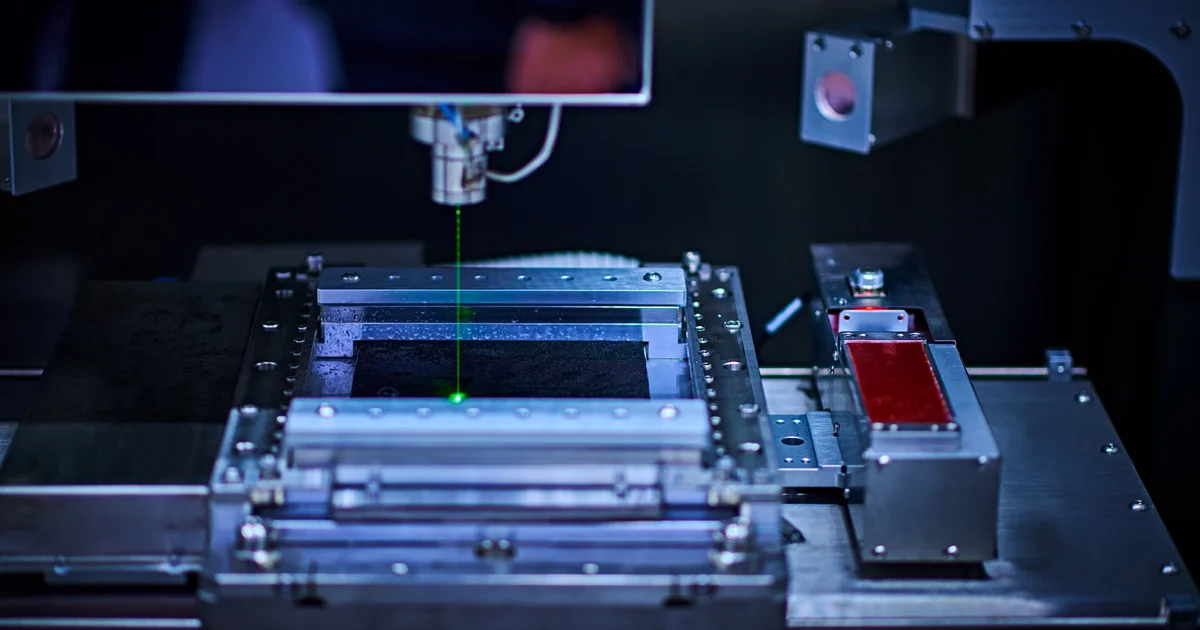
This complementary expertise (Opens in new window) has bound Taiwan and Lithuania to each other’s future. Alongside importing Lithuanian laser technology, in 2023 Taiwan’s Industrial Technology Research Institute and the Lithuanian Laser Association established (Opens in new window) the Ultrafast Laser Technology Research and Innovation Centre (ULTRI) to enhance their collaboration in the field. In early September, Taiwan and Lithuania signed a new memorandum of understanding (Opens in new window) to expand the work of ULTRI with a new injection of funding and with the explicit focus on semiconductor applications for laser research.
This collaboration is far greater than simple economic exchange. Taiwan sees semiconductors as being (Opens in new window) to the 21st century what petroleum was to the 20th. They underpin virtually every facet of the modern global economy, from smartphones and cars to AI data centres and weapons systems, making their supply chains a matter of both economic competitiveness and national security.
It is this perspective on the essential nature of semiconductors that drives Taiwan’s “silicon shield (Opens in new window)” – the idea that Taiwan’s dominance in advanced chip manufacturing, led by Taiwan Semiconductor Manufacturing Company (TSMC), can deter any attempt by China to annex it by threatening catastrophic technological and global supply chain disruption if war broke out. It is this expertise that gives other countries a material stake in defending the status quo of Taiwan’s de facto independence.
This shield, however, is only as strong as its market dominance. Should other countries be able to out-compete Taiwan’s expertise in the field, then greater vulnerability (Opens in new window) to Chinese aggression starts to emerge. This necessitates the Taiwanese being hyper-aware of the advances in complementary technology like lasers and building durable partnerships to be able to incorporate these technologies into their semiconductor industry.
In Lithuania, Taiwan has not only found a strong technological partner, but a sympathetic ally. Lithuania’s own recent history as a small nation subjugated by a neighbouring great power gives it an empathy (Opens in new window) for Taiwan’s situation. With Russia’s current belligerent war on Lithuania’s doorstep, Vilnius has an acute understanding of what is at stake for Taiwan.
Lithuania has also positioned itself as a nation seeking to shape the geopolitical environment through moral courage and diplomatic energy. Vilnius often strides out in front (Opens in new window) of the larger European powers in its advocacy for Ukraine and then uses this diplomatic entrepreneurship to challenge European states to follow. The dispute over the Taiwan Representative Office was a further expression of this instinct – demonstrating Vilnius’s unwillingness to submit itself to China’s legal fiction concerning Taiwan.
Trade between Lithuania and China has largely recovered (Opens in new window), and the Taiwan Representative Office has retained its name. However, the more consequential story has developed within Lithuania’s laboratories. Economic statecraft and technological interdependence are becoming as important to security as troops and treaties, and it may be Lithuania’s ultrashort pulse lasers that become one of the central tools of peace in the Indo-Pacific.











Leave a comment