


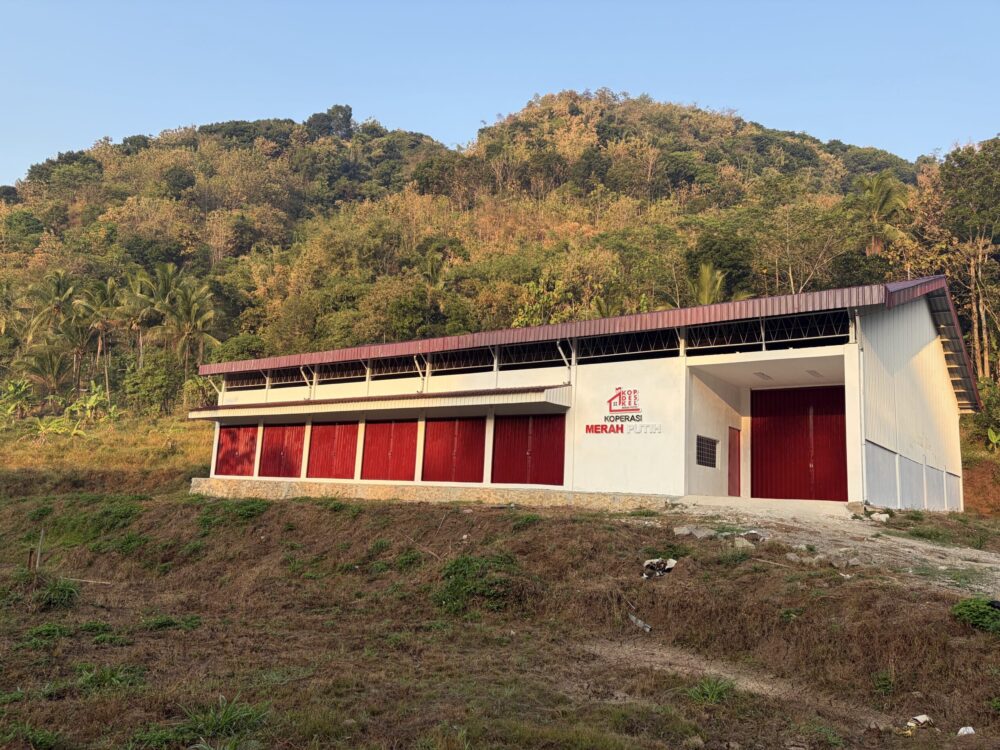
Drive almost anywhere in rural Indonesia now and it’s hard to miss them: prominent red-and-white buildings, based on a uniform 30 by 20 metre layout, all with the same centrally-designed features and deposited on whatever land the village administration was willing to hand over. Some sit isolated near forests or fields, whilst others have been squeezed into village hall forecourts so that staff grumble about picking their way around the building to reach their office. Where a main road happens to run along the boundary between two adjacent villages, I have seen two of these buildings located within a few hundred metres of each other, each to be fully equipped, both serving what is functionally a single, undivided catchment.
The Red and White Village Cooperatives (Koperasi Desa Merah Putih, KDMP) program has become the most visible feature of the Indonesian rural landscape under President Prabowo Subianto. According to the Ministry of Cooperatives, as of July 2026 15,845 KDMP had already been built and a further 19,539 were under construction. The program aims to build some 80,000 such cooperatives—one in every village across the entire country. On a recent trip to Indonesia, I stopped by at a few KDMP in Wonogiri (Central Java) and North Toraja (South Sulawesi) to talk to villagers and find out what is going on inside them and what purpose they are supposed to serve.
The first thing you realise immediately is that these so-called cooperatives cannot really be considered cooperatives in any meaningful sense. The birth of Indonesia’s cooperative movement is widely associated with Mohammad Hatta, the country’s first (and much-loved) vice-president, who envisioned cooperatives as vehicles for member-owned, democratically-governed, economic self-determination based on voluntary participation.
I suspect, however, that Hatta would be astonished at what is now being built in the movement’s name: a network of buildings, constructed and operated by a state-owned enterprise, some with brand new vehicles imported from abroad, and with operational directives sent from Jakarta and supervised and monitored by territorial military officers. One Village Head (Kepala Desa) I met was waiting for technical guidance on what economic activities the KDMP should pursue and how it would operate. I suggested to him that the program seemed a little top-down. He responded bluntly without hesitating: “oh, murni top-down (purely top-down)”.
Prabowo has framed the program as an idea he has carried since his years as a young army officer posted to remote villages, where he apparently observed farmers borrowing from moneylenders at ruinous interest rates and unable to purchase basic food items. Rural Indonesia, however, has changed significantly since Prabowo began his military career in the 1970s, a time when Indonesia was ruled by the authoritarian General Suharto. Networks of vibrant small businesses now reach most villages, and a range of community-driven development programs are already on offer. That Prabowo’s scheme was designed with little regard for these contemporary realities is a major factor in why the program seems likely to be counterproductive to its notional goal of rural economic empowerment.
A landscape of good intentions, and inevitable failure
Prabowo announced the KDMP program in a limited cabinet meeting on 3 March 2025, with supporting legal frameworks soon following in the form of a Ministry of Cooperatives circular on 18 March and Presidential Instruction No. 9/2025 on 27 March. These instruments set targets for establishing physical retail and warehouse units in every village and urban ward across Indonesia (there are around 84,000, though the regulation allows adjoining villages to share a single unit, bringing the practical target closer to 80,000). Socialisation with district heads (Bupati) began immediately; the program launched on 21 July 2025, a mere four months after its announcement.
The funding for the program is substantial and is set out in Finance Ministerial Regulation No. 15/2026. 3 billion rupiah (US$166,000) is set aside for the construction costs alone of each cooperative, suggesting a total establishment spend of around US$13 billion nationwide.
Several local building contractors I spoke with, familiar with construction costs in their districts, reckoned they could have built an equivalent structure for around half that price.
The finance ministry’s regulation also directs state-owned banks to extend loans to another newly formed state-owned food sector company, PT Agrinas Pangan Nusantara, or Agrinas, which is responsible for undertaking construction and initially running the KDMP. Repayments on these loans (with interest rates of 6% per year over 6 years), however, are made by the village administrations themselves—for a program they never requested and most consider likely to fail. These repayments are made through deductions from intergovernmental transfer funds: Dana Alokasi Umum (DAU, General Allocation Fund), Dana Bagi Hasil (DBH, Revenue-Sharing Fund), and Dana Desa (Village Fund)—more on that later. One estimate suggested that the program has already absorbed over Rp34 trillion (US$1.9 billion USD) from the 2026 national budget.
It is remarkable that such a fiscal allocation has been rolled out nationwide so rapidly without a background study of prevailing needs, without a published feasibility study, without a cost–benefit analysis, and without trialling the concept first through a pilot rollout. Neither did it appear to consult Indonesia’s own institutional memory regarding the last (failed) major experiment in mass rural cooperatisation, the Suharto-era KUD (Koperasi Unit Desa) network.
According to Gillian Hart, the KUD were primarily “a medium for dispensing patronage to strategic rural groups, who are thereby more likely to identify their interests with those of the state”. The KUDs, which were generally established at the Kecamatan (sub-district) level, were also initially showered with state capital. But most quickly withered once political attention moved on. Anyone who has spent time in rural Indonesia will recognise the pattern already: abandoned, rusting government warehouses from previous decades litter the countryside.
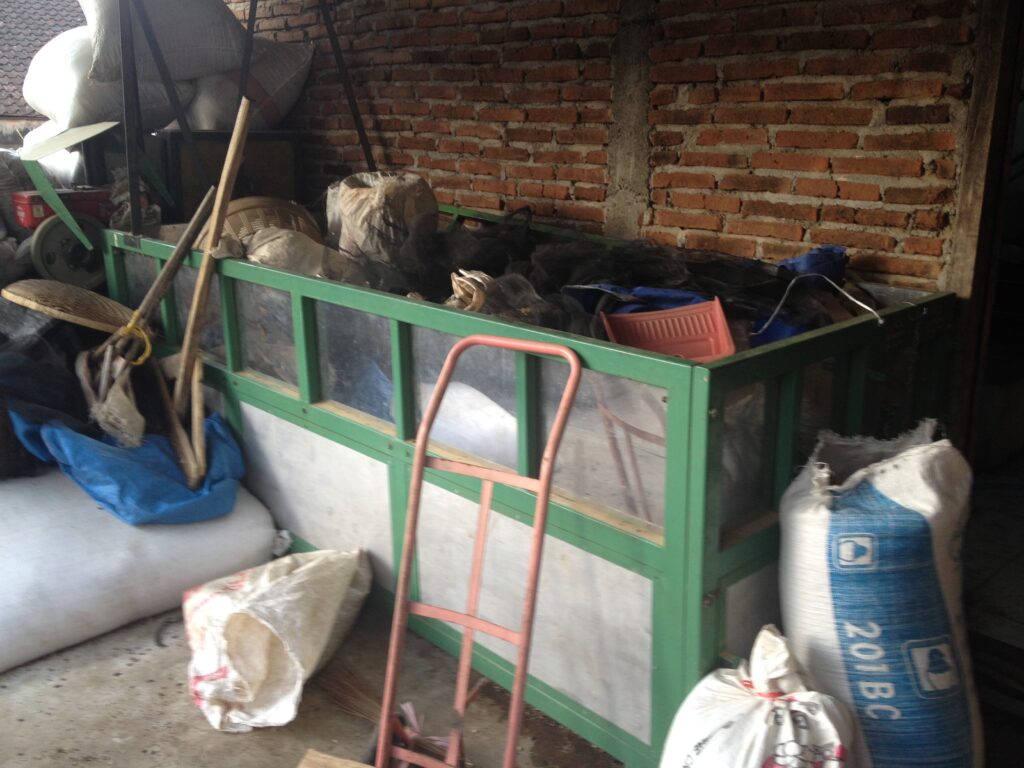
The Indonesian countryside is littered with the remnants of past (failed) rural interventions by the state (Photo: author)
The unravelling of community-driven rural development
Every unit, regardless of existing infrastructure and hinterland, is built to the same template: 20 by 30 metres on a block of 1000m2. A range of business units are envisaged for each cooperative: small-scale revolving credit; a retail store providing basic goods (sembako); distribution of subsidised fertilisers and gas bottles; and the logistical handling and marketing of rural produce. Few cooperative staff or village administrators I spoke with were sure about whether operating capital for such ventures would be forthcoming.
The one-size-fits-all nature of the program design belies the great diversity of developmental needs across rural Indonesia. It also signals a further departure from Indonesia’s 25-year experiment with community-driven development. Since the late 1990s, Indonesia has built a globally-cited model of village development around the opposite premise: that communities themselves were best placed to identify their own needs and manage the money to meet them.
The Kecamatan Development Program (KDP), launched in 1998 with World Bank backing, channelled block grants directly to villagers, who proposed, voted on, and built their own infrastructure projects. From 2007, KDP’s architecture was scaled nationwide as PNPM (Program Nasional Pemberdayaan Masyarakat), extending the same participatory model to tens of thousands of villages across the archipelago.
In 2014, this logic was absorbed into the Village Law (UU Desa) and the Dana Desa (Village Fund), which handed villages unconditional transfers allocated through musyawarah desa (village deliberation), with local procurement and accountability built in. Whatever their real-world shortcomings (including elite dominance in some forums and uneven capacity between villages), all three shared a common premise that local communities were best qualified to decide what a village needs—not a ministry in Jakarta building the same standardised warehouse everywhere at once.
The redeployment of Dana Desa funds toward centrally determined priorities (most notably Covid relief and anti-stunting/malnutrition programs) was already underway before KDMP, but the cooperatives scheme appears to be accelerating this process. On average, 58 per cent of Dana Desa funds are said to be being redeployed to the cooperative units, although several of the people I spoke to suggest the real proportion, once informal pressures and follow-on costs are counted, runs higher still.
This is not then new money arriving in rural Indonesia: it is existing money being reassigned, on top of a Village Fund that had already been narrowing in scope for years. One village head explained how his allocation had been cut from roughly Rp900 million to Rp400 million. “What can I do with only 400 million [US$22,000]?”, he asked. “I can’t build a road or rebuild a health clinic with that”. I asked whether this was frustrating, and the answer came back with more force than I expected: “Luar biasa pusing! (extraordinarily frustrating!)”.
Building or damaging local economies?
The most immediate human cost may not be fiscal at all. Existing small traders—the warung that make up the actual texture of rural Indonesian commerce—are nervous about state-subsidised outlets with direct supply lines to state-owned enterprises opening nearby. Indonesia’s peak small business association (Akumandiri) has warned that cooperatives selling the same staples on more favourable terms risk squeezing out the small operators the program claims to help, and the parliamentary committee overseeing trade and commerce has expressed similar concerns. In practice, the threat may be less immediate than feared: one warung owner I spoke with on Java, who was visiting her local KDMP out of curiosity, said she could still buy most items slightly cheaper from her usual wholesalers than the cooperative was charging.
Indonesia’s Free Nutritious Meals (Makan Bergizi Gratis, MBG) program has already produced a smaller preview of this dynamic, with local vendors and canteen managers losing business to centrally procured contracts. State-supported kitchen units (Satuan Pelayanan Pemenuhan Gizi, SPPG) supplying that program came up unprompted in my own conversations. I was told that contracts were worth around Rp6 million a day, which I suggested was “lumayan untung (fairly profitable)”, to which I was corrected upward: “lebih dari untung! (more than profitable!)”.
MBG has already drawn street protests over exactly this kind of concern, plus corruption, food poisoning, and market disruption complaints, with counter-protests from favoured kitchen operators demanding the program continue uninterrupted. It is the same underlying structure as the cooperative program: centrally designed, state-funded rural interventions captured, in practice, by networks of actors already close to existing patronage relationships.
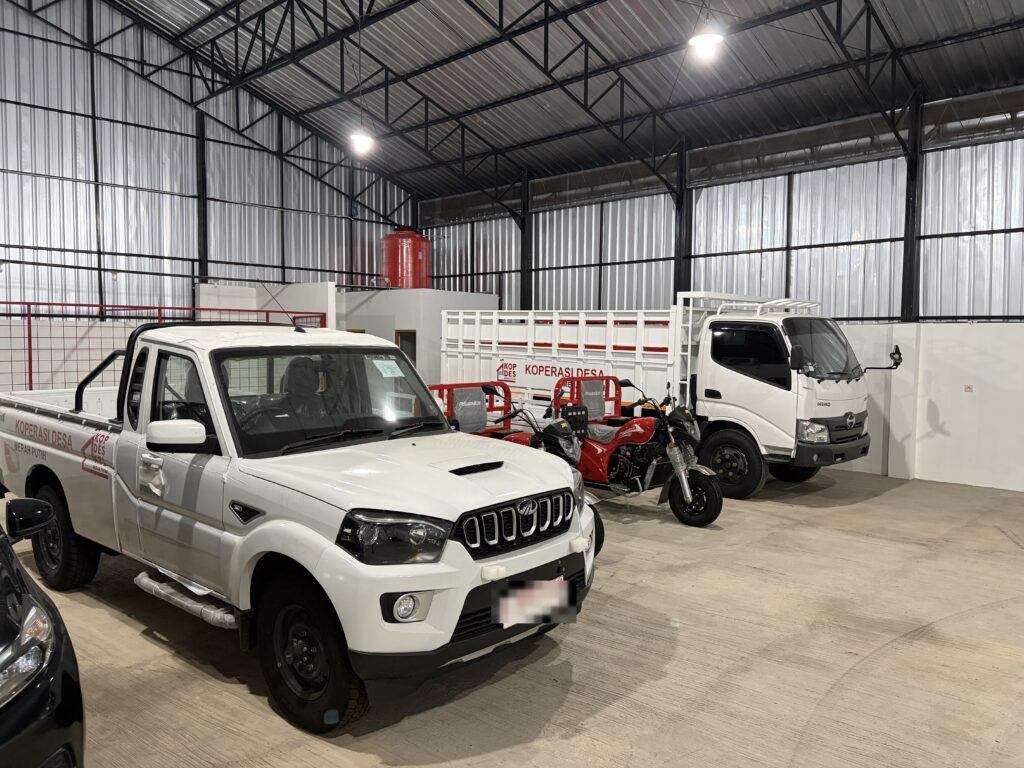
This Red-and-White cooperative has been provided with imported vehicles based on a lucrative contract held by Agrinas, a state-owned company (Photo: author)
Very few of the villagers I spoke to were optimistic about long-term prospects of KDMP. Staff in one village were already discussing how, assuming its inevitable failure, the ceiling lights at their local cooperative’s warehouse—despite it currently housing brand-new vehicles (see photo above)—could be easily elevated and the space transformed into badminton courts. Another commented that one of the walls could be knocked down and the warehouse used as a sheltered parking area. Such contingency plans characterise pessimistic (and realistic) villager attitudes towards KDMP. Sometimes, there was a diplomatic response: “The program is a good idea…. but at the moment we’re just a bit confused (kami bingung).” There is little evidence that villagers are driving a community agenda. At the same time, neither were village heads, cooperative leaders and retail store staff receiving real direction from above: many simply stated “belum ada arahan teknis (we have not yet received technical direction)”. At one site I visited, retail operations had commenced and six staff, employed by Agrinas on short-term contracts, were sitting around waiting for customers despite shelves remaining half-stocked. In this case, operations were run entirely by Agrinas, which was created in 2025 and expected to manage the cooperatives for an initial two years. Agrinas also holds the national KDMP construction contract, awarded by presidential assignment rather than competitive tender, and carries a parallel commitment to import some 105,000 vehicles from India, budgeted at roughly US$1.5 billion.
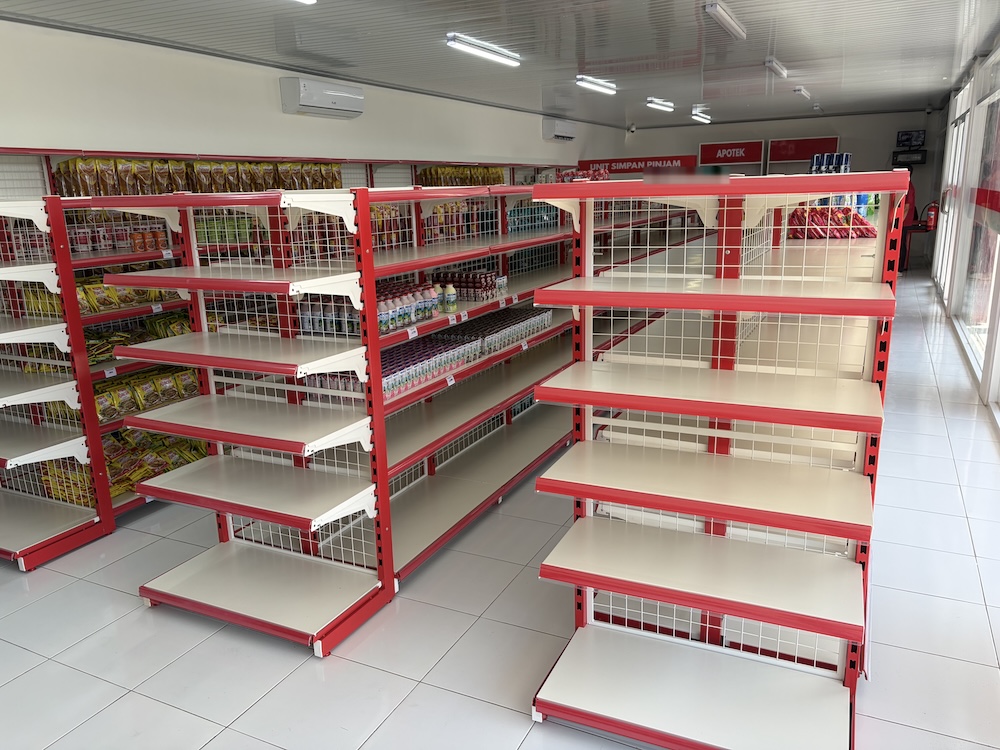
This recently opened KDMP retail store was staffed by six employees while shelves remain partially stacked (Photo: author)
Several of Agrinas’s senior executive positions are held by retired military officers, and the state banks funding the whole arrangement sit under Danantara, the new sovereign investment body through which the Prabowo government has been centralising control over state enterprises nationwide, and it is through that structure that the banks have effectively been directed to bankroll KDMP.
The vehicle import contract has already produced KDMP’s first serious corruption allegation in a July 2026 review by Indonesia Corruption Watch and Project Multatuli, which identified a gap of Rp60–69 million per vehicle between fair import value and the price actually paid through an intermediary trading company, projecting several trillion rupiah in potential rent-seeking across the pickup-truck order alone. It is true that Dana Desa funds themselves have been misappropriated in the past, but at least there is a degree of local accountability: villagers said they had no idea about how much contracts for Agrinas’ construction and supply activities in their village were worth.
Who holds the keys?
A key feature of the Prabowo presidency has been the rise of military involvement in all facets of society, and the KDMP is no exception. The most consistent detail across the sites I visited was not economic but institutional: the presence and influence of military personnel. Babinsa (village-level non-commissioned officer the Indonesian military stations in every village under Indonesia’s territorial command structure) or Koramil (sub-district military commands) were deeply involved. At several KDMP buildings I came across, villagers explained that the keys to open locked facilities were still physically being held by Koramil.
This process fits into a wider pattern. In October 2024, Prabowo’s own cabinet, ministers included, underwent paramilitary-style training at the Akmil military academy in Magelang, styled by the president as “the military way”, a spectacle that drew public unease over the military’s “dual function” (dwifungsi), the Suharto-era doctrine granting the armed forces a formal role in civilian governance. KDMP’s own frontline managers have separately been enrolled in a harsher round of paramilitary training under a national recruitment scheme, one that has already cost several trainees their lives from heatstroke and cardiac arrest during 45 days of basic military drilling. 25 years after reformasi dismantled the military’s formal claim to civilian power, KDMP is a reminder of how much of that settlement can be quietly eroded through administrative instruction alone, without anyone needing to declare it.
Local military would participate in village meetings establishing the KDMP, making sure that the “right” decision was arrived at, and village heads were “assisted” by local military to identify the 1000m2 necessary to be allocated to the project. In practice, refusal to cooperate is not a realistic option for village officials: “mau nggak mau, harus (whether we want to or not, we must [support the program])”. One village head described a system with perceived consequences attached to non-compliance: “ada yang menolak [KDMP], tapi ada konsekuensinya…..Dana Desa bisa ditahan semua (some do refuse, but there are consequences…the Village Fund may be entirely withheld)”. A Ministry of Finance regulation requires a village deliberation, or musyawarah desa, to formally register the cooperative’s establishment, which one village head made clear was simply procedural cover for a decision that is not, in practice, genuinely voluntary.
Related
The Nadiem trial and Indonesia’s “rubber” anti-corruption laws
Loose definitions aid questionable prosecutions
A typical cooperative may have around twenty members, but those members were generally people already connected to village or sub-village (dusun) government. Few ordinary villagers have voluntarily signed up themselves to become members. Under Indonesia’s Cooperatives Law (UU No. 25/1992), members are required to make two core capital contributions: Simpanan Pokok (a one-off “principal deposit”); and Simpanan Wajib (a recurring “mandatory deposit”, typically monthly). Few villagers are willing to tie up their own precious financial resources in the program: one dusun head, who was himself a member, confided to me that even he didn’t actually use his own personal money either: “we used the village budget”. This is not a cooperative recruiting from the community it is meant to serve; it is the pre-existing village bureaucracy reconstituting itself under a new legal form, fuelled by state patronage.
Neither are Indonesian villagers enthusiastic about relinquishing (hibahkan) 1,000m2 of land for a government program they consider likely to fail. This has been a sticking point for many villages in the North Toraja highlands of Sulawesi, where only 17 of 111 villages had built cooperative by July 2026. Village heads there told me that the slow uptake was due to the ubiquity of land held under customary tenure and the unwillingness of landowners to part from their land. “Who is going to handover land to the government? Noone! Let alone on the main road, which is where they [the government] want them.” I visited one of the 17 cooperatives in North Toraja: it had been built on the grounds of a primary school.
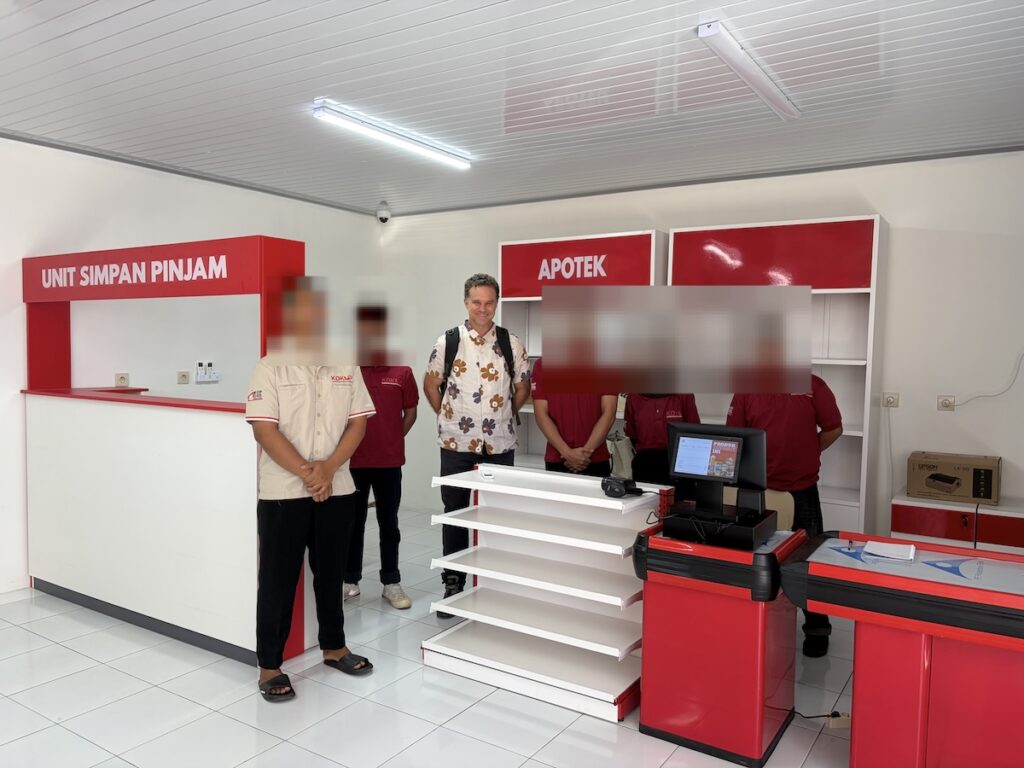
The author with staff at a KDMP shopfront (Photo: author)
Political motivations: developing state patronage
The KDMP program is apparently so poorly designed and susceptible to corruption that it almost appears as though it was never seriously intended to generate enhanced rural development outcomes.
It seems that the least damaging version of the outcome is a fiscal write-off—trillions of rupiah spent on buildings that end up as parking areas and badminton courts. That would be the fortunate outcome. There is, of course, the opportunity costs: health clinics, village roads, and water supply systems that never get built. Full implementation would risk deeper damage still: rising credit exposure for state-owned banks, further threats to Indonesia’s sovereign credit rating, and the erosion of small traders’ livelihoods. Incompetent program management will likely spare most small traders from that fate, though not from the short-term market disruption MBG has already shown is possible. The greatest cost, however, may be borne by the still-fragile institutions of democracy in post-reformasi Indonesia.
As Gillian Hart described for the Suharto-era KUD program, the KDMP is probably best understood as an attempt to enrol clients across the country in a patronage system, one aimed at shoring up support ahead of the next national election in 2029. For this kind of patronage to work politically, it is not even necessary that KDMP deliver on its stated development goals; what matters is the web of temporary jobs, contracts, and obligations the program creates along the way.
Similar accusations have been levelled at Prabowo’s other flagship rural intervention, MBG. Indonesia Corruption Watch’s own investigation into MBG’s kitchen network found the foundations managing its meal-kitchen units linked to political parties, campaign teams, supporters of both Prabowo and his predecessor Joko Widodo, and to military and law-enforcement figures. The government’s own National Nutrition Agency (Badan Gizi Nasional, BGN) chief referred to MBG as Prabowo’s “political tender”—planned years ahead, promised on the campaign trail, and delivered once he won. Those benefiting from the lucrative contracts are expected to provide political support to Prabowo in the coming years.
Structurally, Indonesia’s other centrally-run rural megaproject, KDMP, appears to be designed with a very similar political calculus in mind.











Leave a comment