


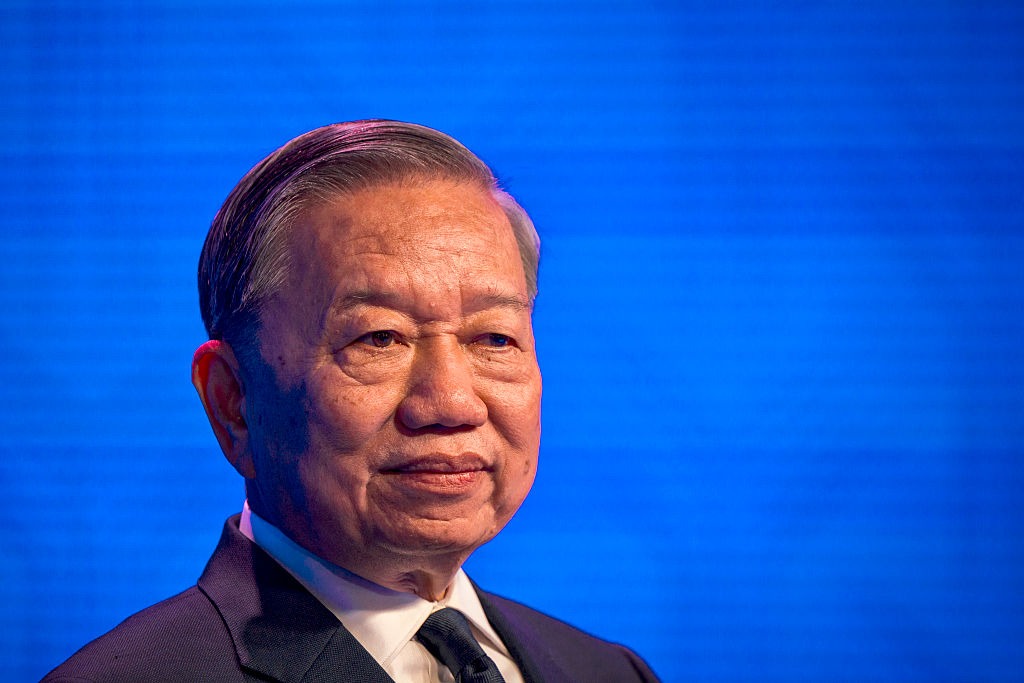
Vietnam’s Communist Party chief and president, To Lam, has arrived for his first state visit to Australia since becoming party chief in late 2024. Arriving two years after the Comprehensive Strategic Partnership between the two countries was signed, the trip comes at a high in the relationship. But the warmth should not obscure its strategic purpose. To Lam has come to diversify: to broaden Vietnam’s portfolio of partners, identify where Australia offers leverage others cannot and convert a cordial relationship into concrete opportunities.
Since 2024, To Lam has tied his leadership to an ‘era of national rise’, an agenda of economic transformation, institutional reform and technological upgrading. His diplomacy has followed the same logic. He has become an active party chief, travelling widely for the capital, expertise and technology needed to move the country up the value chain. At the same time, he remains committed to Vietnamese foreign policy: safeguarding sovereignty, avoiding formal alignment and keeping every door open.
Nowhere is this clearer than in how Hanoi manages the great powers. Early in 2026, To Lam was in Washington for the inaugural meeting of Donald Trump’s Board of Peace. Soon after, he was in Beijing speaking of the need to defend the global free-trading order. Engaging both sides while allowing neither to dictate terms is not indecision. That balancing act is most fraught with China, the neighbour that Vietnam can least afford either to alienate or to trust. Hanoi has long managed Beijing through economic integration, party-to-party ties and resistance to encroachment. Yet the pressure is sharpening. Chinese coercion at sea and continued reclamation in the Paracel Islands underline the limits of reassurance. Diversification in foreign policy is Hanoi’s answer, and Australia forms one part of it.
Australia and Vietnam are both hedging, but against different risks and with different instruments. Vietnam hedges against coercion and entrapment. It does so through non-alignment, diplomatic flexibility and a portfolio of partnerships. Australia hedges against Chinese predominance by strengthening its US alliance, and it hedges against uncertain American commitment by building regional relationships and national capability.
That divergence was on display at this year’s Shangri-La Dialogue, where To Lam framed the moment around three converging crises of international order, development and strategic trust, and prescribed centrality and confidence-building of the Association of Southeast Asian Nations. Meanwhile, Australian Deputy Prime Minister Richard Marles, addressing the maritime session a day later, was blunter, placing more weight on deterrence, defence capability and a durable American presence because it no longer assumes that economic interdependence alone can preserve regional stability. Their strategies are not interchangeable, but they point towards the same preference: an Indo-Pacific in which a single power cannot dictate terms and smaller and middle powers retain room for manoeuvre.
Both are also trading nations with a stake in freedom of navigation. Neither wants a Southeast Asia that hardens into rival camps nor bends to a single hegemon. Both are preparing for a United States that may become less willing or able to sustain the regional order it once built. That shared anxiety gives the relationship its present momentum.
To Lam’s visit builds on a partnership that has matured steadily. Vietnam is now among Australia’s 10 largest trading partners, while Australia remains an important economic partner for Vietnam. Two-way trade in goods and services reached around A$30 billion in 2025, while bilateral investment stood at US$1.9 billion as of December 2025. That combination of growth and unrealised potential makes Australia useful to Hanoi without making it the centrepiece of any strategy.
What sustains the relationship is that each side answers a need in the other. For Vietnam, Australia is a stable market and a source of energy, education, critical minerals, agricultural expertise and technology. It is also a maritime security partner capable of providing training, institutional support and domain awareness without demanding that Hanoi choose sides. For Australia, Vietnam is one of Southeast Asia’s most consequential states: economically exposed, uneasy about coercion and determined to preserve room for independent action.
Defence cooperation already has practical foundations. Australia has provided military education, and English-language and peacekeeping training for more than two decades. Vietnamese personnel train in Australia, while the Vietnamese navy participates in Exercise Kakadu and receives Australian ship visits. In April, a Vietnamese warship joined Kakadu. Later HMAS Toowoomba visited Da Nang and trained with the Vietnamese navy in the South China Sea. These exchanges build familiarity without requiring formal alignment.
The South China Sea disputes are important to watch during the visit, especially given escalating tensions between China and Vietnam this year. Both Australia and Vietnam have an interest in stability, freedom of navigation and respect for international law. Any agreement on maritime awareness, coastguard cooperation, training or information-sharing would be more significant than its technical presentation suggests.
Canberra should see the relationship as it is: genuine and worth the investment yet bounded by Vietnam’s determination to keep moving among the great powers and settle behind none of them. On that much, the two capitals find themselves in agreement. They are practising different forms of hedging, but both want a region in which no state is forced into choices it would rather keep open.







Leave a comment